


Carolina Parakeet
Carolina Parrot, Carolina Conure · Conuropsis carolinensis
By the Birdfact teamChecked by Nathan Cope
On this page10 sections
How to recognise it
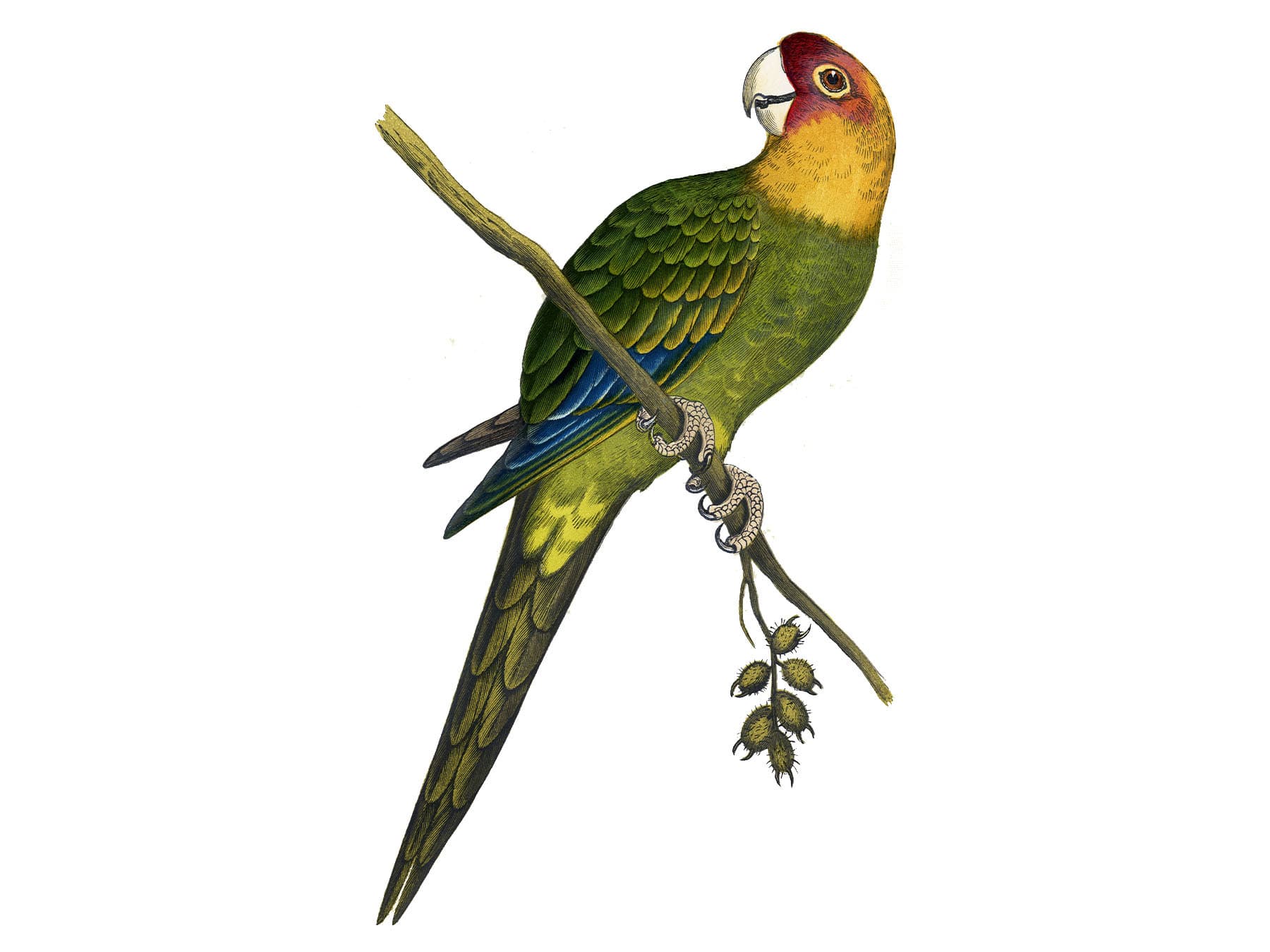
The Carolina Parakeet was a medium-sized parrot, with vibrant green plumage covering most of its body. Its head was distinctively yellow, with orange-red coloring on the forehead and cheeks. It had patches of yellow to orange at the bend of its wings, on its thighs, and around its vent. The bill was pale pinkish-white, with areas of bare white skin around the eyes.
Both males and females shared nearly identical coloring, though males were slightly larger on average. Juveniles had mostly green heads with orange-red foreheads and lores and lacked the yellow-orange patches found on adults' wings and thighs.
Its size
Adults- Length
- 32–34 cm
- Wingspan
- 53–58 cm
- Weight
- 250–300 g
Its song and calls
Carolina Parakeets were known for their loud, raucous calls. Their vocalizations were described as a mixture of harsh squawks and more melodious whistles. The calls were often likened to 'qui-qui' or 'pi-pi-chu'.
In flight, they would emit constant chattering sounds, making their presence known even before they were visible.
When and where to see it
Tips for seeing it
- Look for historical records and museum specimens to learn about their appearance
- Visit natural history museums with Carolina Parakeet exhibits
- Study their former habitats to understand their ecological niche
- Learn about their extinction to promote the conservation of other parrot species
What it eats
Carolina Parakeets primarily fed on seeds, nuts, and fruits. They showed a particular fondness for cockleburs and sandburrs.
These birds were also known to consume salt, often visiting salt licks. Their strong beaks allowed them to crack open tough seeds and nuts efficiently.
Nesting and breeding
Carolina Parakeets typically bred in the spring, forming monogamous pairs. They nested in hollow trees, often in small colonies. The female would lay 2-5 white eggs per clutch.
Both parents participated in incubating the eggs, which lasted about 23 days. The nests were simple, often just a bed of wood chips at the bottom of a tree cavity.
Chicks were altricial, born naked and helpless. They fledged after about 6-8 weeks but remained with their parents for some time after leaving the nest.
Behaviour
Carolina Parakeets were highly social birds, often seen in large, noisy flocks. They were known for their acrobatic flying skills, maneuvering through forests with agility.
These parakeets showed strong flock loyalty, often returning to fallen companions, which unfortunately made them vulnerable to hunters.
Conservation
The Carolina Parakeet became extinct in the early 20th century, with the last captive bird dying in 1918. Factors contributing to their extinction included habitat loss, hunting for their colorful feathers, and farmers killing them to protect crops.
Their story serves as a cautionary tale for bird conservation efforts worldwide.
Quick facts
- Length
- 32–34 cm
- Wingspan
- 53–58 cm
- Weight
- 250–300 g
- Lifespan
- 10–30 years
- Family
- Parrots
- Migration
- Resident
- Global status (IUCN)
- Extinct
- World population
- 0 (Extinct)
- Population trend
- Extinct
- Also called
- Carolina Parrot, Carolina Conure
- Scientific name
- Conuropsis carolinensis
Sources
2- 1Mckinley, D., The balance of decimating factors and recruitment in extinction of the Carolina Parakeet, Pt. 1. Indiana Audubon Quarterly 58 (1):8-18. (1980)
- 2BirdLife International. 2021. Conuropsis carolinensis. The IUCN Red List of Threatened Species 2021: e.T22685776A195444267. Source (opens in a new tab)

Checked by
Nathan Cope, founder and editor
Nathan founded Birdfact and leads its writers and contributors in the UK, the US and Canada. He has watched and studied birds for more than ten years, and checks every article and species guide before it’s published.