


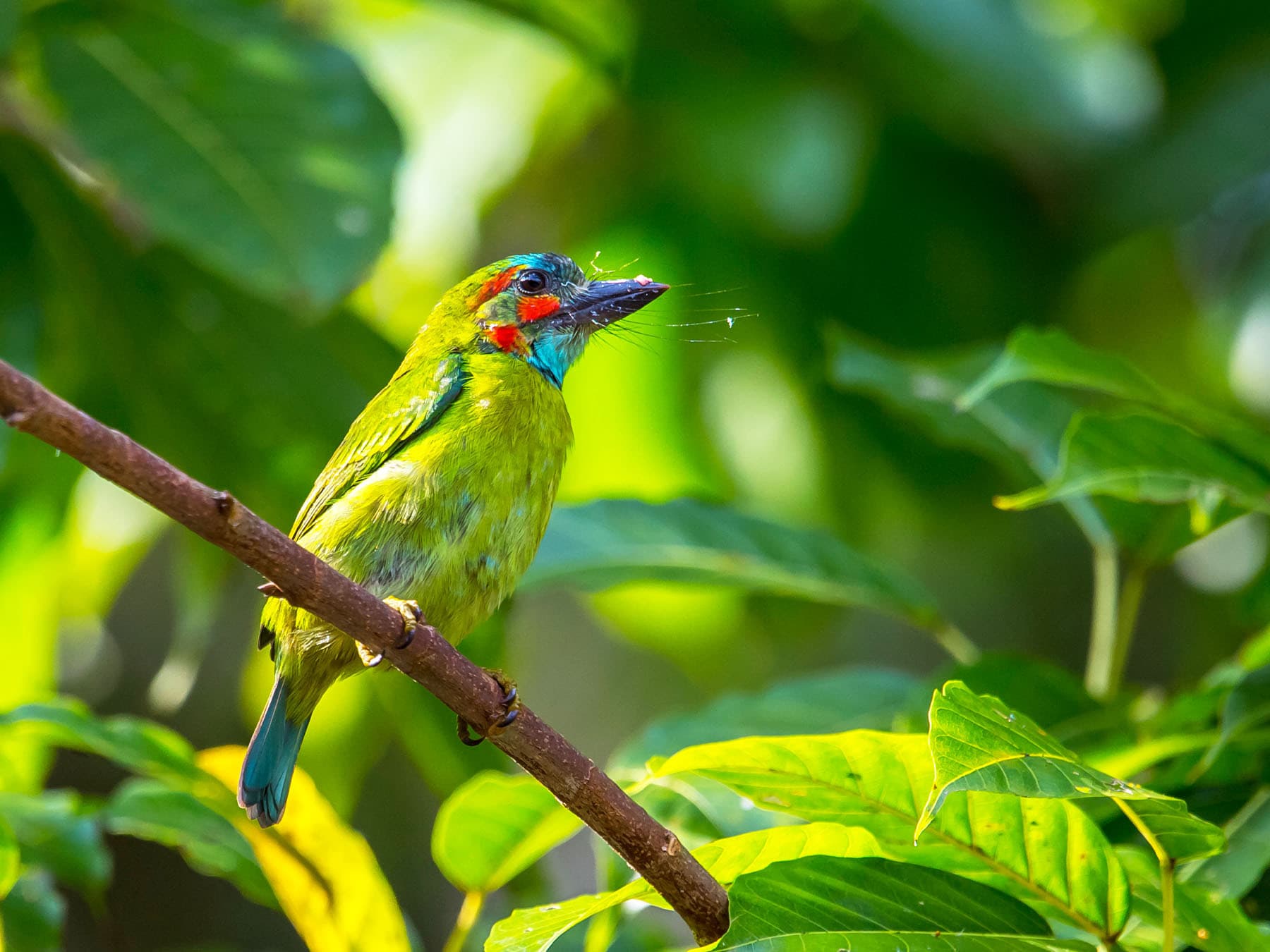
Blue-eared Barbet
Psilopogon cyanotis
By the Birdfact teamChecked by Nathan Cope
On this page11 sections
How to recognise it
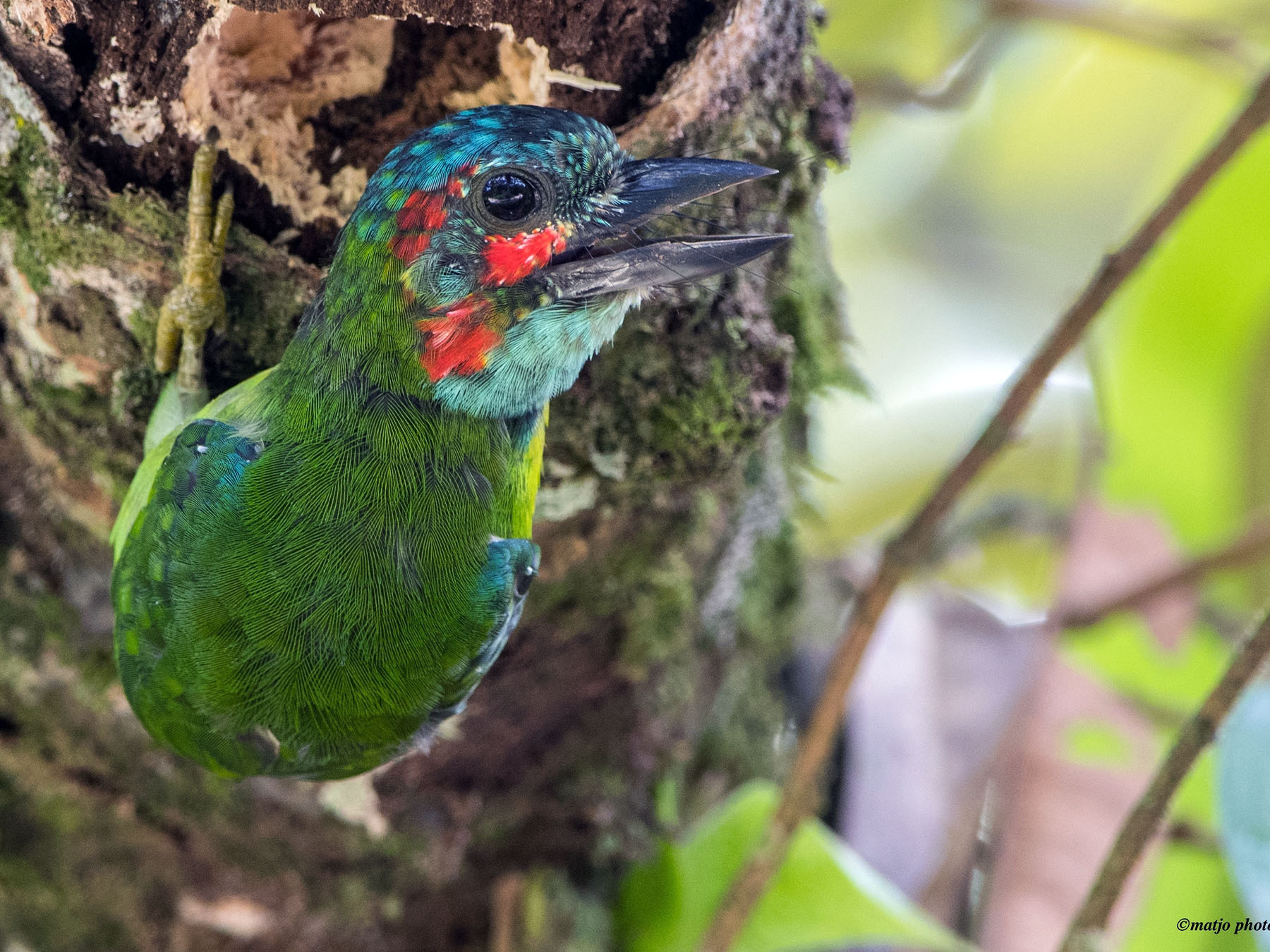
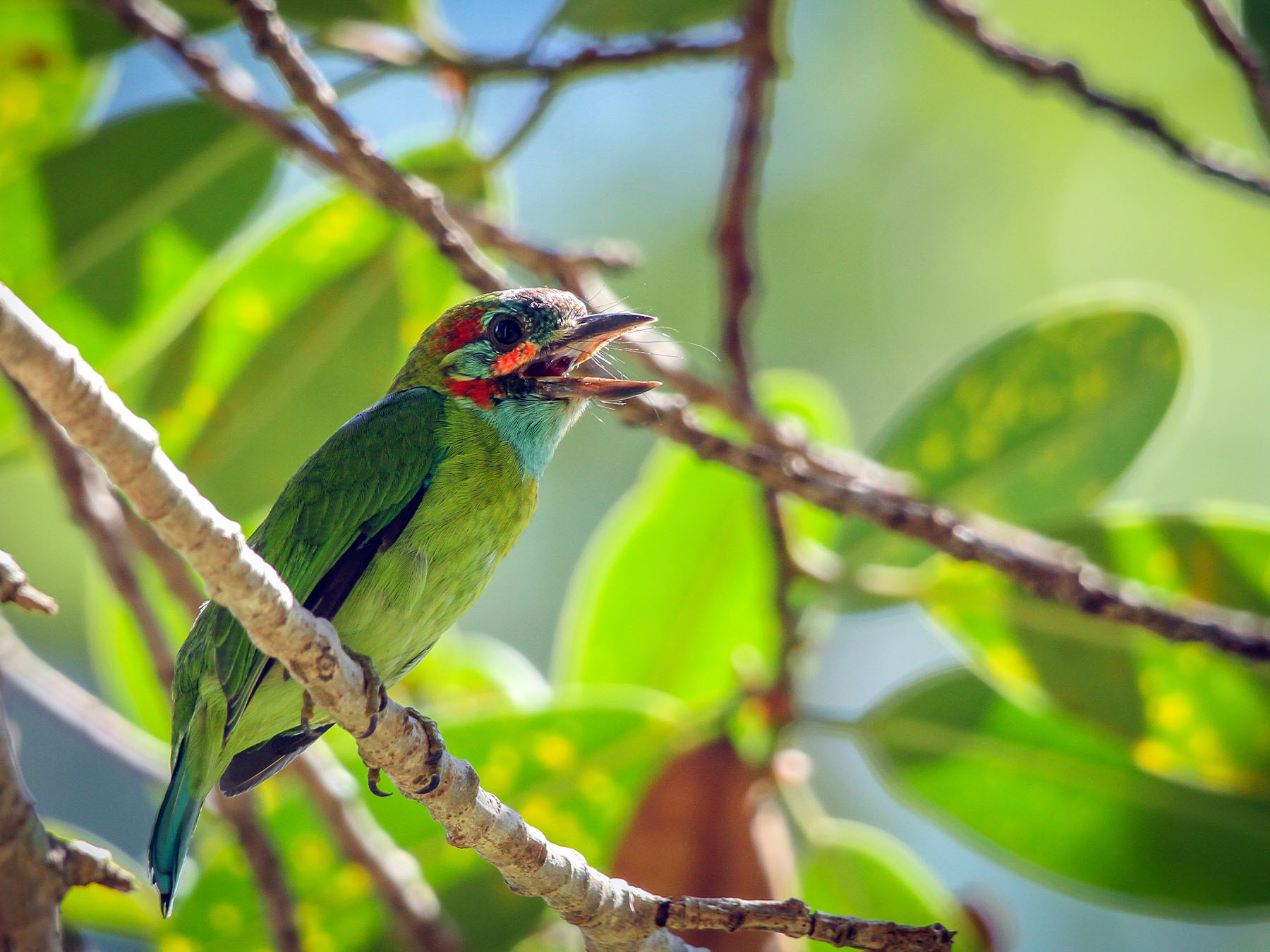
The Blue-eared Barbet is a vibrant, medium-sized bird with predominantly green plumage. Its most distinctive features are the turquoise-blue ear coverts and throat, black and violet forehead, and pinkish-red patches on the face.
Both males and females share similar colouration, though females may be slightly duller. Juveniles have primarily green plumage with less pronounced facial markings compared to adults.
Its size
Adults- Length
- 20–23 cm
- Wingspan
- 32–36 cm
- Weight
- 60–85 g
Its song and calls
The Blue-eared Barbet's call is a distinctive, repetitive 'poo-pook' or 'poo-poo-pook'. This vocalisation is often delivered in a series, with the bird bobbing its head with each note.
During the breeding season, pairs may engage in duets, with mates alternating their calls in a rhythmic pattern.
When and where to see it
The Blue-eared Barbet is not recorded regularly in the UK, Ireland, the United States or Canada.
Worldwide: recorded regularly in 12 countries
Countries where it was recorded in at least 3 of the 6 years 2019–2024. Linked countries have their own bird list.
Data: EOD – eBird Observation Dataset (Cornell Lab of Ornithology), accessed via GBIF.org, CC BY 4.0. Records from 2019–2024, aggregated and filtered by Birdfact. How these lists are made
Tips for seeing it
- Listen for their distinctive 'poo-pook' call to locate them in the canopy
- Look for them near fruiting trees, especially figs
- Observe early morning or late afternoon when they are most active
- Use binoculars to spot their colourful facial markings
What it eats
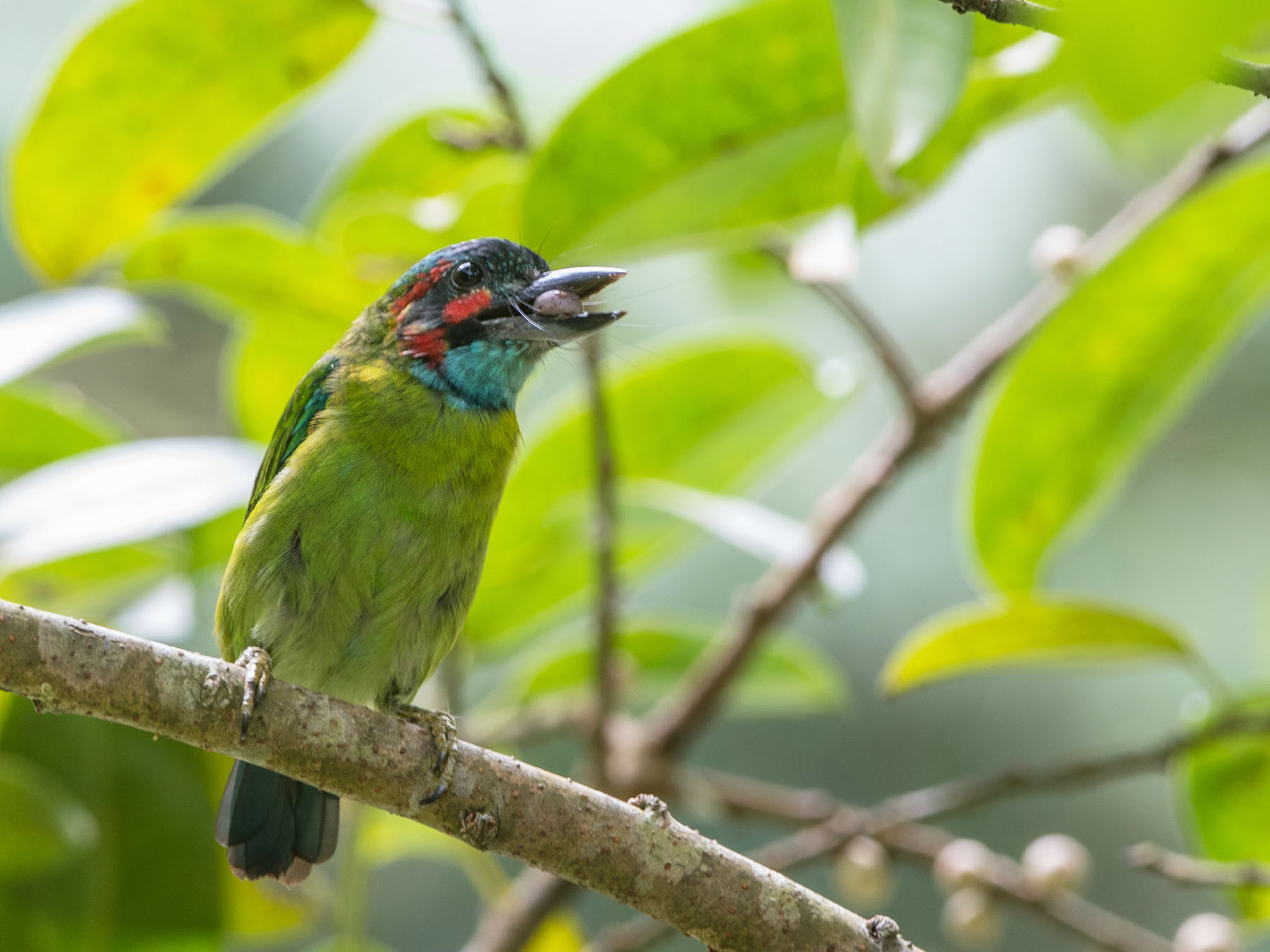
The Blue-eared Barbet primarily feeds on fruits, with figs being a particular favourite. They supplement their diet with insects, especially during breeding season.
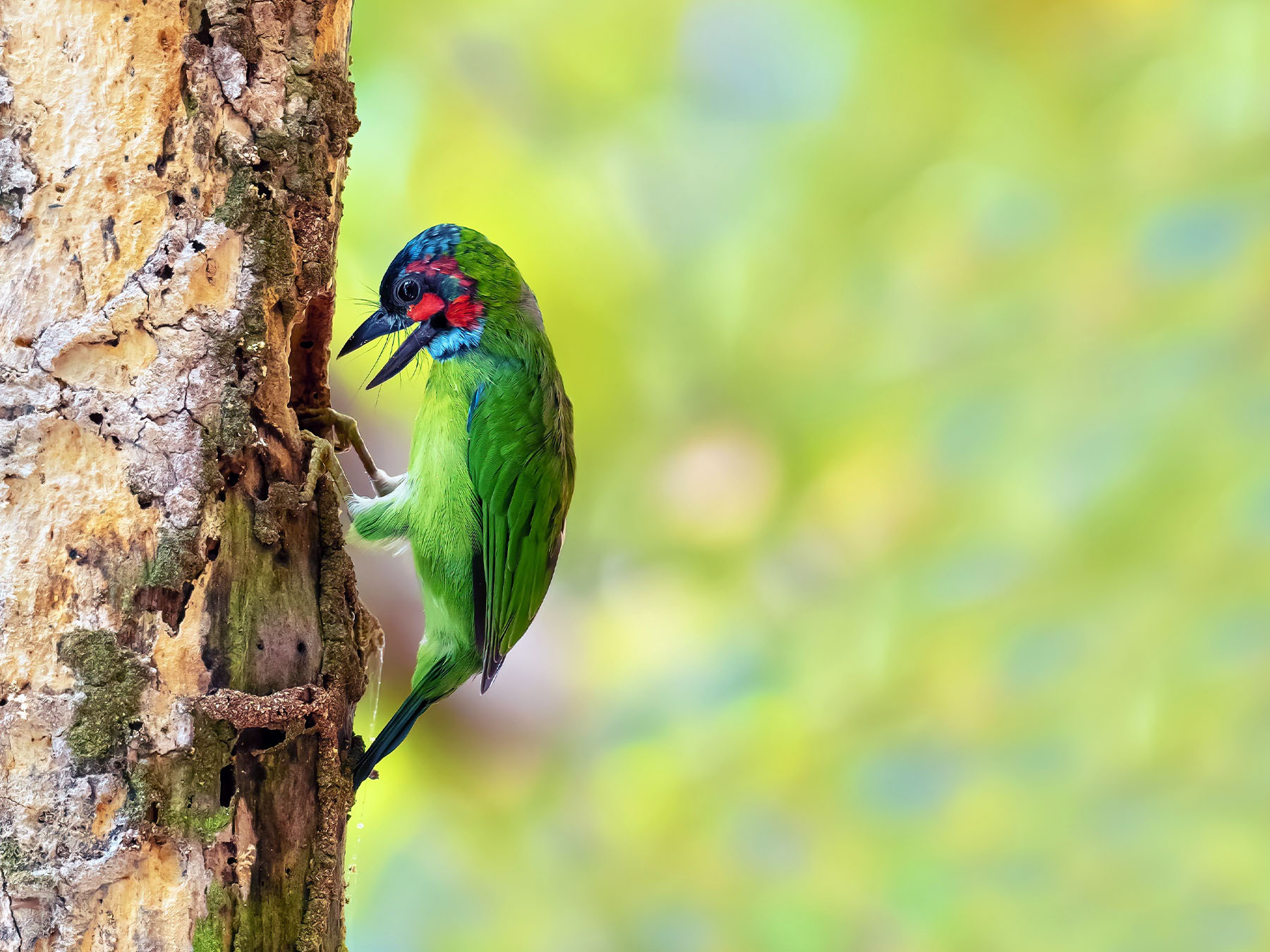
Their strong, chisel-like bill is well-adapted for excavating tree bark to find insect larvae and for handling various fruits.
Nesting and breeding
Breeding season for Blue-eared Barbets typically occurs between February and July. Pairs form monogamous bonds and work together to excavate nesting cavities in dead trees or branches.
The female usually lays 2-4 white eggs in the nest cavity. Both parents share incubation duties, which last for about 13-15 days.
After hatching, the nestlings are cared for by both parents for approximately 31-33 days before fledging. The young birds may stay with their parents for some time after leaving the nest.
Behaviour
Blue-eared Barbets are typically seen perched upright on branches, often in pairs or small groups. They are known for their habit of bobbing their heads while calling, a behaviour that helps locate them in dense foliage.
These birds are generally sedentary and defend their territories year-round.
Conservation
While the Blue-eared Barbet is currently listed as Least Concern by the IUCN, it faces localised threats from habitat loss due to deforestation.
Conservation efforts focus on protecting tropical and subtropical forests within its range to maintain stable populations.
More photos
5 photos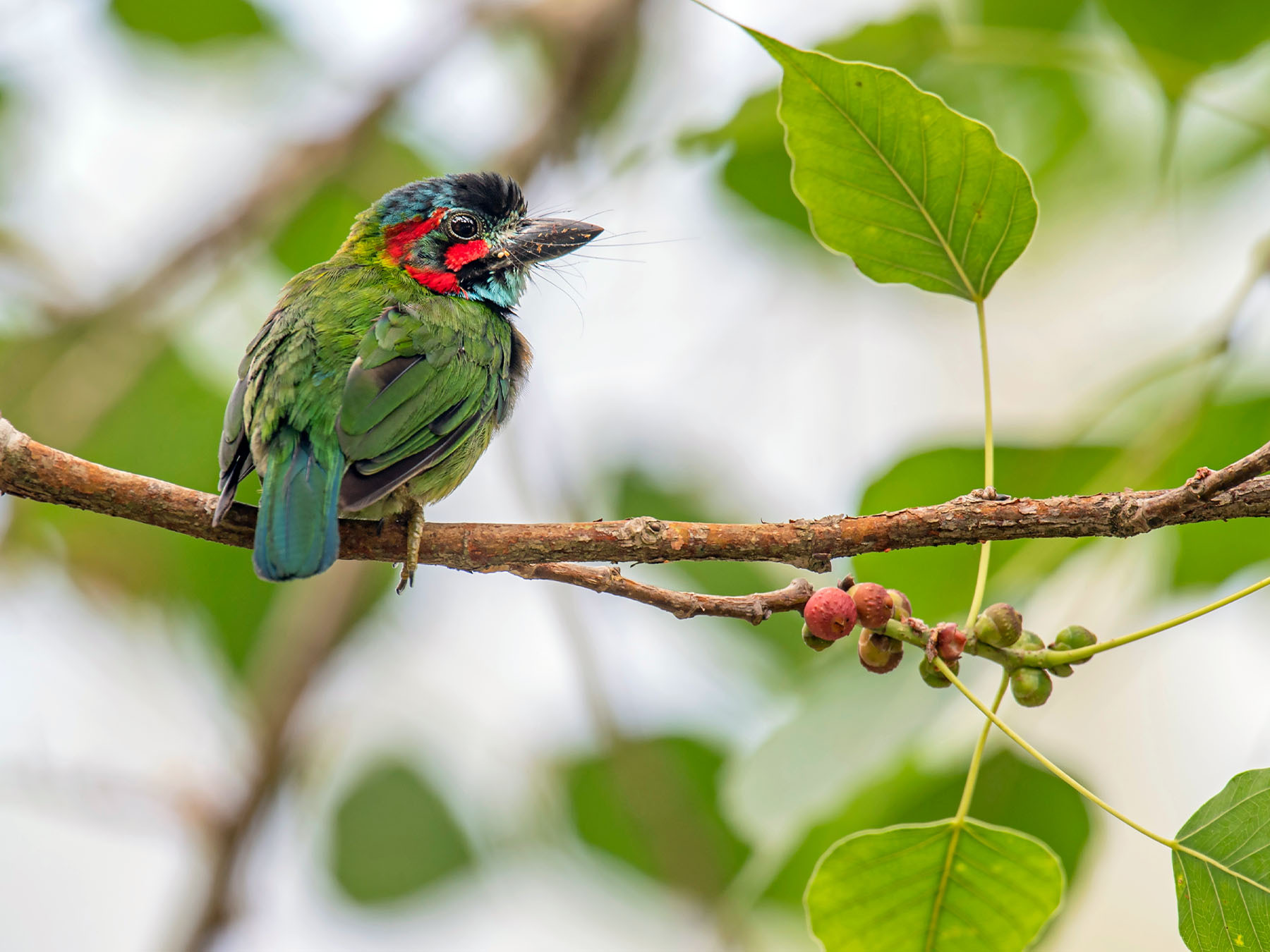
Quick facts
- Length
- 20–23 cm
- Wingspan
- 32–36 cm
- Weight
- 60–85 g
- Family
- Asian Barbets
- Migration
- Resident
- Global status (IUCN)
- Least Concern
- World population
- Not quantified, but locally common
- Population trend
- Decreasing
- Scientific name
- Psilopogon cyanotis
Sources
3- 1BirdLife International. 2024. Psilopogon cyanotis. The IUCN Red List of Threatened Species 2024: e.T22726130A264101761. Source (opens in a new tab)
- 2BirdLife International. 2024. Psilopogon cyanotis. The IUCN Red List of Threatened Species 2024: e.T22726130A264101761. Source (opens in a new tab)
- 3del Hoyo et al. (2002)

Checked by
Nathan Cope, founder and editor
Nathan founded Birdfact and leads its writers and contributors in the UK, the US and Canada. He has watched and studied birds for more than ten years, and checks every article and species guide before it’s published.