


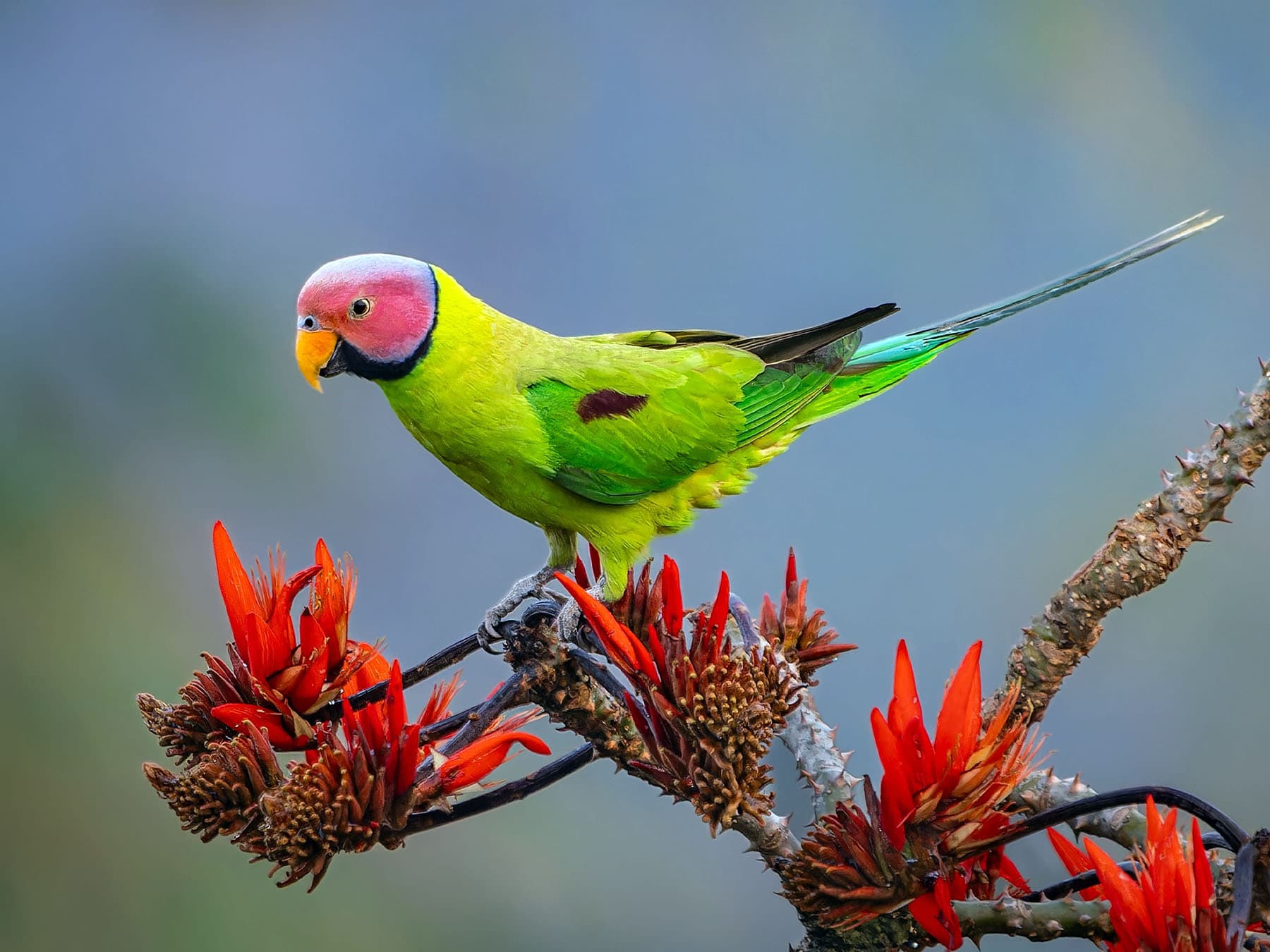
Blossom-headed Parakeet
Rosy-headed Parakeet, Himalayapsitta roseata · Psittacula roseata
By the Birdfact teamChecked by Nathan Cope
On this page11 sections
How to recognise it
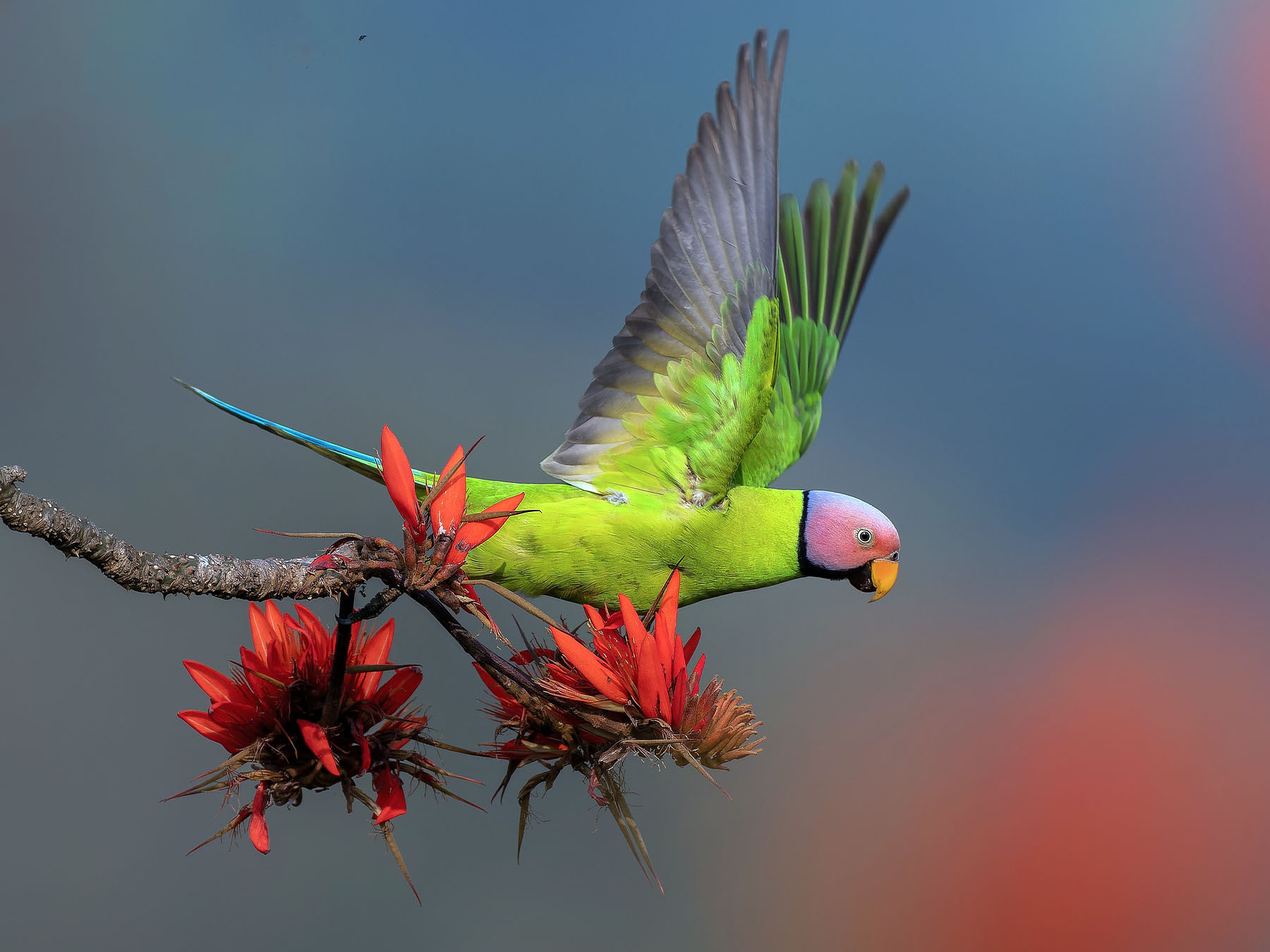
The Blossom-headed Parakeet is a striking medium-sized parrot, primarily green in colour. Males have a distinctive rosy pink face that transitions to bluish-lilac on the back of the head, with a black neck ring. The body is bright green, including the rump. The tail is long and tapered, with central feathers showing pale yellow tips.
Females have a duller, grey-blue head instead of pink colouring. Both sexes have a red beak and grey legs. Juveniles are similar to females but have an all-green head.
Its size
Adults- Length
- 33–36 cm
- Wingspan
- 42–48 cm
- Weight
- 110–130 g
Its song and calls
Blossom-headed Parakeets have a variety of vocalisations, including sharp, high-pitched 'kee-kee' calls often given in flight. Their repertoire includes softer chattering and whistling notes when perched.
During courtship, males produce a series of melodious warbles and trills to attract females.
When and where to see it
The Blossom-headed Parakeet is not recorded regularly in the UK, Ireland, the United States or Canada.
Worldwide: recorded regularly in 7 countries
Countries where it was recorded in at least 3 of the 6 years 2019–2024. Linked countries have their own bird list.
Data: EOD – eBird Observation Dataset (Cornell Lab of Ornithology), accessed via GBIF.org, CC BY 4.0. Records from 2019–2024, aggregated and filtered by Birdfact. How these lists are made
Tips for seeing it
- Look for them in open woodlands and cultivated areas with trees
- Listen for their distinctive, sharp calls, especially at dawn and dusk
- Observe fruiting trees where they often feed in small groups
- Use binoculars to spot the male's pink head, which stands out against green foliage
What it eats
Blossom-headed Parakeets are primarily herbivorous, feeding on a variety of fruits, berries, nuts, and seeds. They have a particular fondness for figs and other soft fruits.
These parakeets also consume flower buds, nectar, and occasionally cultivated grains, sometimes leading to conflicts with farmers.
Nesting and breeding
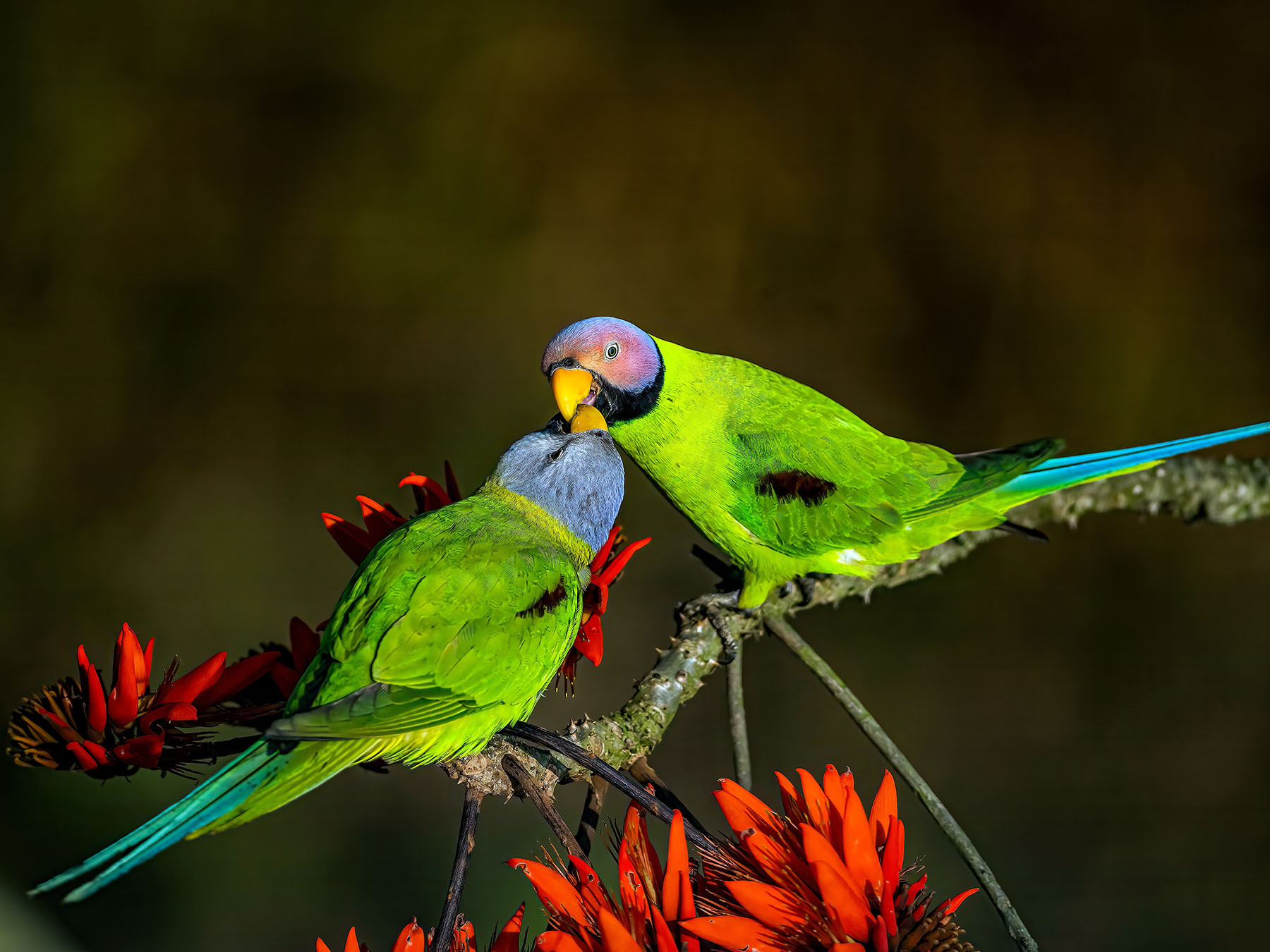
Breeding season for Blossom-headed Parakeets typically occurs from January to April. Pairs form strong bonds and engage in mutual preening and feeding as part of courtship.
These parakeets are cavity nesters, often using natural tree hollows or abandoned woodpecker holes. The female lays 4-6 white, rounded eggs in the unlined cavity.
Incubation lasts about 22 days and is primarily performed by the female. Both parents care for the chicks, who fledge after approximately 7 weeks but remain dependent on them for several more weeks.
Behaviour
Blossom-headed Parakeets are highly social, often seen in small flocks or pairs. They are agile flyers, manoeuvring swiftly through forest canopies.
These parakeets are known for their acrobatic feeding habits, often hanging upside down to reach fruits and seeds on thin branches.
Conservation
The Blossom-headed Parakeet is classified as Near Threatened due to habitat loss and capture for the pet trade.
Conservation efforts focus on protecting its forest habitats and enforcing laws against illegal trapping and trade. Monitoring programs are in place to track population trends.
More photos
3 photos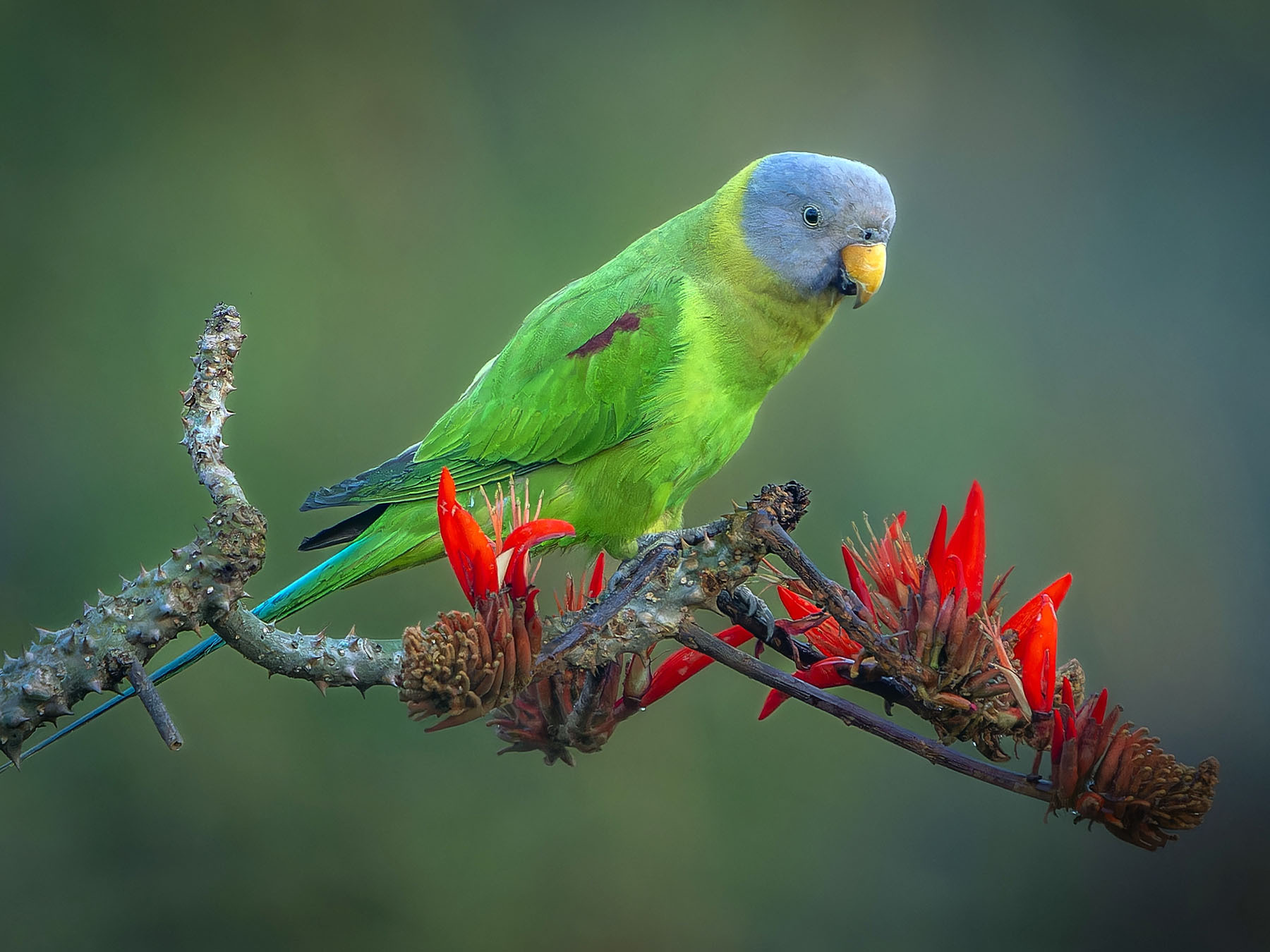
Quick facts
- Length
- 33–36 cm
- Wingspan
- 42–48 cm
- Weight
- 110–130 g
- Lifespan
- 15–20 years
- Family
- Parrots
- Migration
- Resident
- Global status (IUCN)
- Near Threatened
- World population
- Not quantified, but the overall abundance appears to be much reduced across its range in recent decades
- Population trend
- Decreasing
- Also called
- Rosy-headed Parakeet, Himalayapsitta roseata
- Scientific name
- Psittacula roseata
Sources
3- 1BirdLife International. 2023. Himalayapsitta roseata. The IUCN Red List of Threatened Species 2023: e.T22685486A241241739. Source (opens in a new tab)
- 2BirdLife International. 2023. Himalayapsitta roseata. The IUCN Red List of Threatened Species 2023: e.T22685486A241241739. Source (opens in a new tab)
- 3Collar and Kirwan (2017)

Checked by
Nathan Cope, founder and editor
Nathan founded Birdfact and leads its writers and contributors in the UK, the US and Canada. He has watched and studied birds for more than ten years, and checks every article and species guide before it’s published.