


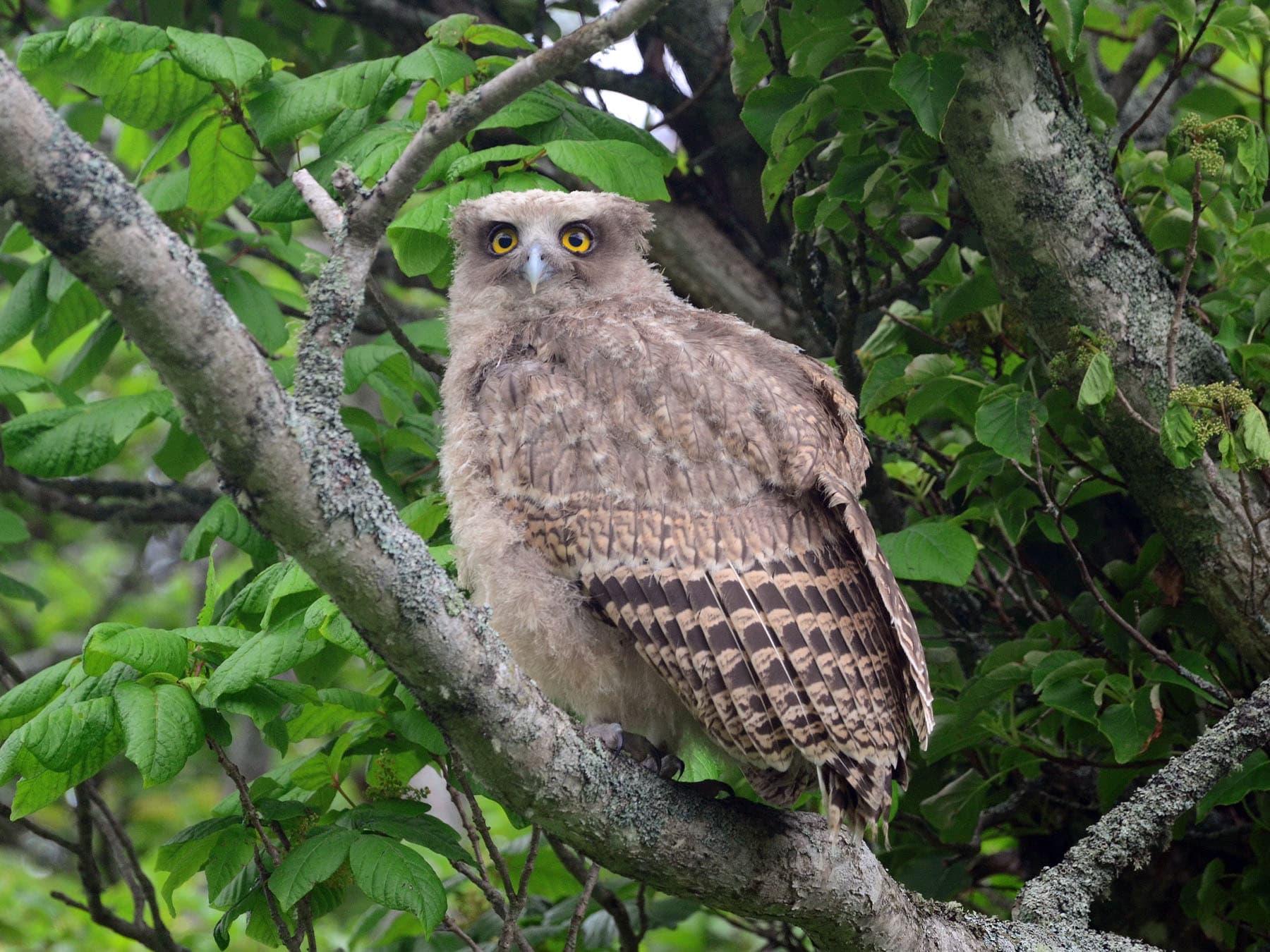
Blakiston's Fish-Owl
Blakiston's Eagle-owl · Ketupa blakistoni
By the Birdfact teamChecked by Nathan Cope
On this page11 sections
How to recognise it
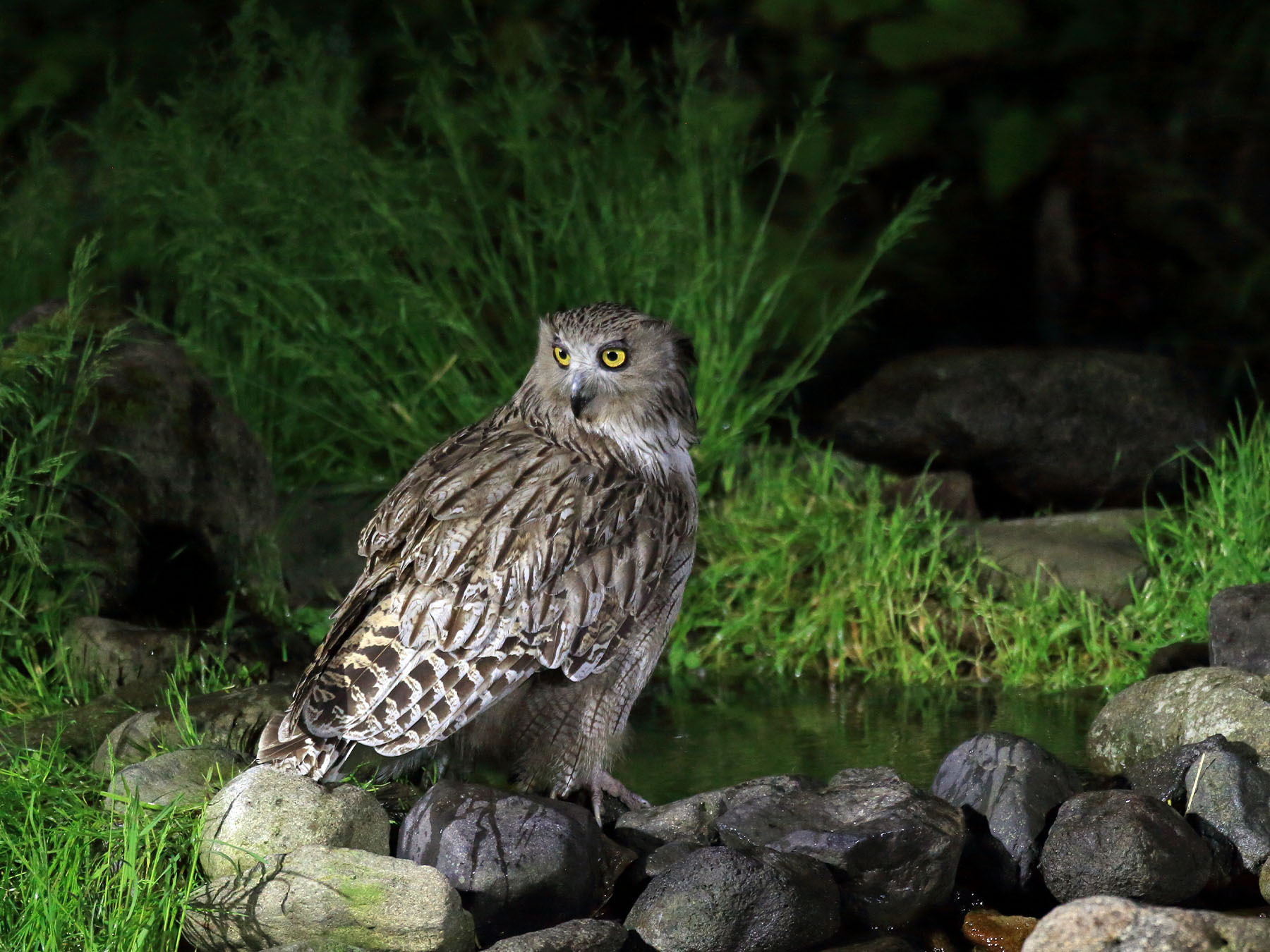
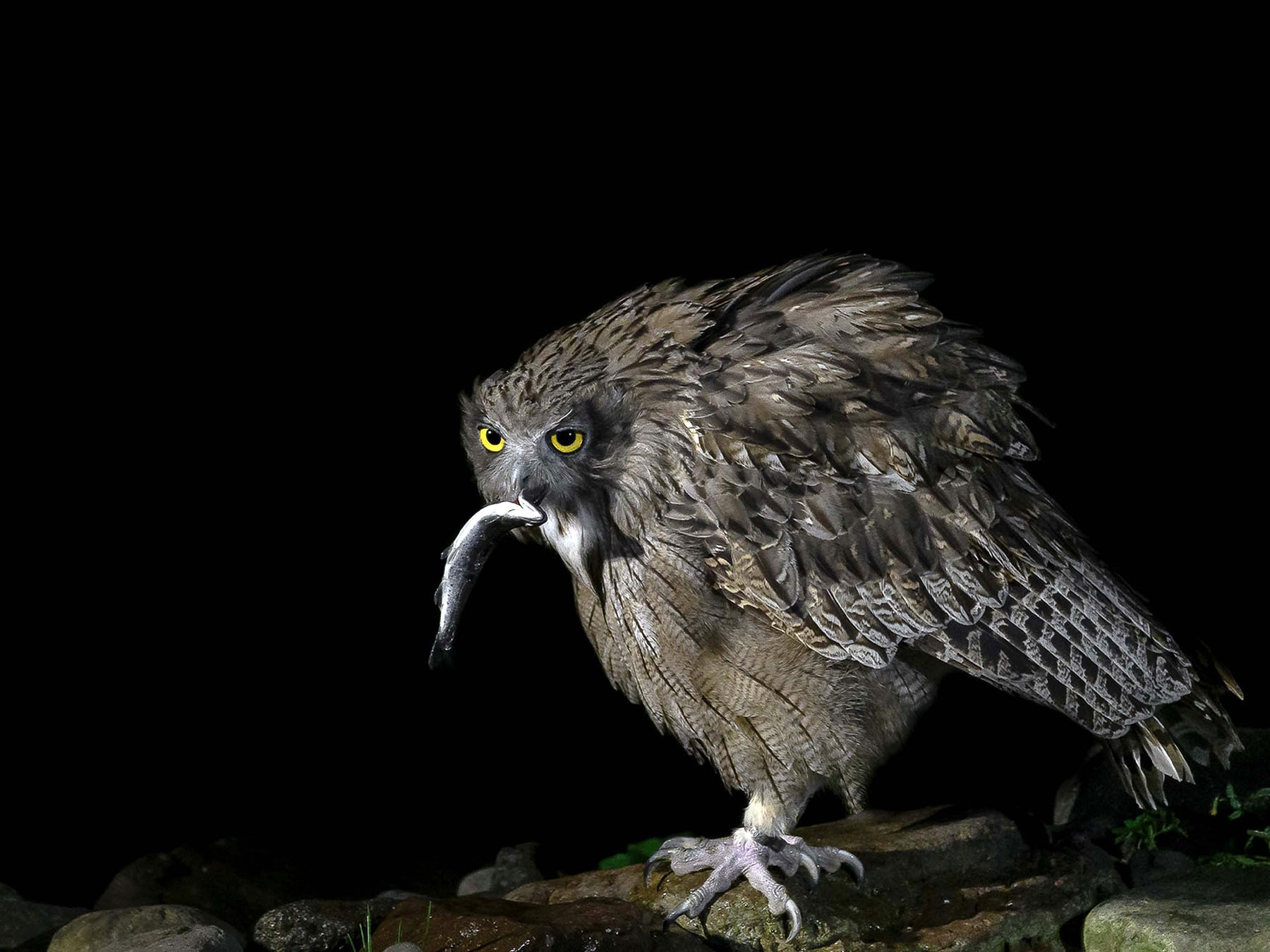
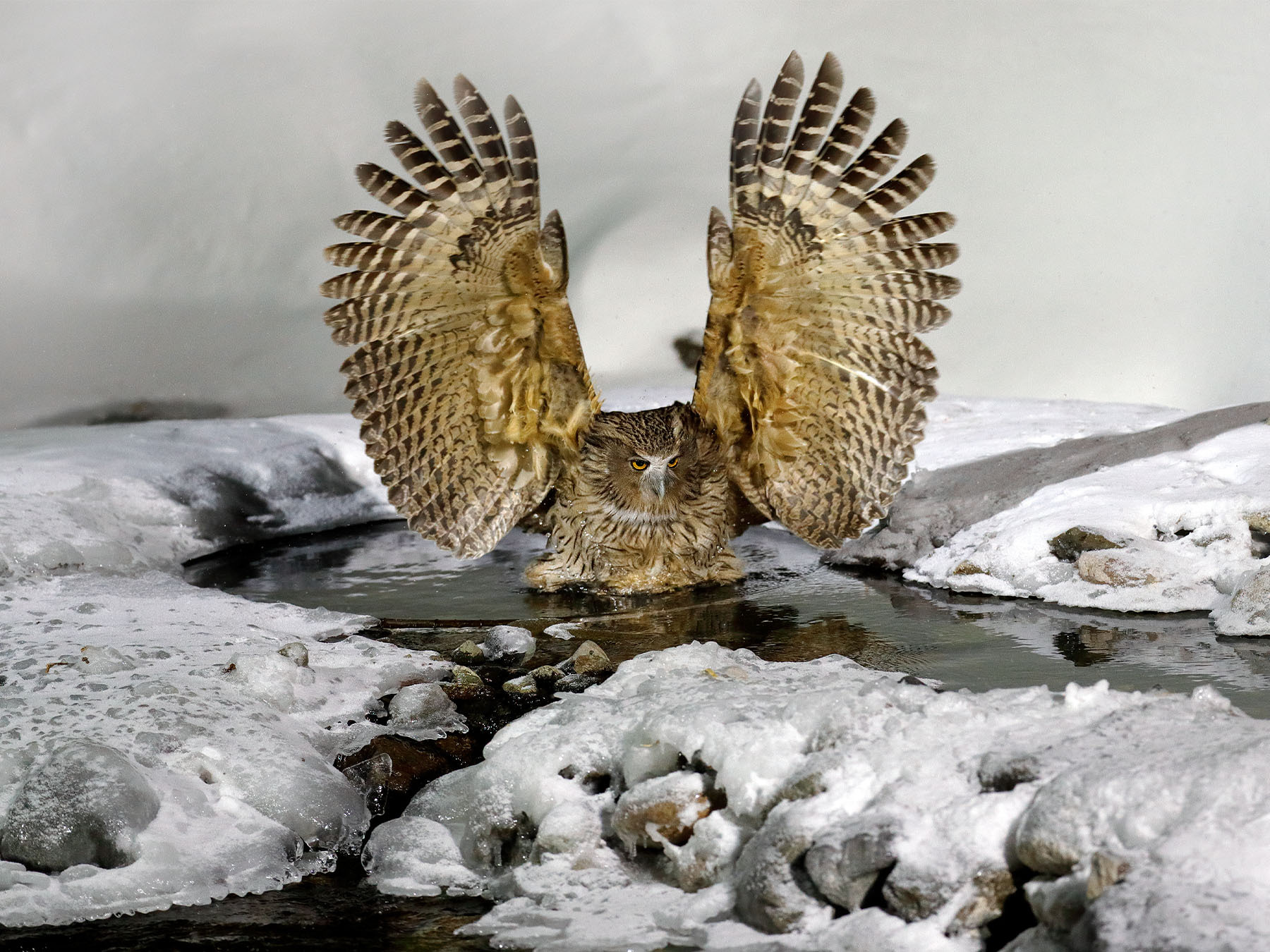
Blakiston's Fish-Owl is one of the world's largest owls (second only to the Eurasian Eagle-owl), with a massive, stocky build and prominent ear tufts that typically extend horizontally.
Its plumage is predominantly buff-brown, streaked and mottled with darker colours, providing excellent camouflage against tree bark.
Females are notably larger than males, but both sexes share similar colouration. Juveniles can be distinguished by their whiter feather edges and spots, along with their bluish bill and toes, rather than the grey-horn colouring of adults.
Its size
Adults- Length
- 60–72 cm
- Wingspan
- 180–190 cm
- Weight
- 3000–4600 g
Its song and calls
Blakiston's Fish-Owls produce deep, resonant hooting calls that can be heard over long distances. Their vocalisations are often described as a series of low, booming 'boo-boo-boo' sounds.
During courtship, pairs engage in duet calling, with the male's voice typically lower in pitch than the female's.
When and where to see it
Tips for seeing it
- Look for them near rivers and streams in old-growth forests
- Listen for their deep, resonant hooting calls at night
- Search for signs of activity, such as fish remains or large pellets near potential roosting sites
- Be patient and quiet; these owls are shy and easily disturbed
What it eats
As their name suggests, Blakiston's Fish-Owls primarily feed on fish, including salmon and trout. They also consume amphibians, crustaceans, and small mammals.
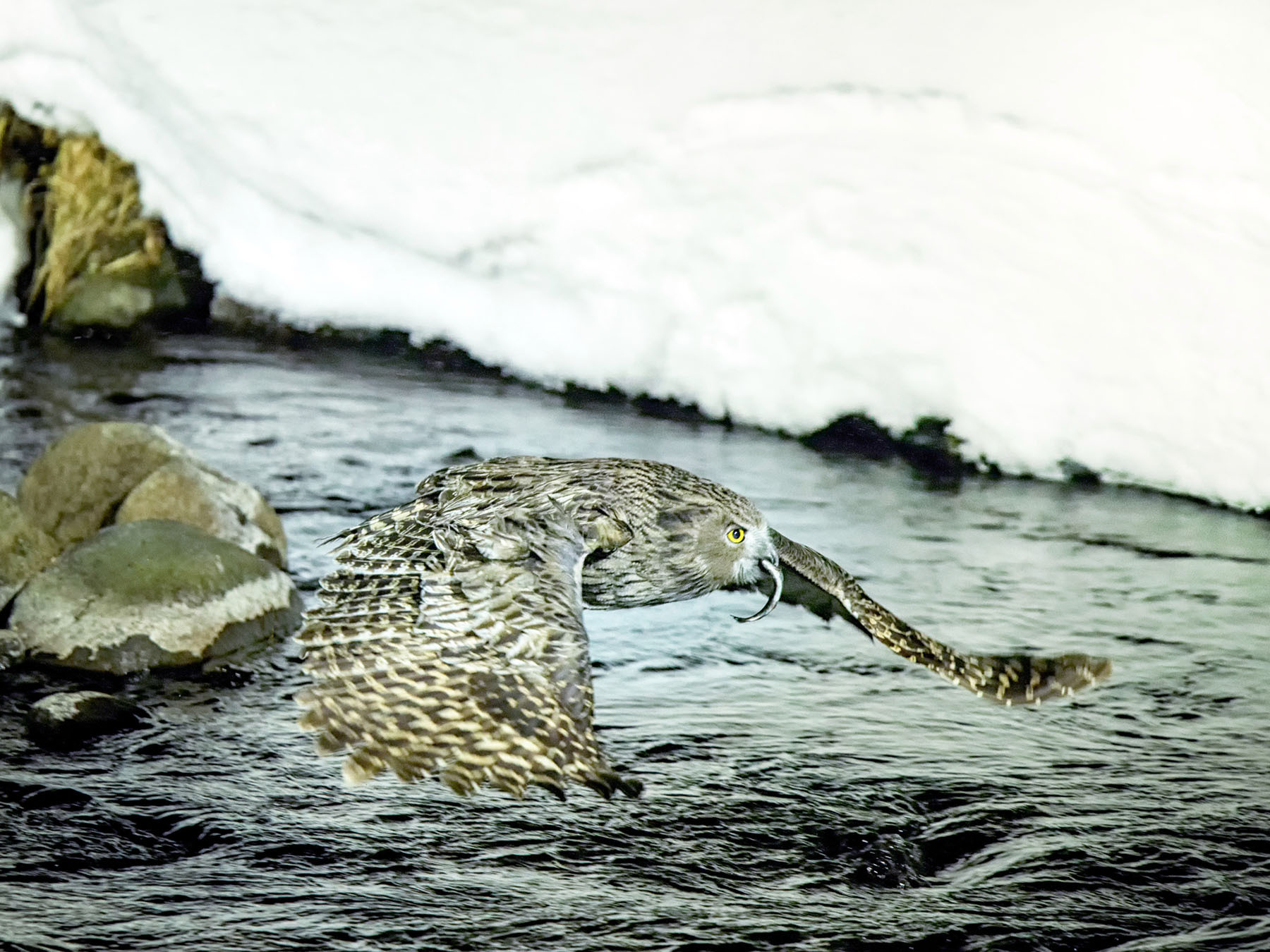
These owls hunt by perching near water bodies and swooping down to snatch prey from the surface or by wading into shallow water to catch fish with their talons.
Nesting and breeding
Breeding pairs of Blakiston's Fish-Owls form long-term, monogamous bonds. The breeding season typically begins in late winter to early spring, with courtship involving duet calling between mates.
Nests are usually located in large tree cavities near water bodies, often in old-growth trees. The female lays 1-2 white eggs, which are incubated primarily by her for about 35-37 days.
Both parents care for the young, which fledge after approximately 50-55 days but remain dependent on their parents for several months. Young owls may stay in their parent's territory for up to two years.
Behaviour
This nocturnal hunter is primarily solitary, coming together only during the breeding season. Blakiston's Fish-Owls are known for their unique fishing technique, wading into shallow streams to catch prey with their powerful talons.
They are generally sedentary, maintaining year-round territories along riverbanks.
Conservation
Blakiston's Fish-Owl is classified as Endangered due to habitat loss, particularly the destruction of old-growth forests near rivers.
Conservation efforts focus on protecting remaining habitats and raising awareness about the species' ecological importance. Artificial nest boxes have been used in some areas to support breeding populations.
More photos
5 photos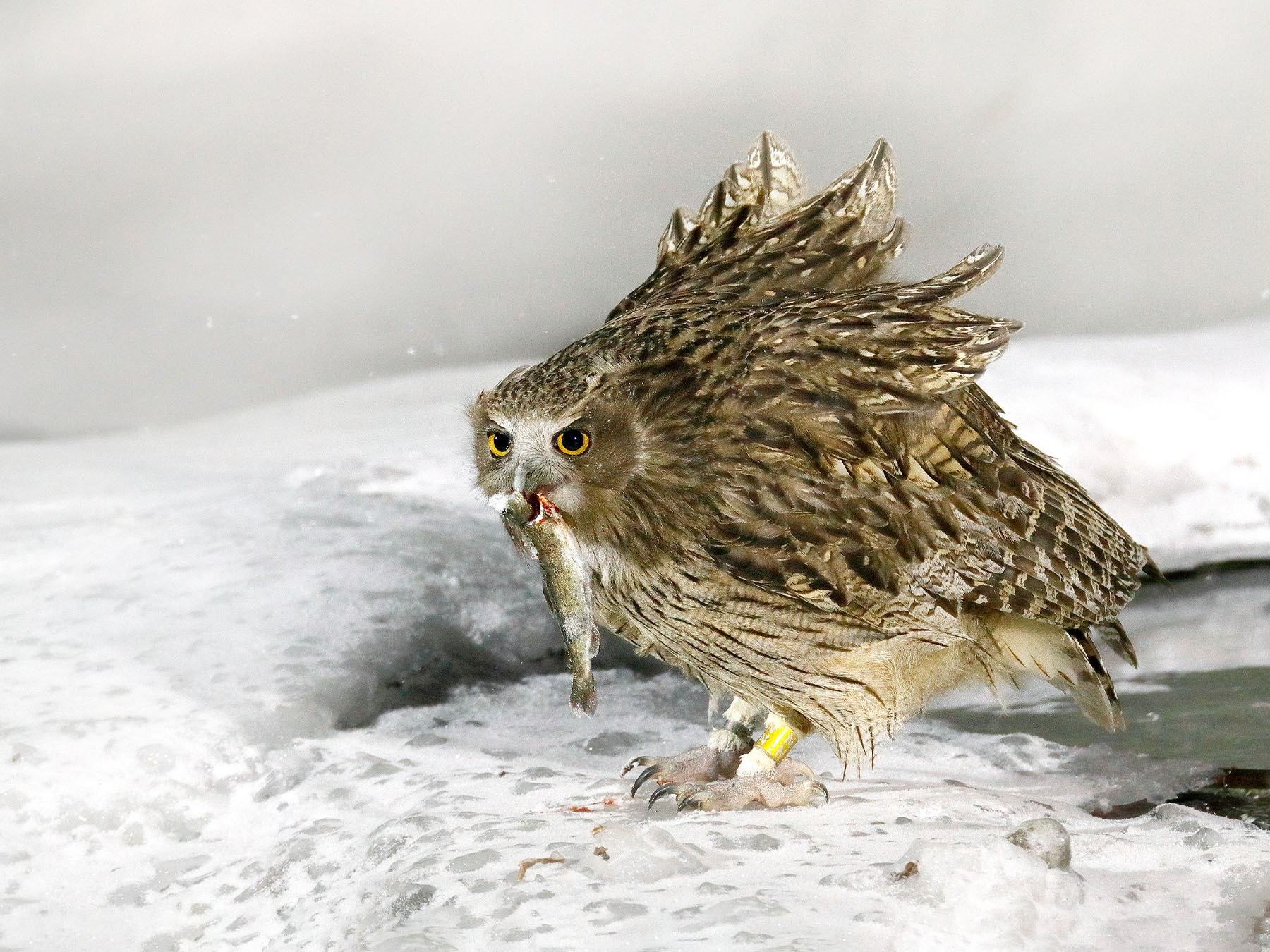
Quick facts
- Length
- 60–72 cm
- Wingspan
- 180–190 cm
- Weight
- 3000–4600 g
- Lifespan
- 8–15 years
- Family
- Owls
- Migration
- Resident
- Global status (IUCN)
- Endangered
- World population
- 1,000 - 2,499 mature individuals
- Population trend
- Decreasing
- Also called
- Blakiston's Eagle-owl
- Scientific name
- Ketupa blakistoni
Sources
4- 1BirdLife International. 2016. Bubo blakistoni. The IUCN Red List of Threatened Species 2016: e.T22689007A93214159. Source (opens in a new tab)
- 2BirdLife International. 2016. Bubo blakistoni. The IUCN Red List of Threatened Species 2016: e.T22689007A93214159. Source (opens in a new tab)
- 3BirdLife International. 2016. Bubo blakistoni. The IUCN Red List of Threatened Species 2016: e.T22689007A93214159. Source (opens in a new tab)
- 4Konig, C., B. Weick. A Guide to the Owls of the World.. New Haven: Yale University Press. (1999)

Checked by
Nathan Cope, founder and editor
Nathan founded Birdfact and leads its writers and contributors in the UK, the US and Canada. He has watched and studied birds for more than ten years, and checks every article and species guide before it’s published.