


Black Swan
Cygnus atratus
By the Birdfact teamChecked by Nathan Cope
On this page13 sections
How to recognise it
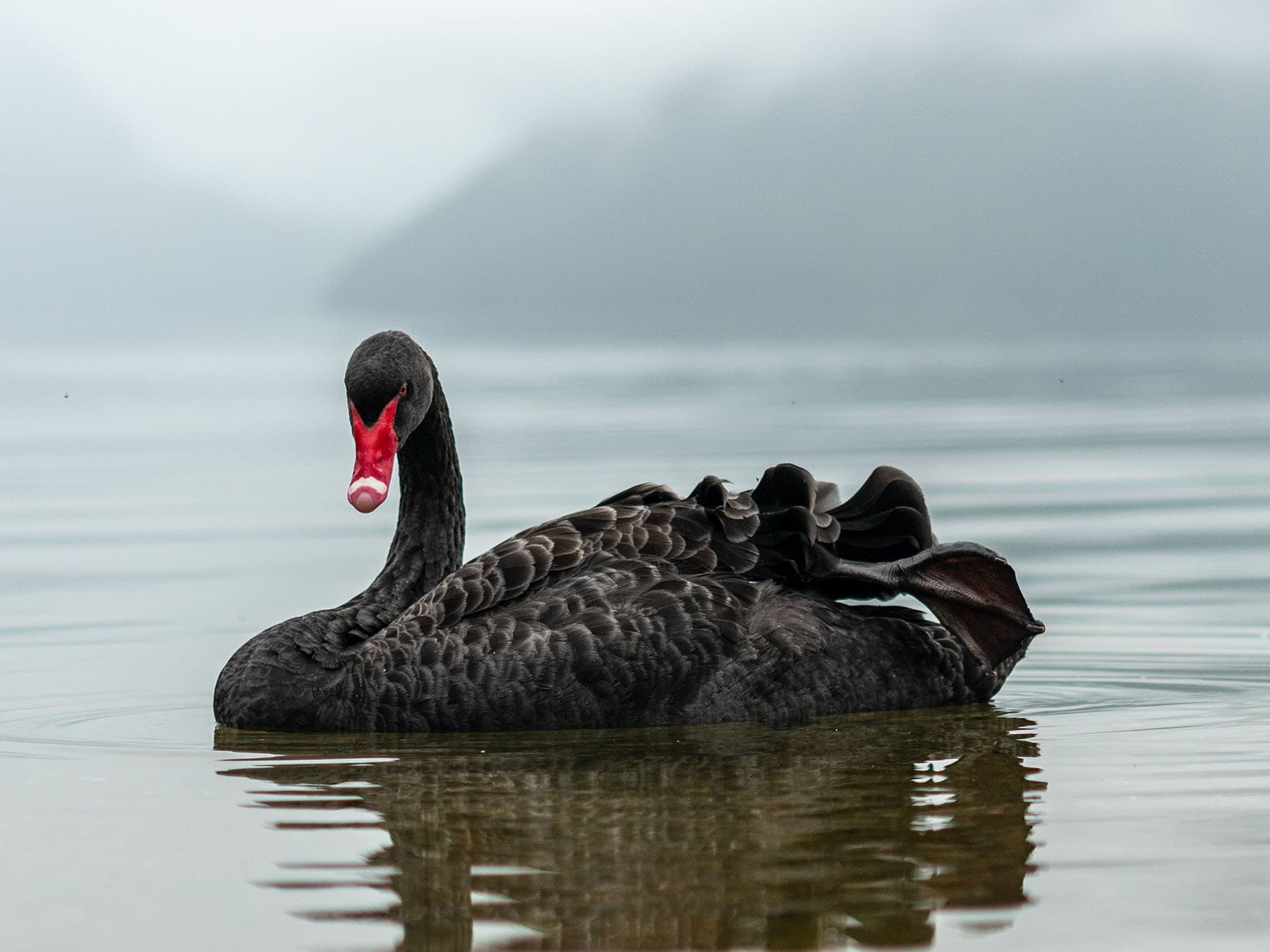
The Black Swan is an unmistakable, large waterbird defined by its almost entirely black plumage. These dark feathers are often subtly fringed with grey and appear distinctively ruffled along the wings. When the bird takes flight, a striking contrast is revealed: pure white primary and secondary flight feathers that remain completely hidden while the swan is swimming or resting.
Their vibrant, deep orange-red bill features a distinct narrow white band near the tip, drawing the eye against their dark profile. They possess the longest neck relative to body size of any swan species — containing up to 25 vertebrae — which they hold in a graceful 'S' curve on the water. Their eyes range from reddish to pinkish, while their sturdy legs and webbed feet are a muted greyish-black.
While male and female Black Swans share the same striking colouration, they are slightly sexually dimorphic. Females, known as pens, are generally smaller than the males, or cobs. A close look at a pair will also reveal that the female's bill is typically shorter and less straight than her partner's, though this can be difficult to spot from a distance.
Its size
Adults- Length
- 110–142 cm
- Wingspan
- 160–200 cm
- Weight
- 3700–9000 g
Its song and calls
The Black Swan possesses a surprisingly musical and far-reaching voice, producing a resonant, bugle-like sound that carries exceptionally well across open water. They use this distinctive, honking call both while swimming and during flight, helping to communicate with their flock or maintain contact with their partner over long distances.
At close quarters, their vocal repertoire reveals much more variety. They produce a range of softer, crooning notes when interacting intimately with their mate or guiding their newly hatched cygnets. If disturbed while nesting or breeding, their tone shifts dramatically; they will emit sharp whistles and aggressive hisses as a clear warning to intruders. Even their wings contribute to their unique soundscape, making a distinct, rhythmic whistling or humming noise as they fly overhead, which helps flocks stay synchronised in the air. This mechanical wing-whistle is a characteristic feature of their flight, often audible before the birds themselves are spotted against the sky.
- Call0:00 / 0:05
Recorded in Bretagne, France · December 2024
When and where to see it
OctoberLeaving
Most recorded in October
- 1. Newport0.10%
- 2. Devonunder 0.1%
- 3. Stockton-on-Teesunder 0.1%
- 4. Merseysideunder 0.1%
- 5. Donegalunder 0.1%
Each dot is a county, state or province: the bigger and darker, the larger the bird’s share of that place’s bird records that month. Grey dots: no regular records. The ringed point is the centre of the bird’s records this month; the arrow shows how it moved since last month, and the dashed loop its path through the year. “Arrivals” colours places where it becomes regular this month (orange) or is in its last regular month (grey). GBIF eBird Observation Dataset, 2019–2024. Map data: Natural Earth, US Census Bureau; place centres © OpenStreetMap contributors.
In your area
See when the Black Swan is recorded in your county, state or province.
How often the Black Swan turns up in the UK, Ireland and the United States through the year, from birdwatchers' records.
United Kingdom
Resident · all year · most records in July
Ireland
Winter visitor · regularly Nov–Jun · most records in February
United States
Resident · all year · most records in February
Show as a table
| Month | United Kingdom | Ireland | United States |
|---|---|---|---|
| January | 0.013% (regular) | 0.004% (regular) | <0.001% (regular) |
| February | 0.009% (regular) | 0.012% (regular) | 0.001% (regular) |
| March | 0.010% (regular) | 0.005% (regular) | <0.001% (regular) |
| April | 0.011% (regular) | 0.002% | <0.001% (regular) |
| May | 0.012% (regular) | 0.002% | <0.001% (regular) |
| June | 0.013% (regular) | 0.004% (regular) | <0.001% (regular) |
| July | 0.017% (regular) | 0.004% | <0.001% (regular) |
| August | 0.016% (regular) | 0.006% | <0.001% (regular) |
| September | 0.016% (regular) | 0.002% | <0.001% (regular) |
| October | 0.014% (regular) | 0.001% | <0.001% (regular) |
| November | 0.013% (regular) | 0.006% (regular) | <0.001% (regular) |
| December | 0.012% (regular) | 0.005% (regular) | <0.001% (regular) |
Recorded regularly in
Worldwide: recorded regularly in 33 countries
Countries where it was recorded in at least 3 of the 6 years 2019–2024. Linked countries have their own bird list.
Europe (23)
Africa (1)
North America (1)
South America (1)
Oceania (2)
Data: EOD – eBird Observation Dataset (Cornell Lab of Ornithology), accessed via GBIF.org, CC BY 4.0. Records from 2019–2024, aggregated and filtered by Birdfact. How these lists are made
Tips for seeing it
To spot a Black Swan in its native Australia or introduced ranges like New Zealand and the United Kingdom, head to large, permanent bodies of water. Lakes, estuaries, and expansive wetlands are ideal, particularly those with plenty of submerged vegetation. Because they require a 40-metre runway of clear water to take off, they rarely settle on small, enclosed ponds or narrow rivers.
While their jet-black plumage and vibrant red bill make them unmistakable on the water, the real spectacle happens when they take flight. Watch for the sudden flash of brilliant white primary and secondary feathers that remain completely hidden when the bird is swimming. If you are near a breeding pair, keep a respectful distance. They can be highly territorial and will aggressively defend their large floating nests. Listen out for their resonant, bugle-like calls, which often announce a flock's arrival long before they come into view.
What it eats
The Black Swan is primarily herbivorous, relying heavily on aquatic vegetation to sustain its large frame. Their diet consists mainly of algae and submerged weeds, including species like Typha, Potamogeton, and Myriophyllum. To reach this sub-aquatic foliage, they plunge their exceptionally long necks into water up to a metre deep, often upending their entire bodies just like a dabbling duck to graze on the riverbed.
While their natural foraging grounds are strictly aquatic, they are highly adaptable feeders when conditions demand it. When underwater food is scarce, or when heavy rains flood new areas, Black Swans will readily venture onto land. They can often be seen grazing on dry pastures, grasslands, or flooded agricultural fields. This terrestrial foraging habit occasionally brings them into conflict with farmers, as a large flock of swans can quickly consume significant quantities of commercial crops. They use their serrated bill edges to efficiently tear aquatic stems and strip leaves from terrestrial plants, processing large volumes of vegetation daily.
Nesting and breeding
Black Swans are strictly monogamous and typically pair for life, breeding either in isolated pairs or small, loose colonies in shallow wetlands. Their nest is a massive, untidy floating mound constructed from reeds, grasses, sticks, and dead leaves. These impressive structures are usually anchored to a small island or built up from the bottom in deeper water to protect the eggs against fluctuating water levels.
The female lays a clutch of 5 to 10 pale green eggs. In a behaviour that is highly unusual among swan species, both the male and female share incubation duties. They take turns keeping the eggs warm for between 35 and 48 days, ensuring the nest is rarely left unguarded against predators.
Once hatched, the cygnets are precocial. Covered in fluffy grey down, they are able to swim and feed themselves almost immediately after leaving the egg. Although they fledge at 150 to 170 days old, the young swans often remain with their parents, forming a tight-knit family group until the following breeding season begins.
Behaviour
Taking to the air is a laborious and energy-intensive process for the Black Swan. Weighing up to 9 kilograms, they cannot simply spring into flight. Instead, they require a clear runway of at least 40 metres across the water, flapping their powerful wings and running frantically across the surface to build sufficient lift. Once airborne, however, they transform into strong, graceful, and enduring flyers.
In flight, their appearance changes dramatically as their pure white flight feathers are finally revealed, creating a striking contrast against their black bodies. They fly with their exceptionally long necks fully extended forward, their wings producing a rhythmic whistling sound that helps flocks stay together. Their flight patterns are highly erratic and nomadic, driven by rainfall rather than seasons, as they navigate vast distances across the Australian outback to locate newly flooded inland wetlands. When travelling long distances, they often adopt the classic V-formation common to many waterfowl, which significantly reduces wind resistance for the flock.
Lifespan and predators
Black Swans are notably long-lived birds, particularly once they manage to survive their vulnerable first year as cygnets. In the wild, their typical lifespan ranges from 10 to 15 years. Their survival depends heavily on finding consistent wetland habitats and successfully avoiding predators during their annual moult, a period when they lose all their flight feathers and become completely grounded for roughly a month.
Under optimal conditions, or in protected environments and captivity where food is plentiful and predators are absent, they can live significantly longer. The maximum recorded lifespan for a Black Swan is an impressive 40 years, a testament to their hardiness and adaptability. Once they reach adulthood, their large size and aggressive defensive behaviours mean they have very few natural predators, allowing them to thrive for decades. Their strong pair bonds also contribute to this longevity, as established couples work together to defend resources and raise successive generations.
Conservation
The Black Swan is currently evaluated as Least Concern by the International Union for Conservation of Nature (IUCN). Their global population is considered stable, with estimates suggesting between 100,000 and 500,000 mature individuals in the wild. Across their vast native range in Australia, they face no major global threats and remain a common, widespread species that adapts well to human-altered landscapes.
However, they do face localised pressures that require ongoing monitoring. The primary threat is the drainage and degradation of the permanent wetland habitats they rely on for breeding and during their vulnerable flightless moulting period. Additionally, in certain agricultural areas, their habit of grazing on pastures and crops has led to them being classified as pests. This occasionally results in controlled, legal hunting to manage local numbers and protect agricultural interests, though it does not impact the overall stability of the species.
Courtship & Display
The social lives of Black Swans are anchored by complex and highly ritualised courtship displays. Because they typically mate for life, these intricate displays are used not just to attract a new partner, but to continuously reinforce the bond between an established pair throughout their many years together.
The most spectacular and frequently observed of these rituals is the 'Triumph Ceremony'. Often performed after successfully chasing off a rival or when the pair reunites after a brief separation, the male and female will face each other on the water. They lift their wings slightly and raise their chins, calling repeatedly in unison. The pair then swims in tight, synchronised circles, frequently dipping their bills downwards into the water and posturing aggressively. This elaborate, cooperative dance solidifies their partnership and ensures they remain a cohesive team before the demanding breeding season begins. Such strong pair bonds are essential, as raising cygnets requires intense cooperation from both parents.
Cultural Significance
For centuries in the Western world, the phrase 'black swan' was used as a definitive statement of impossibility. The ancient Roman satirist Juvenal famously characterised a good person as a 'rare bird in the lands, and very like a black swan' — a joke relying on the absolute certainty among Europeans that such a creature simply did not exist.
That certainty was shattered abruptly in 1697 when Dutch explorer Willem de Vlamingh sailed into the Swan River in Western Australia and observed flocks of the dark birds. The discovery profoundly shocked the scientific community and fundamentally altered how people thought about the natural world. Today, a 'black swan event' remains a powerful and widely used metaphor in economics, science, and history. It describes an unpredictable, highly improbable event that defies all previous expectations and carries massive, world-altering consequences. The bird itself remains a proud emblem of Western Australia, featuring prominently on the state's flag and coat of arms.
Quick facts
- Length
- 110–142 cm
- Wingspan
- 160–200 cm
- Weight
- 3700–9000 g
- Lifespan
- 10–15 years · oldest recorded 40 years
- Family
- Ducks, Geese & Swans
- Migration
- Nomadic
- Global status (IUCN)
- Least Concern
- World population
- 100,000 - 500,000 individuals
- Population trend
- Stable
- Scientific name
- Cygnus atratus
Sources
4- 1Black swan - Wikipedia Source (opens in a new tab)
- 2Black Swan Cygnus Atratus Species Factsheet | BirdLife DataZone Source (opens in a new tab)
- 3Black Swan - The Australian Museum Source (opens in a new tab)
- 4Cygnus atratus (black swan) | Animal Diversity Web Source (opens in a new tab)

Checked by
Nathan Cope, founder and editor
Nathan founded Birdfact and leads its writers and contributors in the UK, the US and Canada. He has watched and studied birds for more than ten years, and checks every article and species guide before it’s published.