


Black Lark
Yeltonian Lark · Melanocorypha yeltoniensis
By the Birdfact teamChecked by Nathan Cope
On this page10 sections
How to recognise it
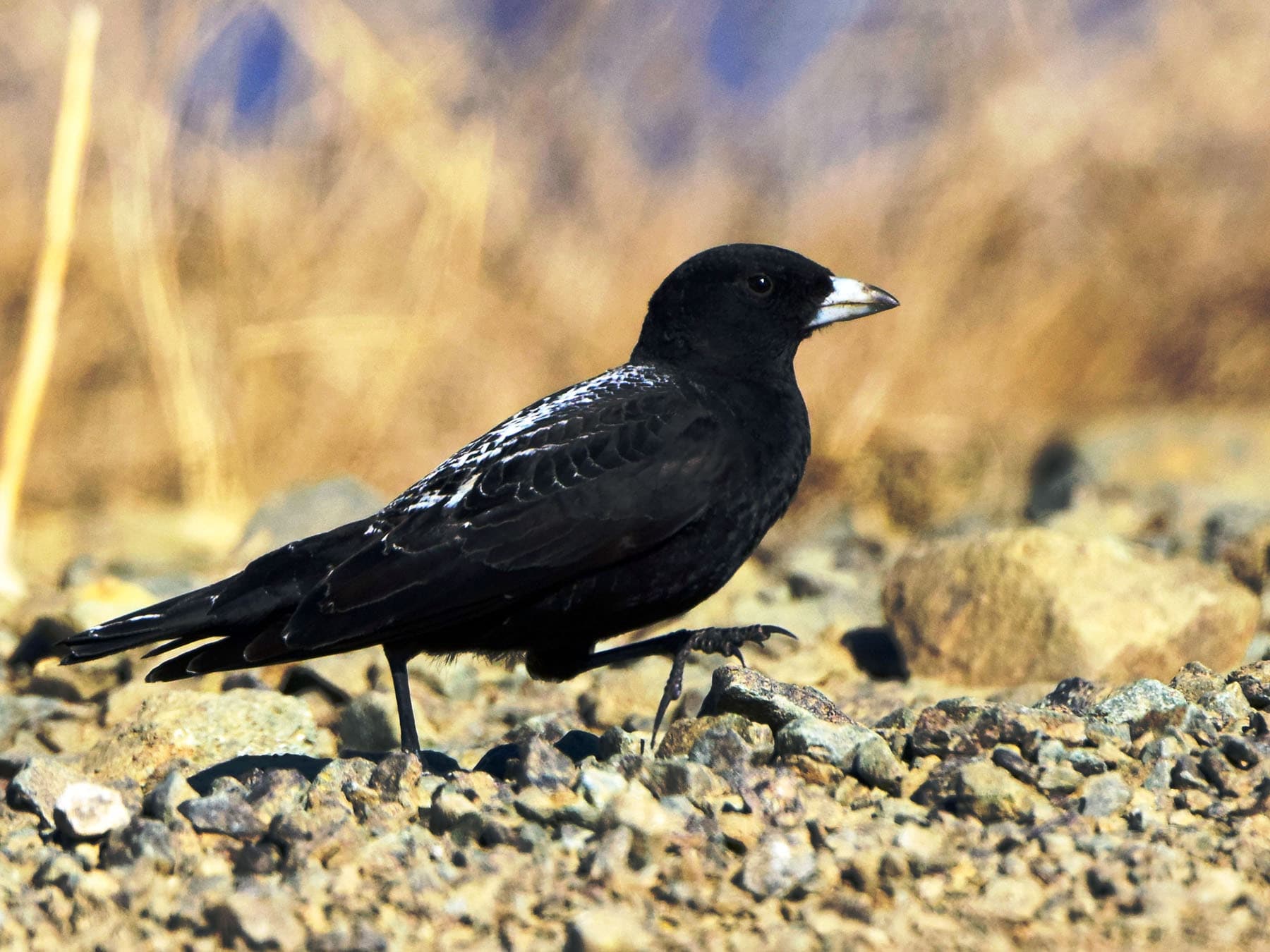
The Black Lark is a striking bird with pronounced sexual dimorphism. Males are almost entirely black, with a slightly curved bill and robust build. Their plumage takes on a glossy sheen during the breeding season.
Females are significantly different, with brown upperparts streaked with darker markings and buff-coloured breasts with fine streaks. Both sexes have relatively short tails and strong legs suited for ground-dwelling.
During the winter, males moult into a plumage similar to females.
Its size
Adults- Length
- 17–20 cm
- Wingspan
- 35–40 cm
- Weight
- 45–80 g
Its song and calls
The Black Lark's song is a melodious warble, often delivered during its display flight. The song includes a series of trills and whistles, sometimes described as 'tiri-tiri-tiri' or 'trr-trr-trr'.
When alarmed, they emit a sharp 'chit' call. Males are more vocal, especially during the breeding season.
When and where to see it
The Black Lark is not recorded regularly in the UK, Ireland, the United States or Canada.
Worldwide: recorded regularly in 2 countries
Countries where it was recorded in at least 3 of the 6 years 2019–2024. Linked countries have their own bird list.
Asia (2)
Data: EOD – eBird Observation Dataset (Cornell Lab of Ornithology), accessed via GBIF.org, CC BY 4.0. Records from 2019–2024, aggregated and filtered by Birdfact. How these lists are made
Tips for seeing it
- Look for Black Larks in open grasslands and semi-desert areas
- Listen for their distinctive song, often delivered in flight
- Observe their ground-foraging behaviour, as they rarely perch in trees
- Watch for the male's striking black plumage, which stands out against the landscape
What it eats
The Black Lark's diet consists primarily of seeds from grasses and other plants. During the breeding season, they supplement their diet with insects and other small invertebrates, which are especially important for feeding their young.
They forage by walking along the ground, picking food items from the soil surface.
Nesting and breeding
Black Larks breed from late April to early July. Males establish territories and perform elaborate flight displays to attract females. Pairs are monogamous during the breeding season.
Nests are built on the ground, often in a small depression well-hidden among vegetation. The female constructs the nest using grass and plant stems and lining it with finer materials. A typical clutch consists of 3-5 eggs, which are pale with brown speckles.
The female incubates the eggs for about 12-13 days. Both parents feed the chicks, which fledge after approximately 10-11 days but remain dependent on their parents for several more weeks.
Behaviour
Black Larks are primarily terrestrial, spending much of their time walking or running on the ground in search of food. They often form small flocks outside the breeding season, particularly in winter.
During courtship, males perform elaborate flight displays, ascending high into the air before descending with outstretched wings.
Conservation
While currently listed as Least Concern, the Black Lark faces threats from habitat loss due to agricultural intensification and overgrazing. Climate change may also impact their breeding range.
Conservation efforts focus on maintaining suitable grassland habitats within their range.
Quick facts
- Length
- 17–20 cm
- Wingspan
- 35–40 cm
- Weight
- 45–80 g
- Lifespan
- 3–5 years
- Family
- Larks
- Migration
- Partial migrant
- Global status (IUCN)
- Least Concern
- World population
- Not quantified
- Population trend
- Decreasing
- Also called
- Yeltonian Lark
- Scientific name
- Melanocorypha yeltoniensis
Sources
2- 1BirdLife International. 2016. Melanocorypha yeltoniensis. The IUCN Red List of Threatened Species 2016: e.T22717301A90011765. Source (opens in a new tab)
- 2BirdLife International. 2016. Melanocorypha yeltoniensis. The IUCN Red List of Threatened Species 2016: e.T22717301A90011765. Source (opens in a new tab)

Checked by
Nathan Cope, founder and editor
Nathan founded Birdfact and leads its writers and contributors in the UK, the US and Canada. He has watched and studied birds for more than ten years, and checks every article and species guide before it’s published.