


Black-backed Woodpecker
Arctic Three-toed Woodpecker · Picoides arcticus
By the Birdfact teamChecked by Nathan Cope
On this page13 sections
How to recognise it
What do Black-backed Woodpeckers look like?
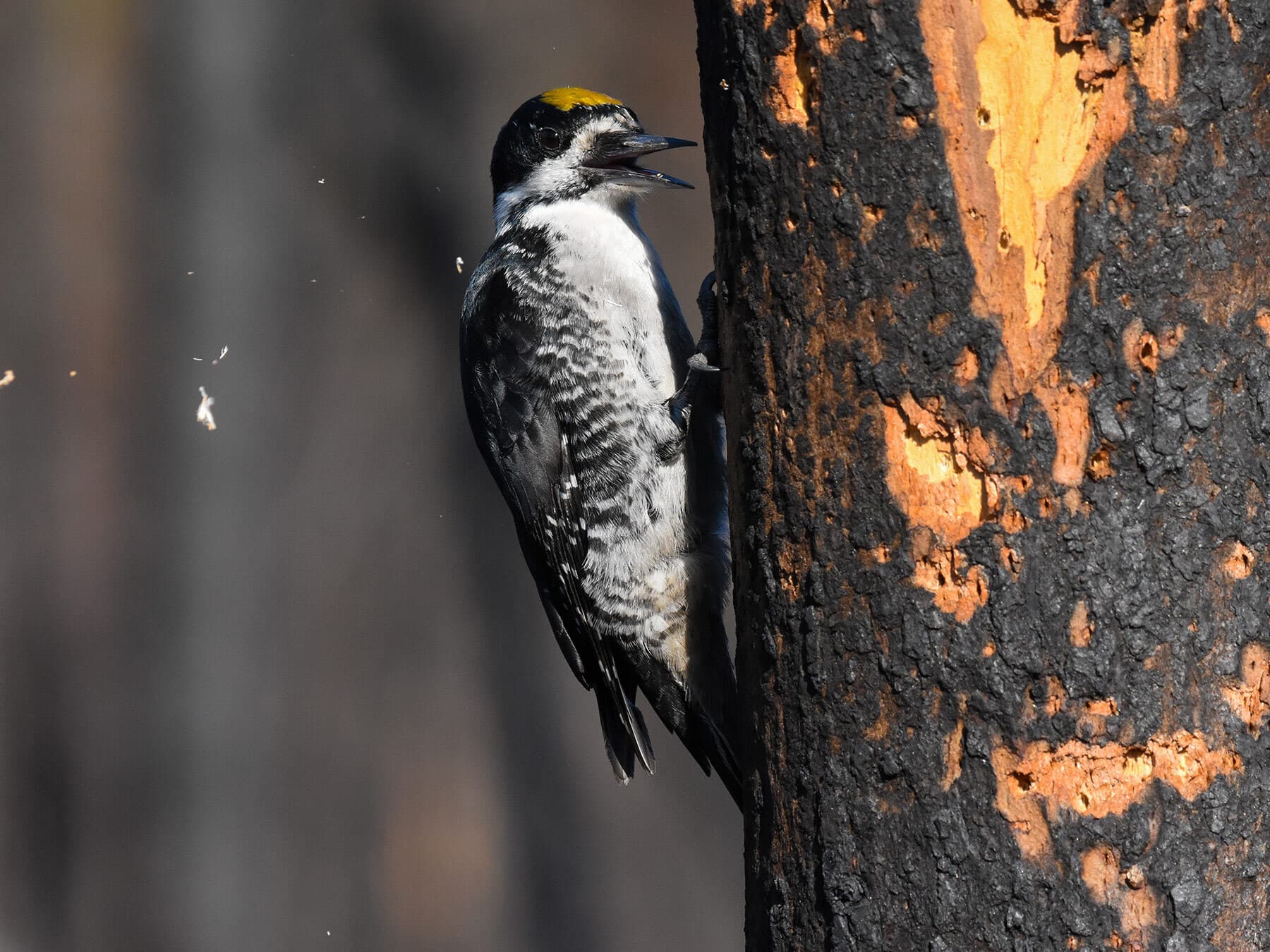
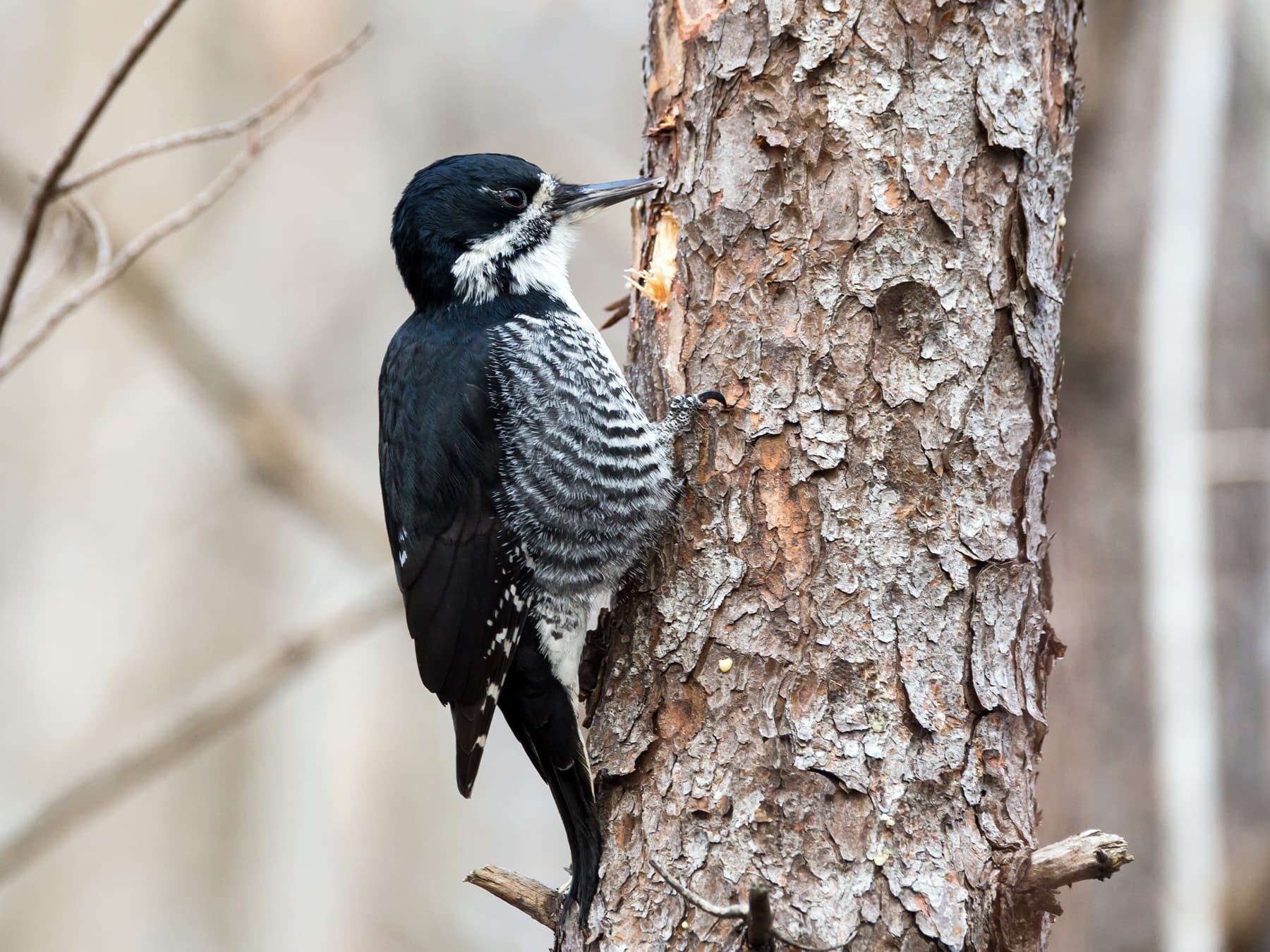
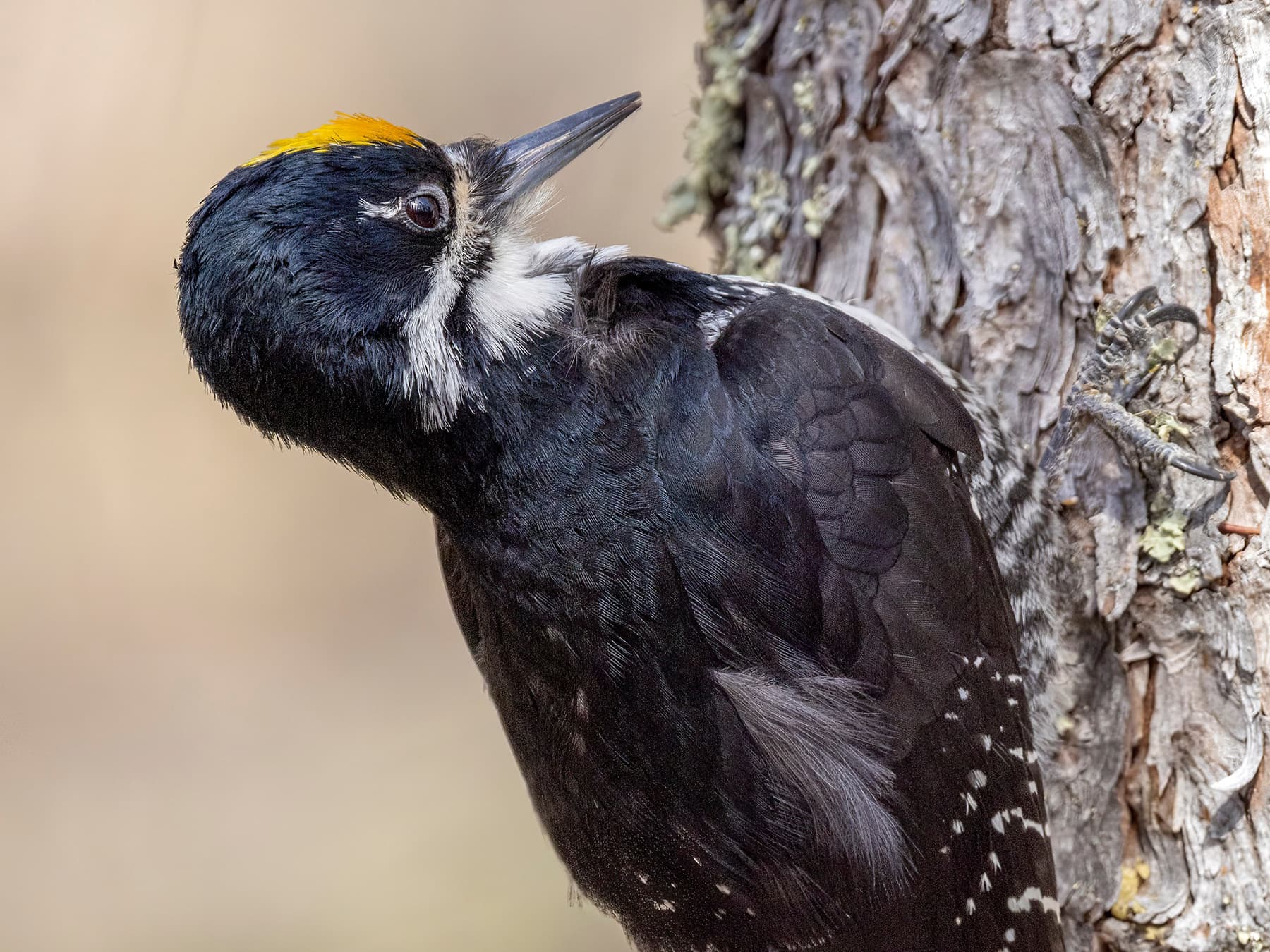
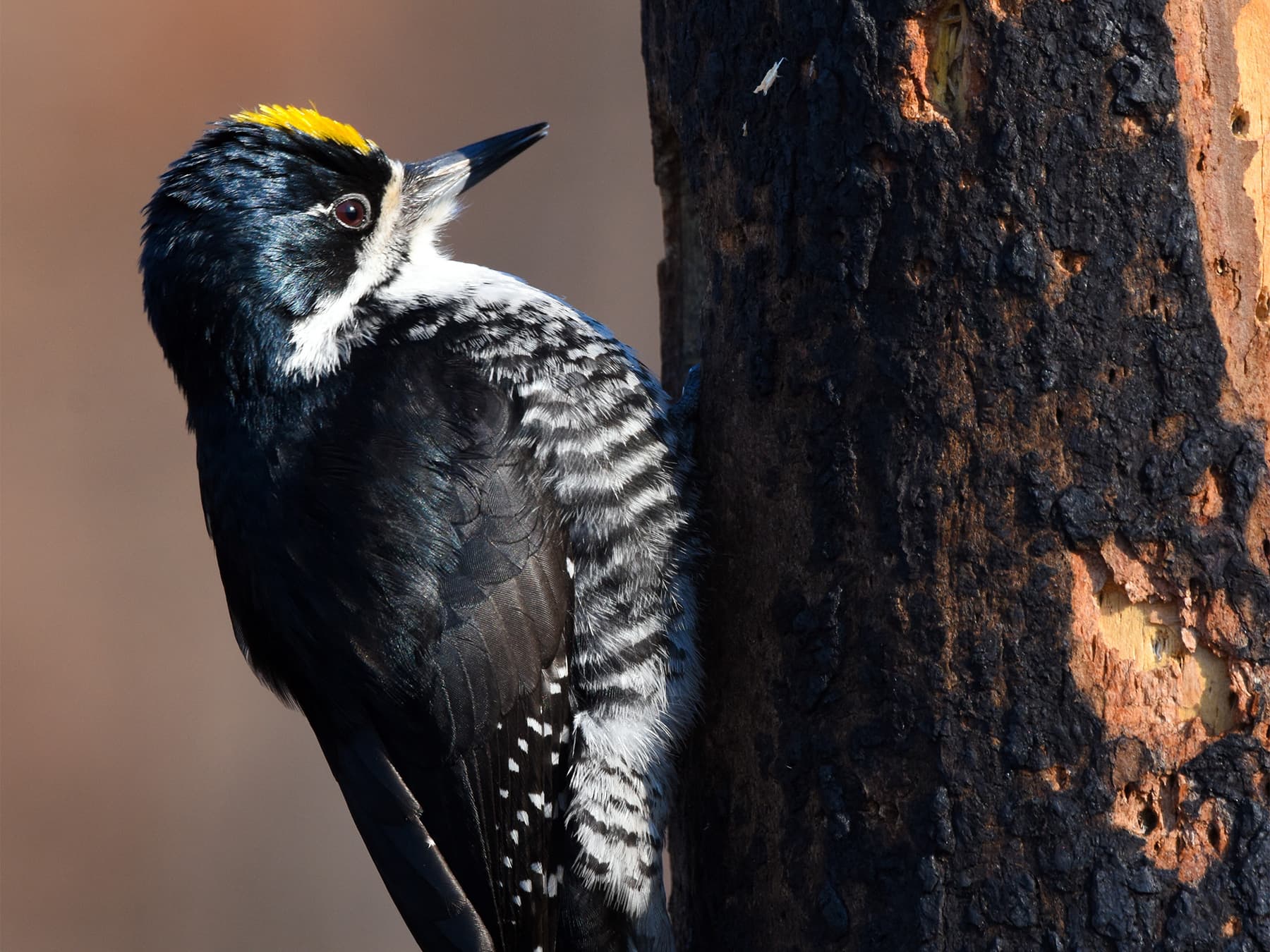
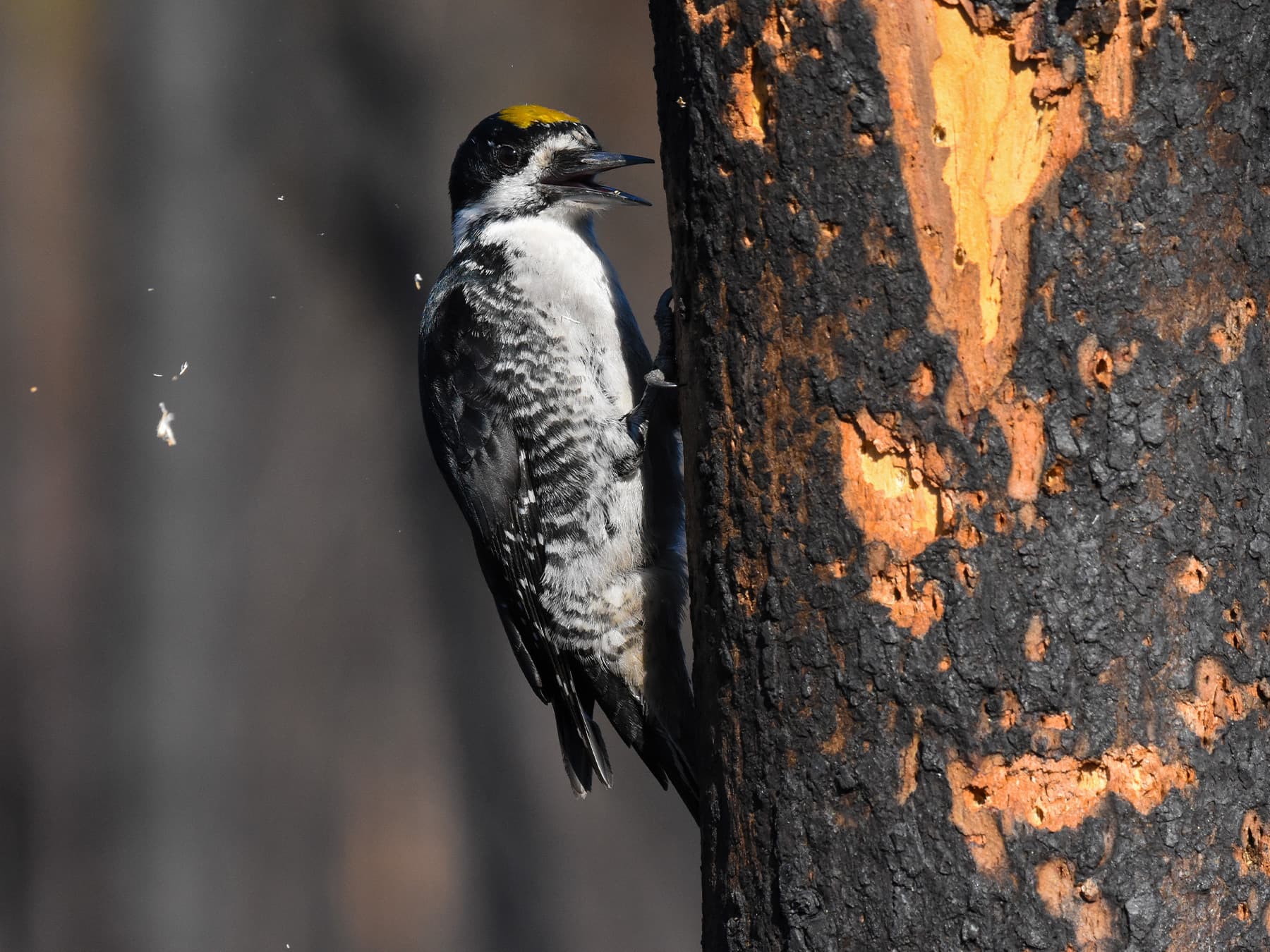
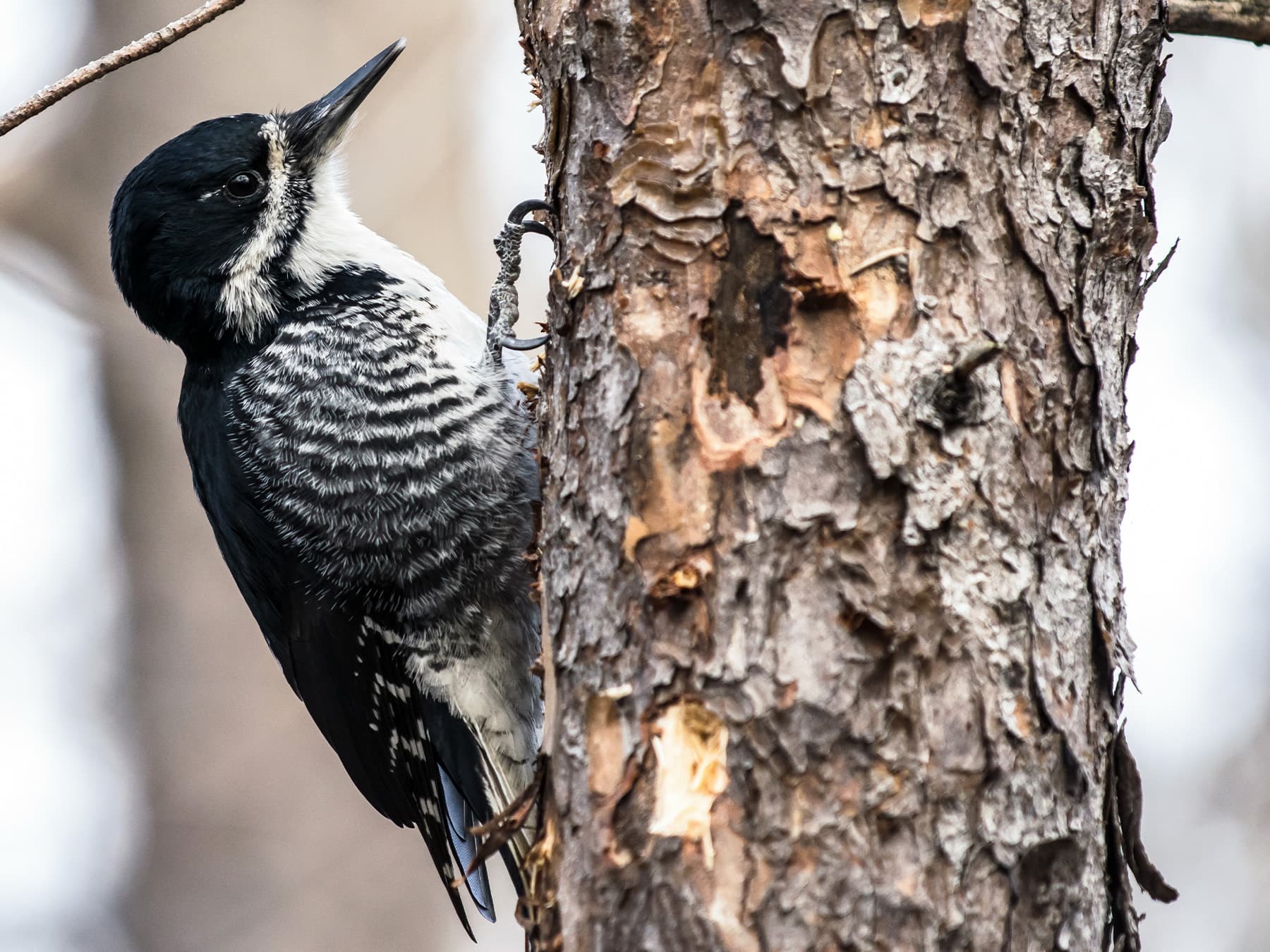
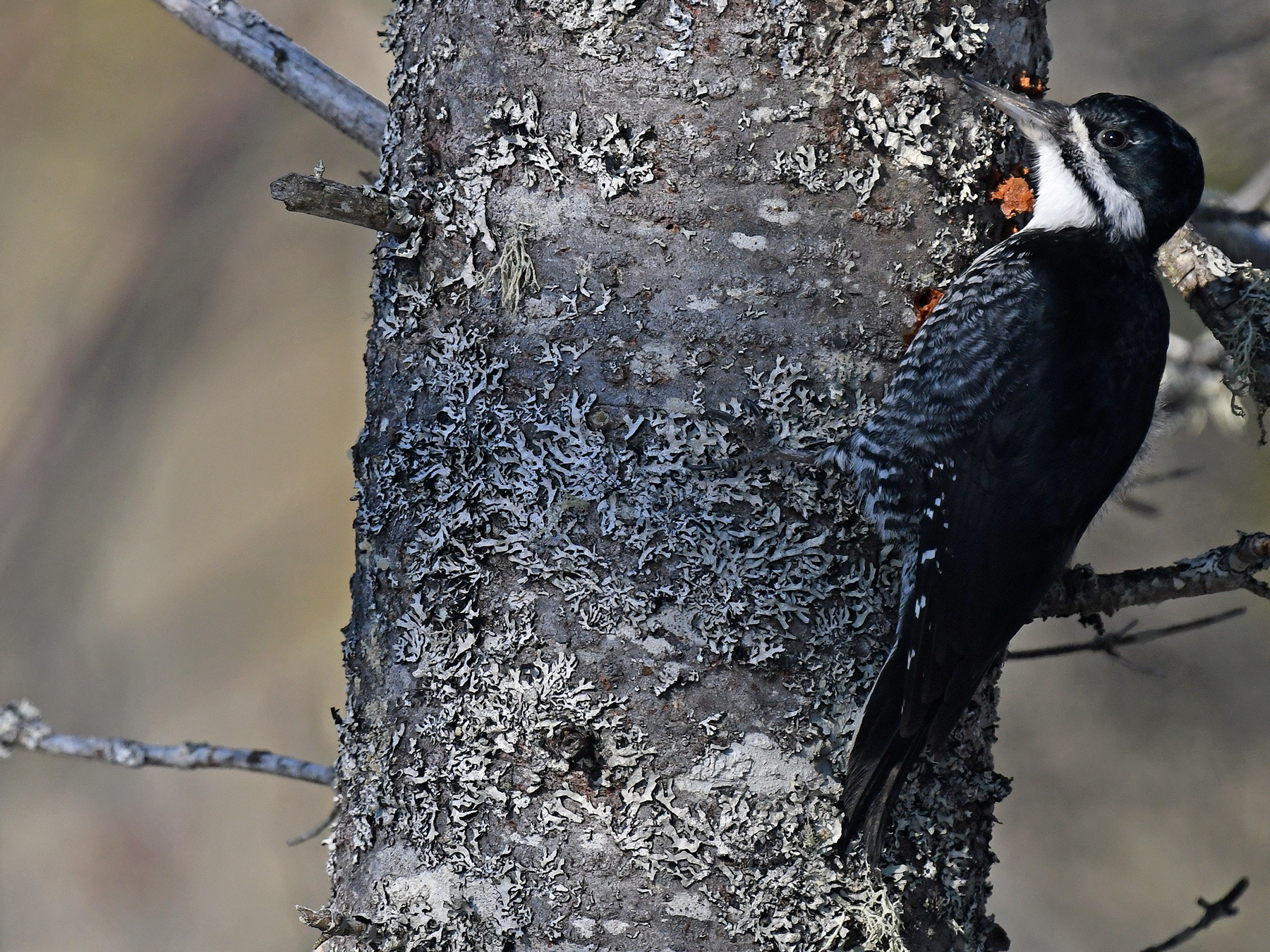
Black-backed woodpeckers do indeed have a black back, but this is not their most remarkable feature. Males have a bright yellow cap, which stands out against their otherwise dark plumage. Facial markings include a bold white stripe across the cheek and a white chin and throat.
The breast and belly are white, with heavy black barring across the flanks and wingtips.
The bill is strong and stout, and slate gray in color. They have three toes on each foot (two facing forwards and one facing backward), and the feet and legs are dark gray. Their eyes are reddish brown.
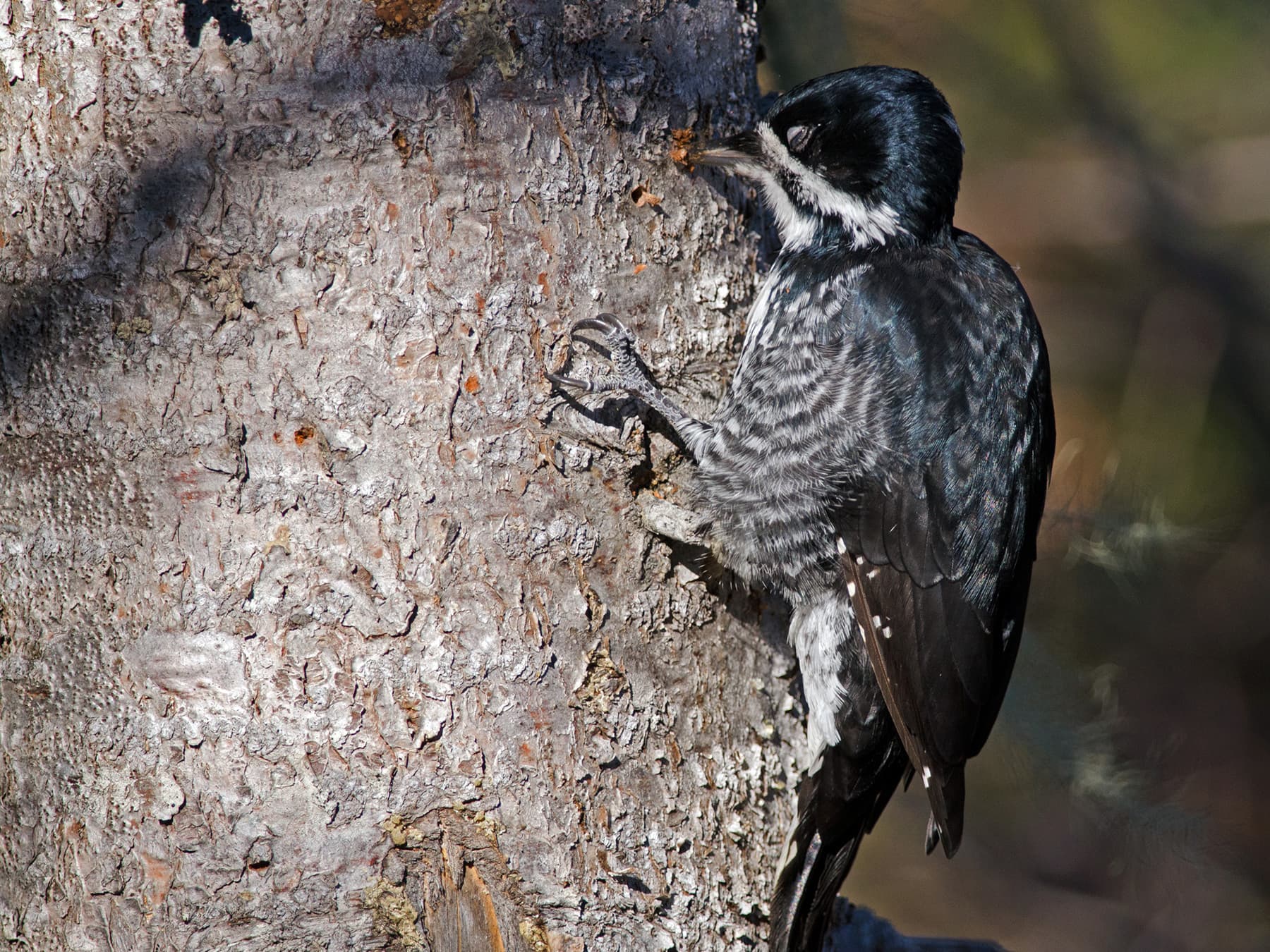
Females lack the yellow crown feathers: their head is solid black, but otherwise, they share the same markings and coloring as males.
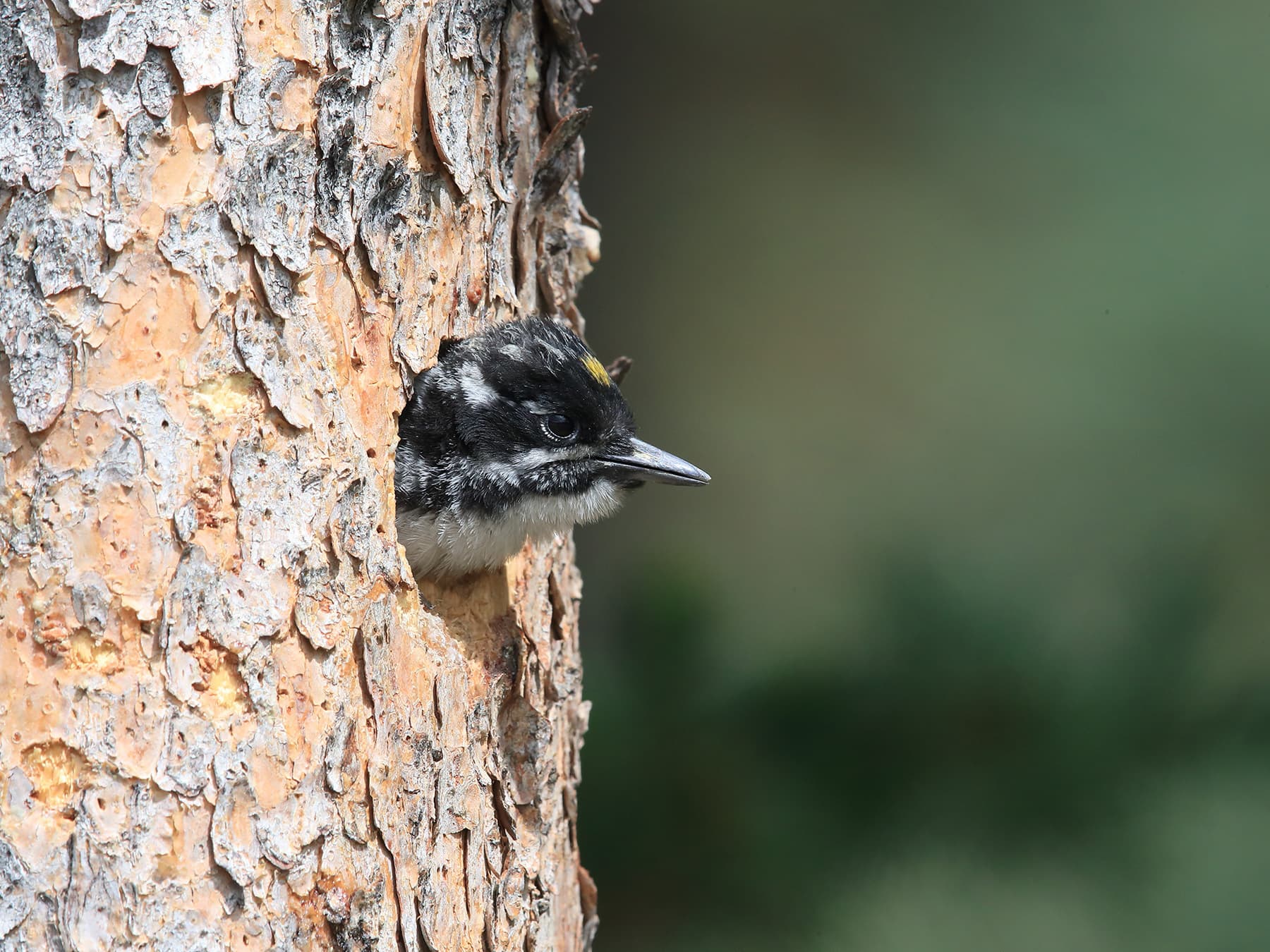
Juvenile black-backed woodpeckers are also similar to adults but have an overall duller plumage, with less vibrant black and a more washed-out whitish buff. Young birds have a blackish cap, with either a barely visible or entirely absent yellow patch.
How big are Black-backed Woodpeckers?
Black-backed woodpeckers are medium-sized members of their family, around the same size as hairy woodpeckers and red-bellied woodpeckers. Females are slightly smaller than males.
- Length: 23 cm (9.1 in)
- Wingspan: 40 cm to 42 cm (15.8 in to 16.5 in)
- Weight: 60 g to 88 g (2.1 oz to 3.1 oz)
Its size
Adults- Length
- 21–24 cm
- Wingspan
- 40–44 cm
- Weight
- 61–88 g
Its song and calls
What sound does a Black-backed Woodpecker make?
A short clicking ‘kyik’ call can be heard all year round, as a contact call and a signal to indicate slight alarm. A distinctive ‘scream-rattle-snarl’ is heard during territorial conflicts, while a shorter rattling sound is made to summon a mate.
- Call0:00 / 0:21
Recorded in St, United States · December 2017
When and where to see it
OctoberIn season
Most recorded in October
- 1. Northwest Territories0.34%
- 2. Alaskaunder 0.1%
- 3. Yukon Territoryunder 0.1%
- 4. Manitobaunder 0.1%
- 5. Newfoundland and Labradorunder 0.1%
Each dot is a county, state or province: the bigger and darker, the larger the bird’s share of that place’s bird records that month. Grey dots: no regular records. The ringed point is the centre of the bird’s records this month; the arrow shows how it moved since last month, and the dashed loop its path through the year. “Arrivals” colours places where it becomes regular this month (orange) or is in its last regular month (grey). GBIF eBird Observation Dataset, 2019–2024. Map data: Natural Earth, US Census Bureau; place centres © OpenStreetMap contributors.
In your area
See when the Black-backed Woodpecker is recorded in your county, state or province.
How often the Black-backed Woodpecker turns up in the United States and Canada through the year, from birdwatchers' records.
United States
Resident · all year · most records in June
Canada
Resident · all year · most records in February
Show as a table
| Month | United States | Canada |
|---|---|---|
| January | 0.003% (regular) | 0.029% (regular) |
| February | 0.005% (regular) | 0.031% (regular) |
| March | 0.001% (regular) | 0.020% (regular) |
| April | <0.001% (regular) | 0.006% (regular) |
| May | 0.002% (regular) | 0.006% (regular) |
| June | 0.010% (regular) | 0.020% (regular) |
| July | 0.007% (regular) | 0.016% (regular) |
| August | 0.005% (regular) | 0.016% (regular) |
| September | 0.004% (regular) | 0.018% (regular) |
| October | 0.003% (regular) | 0.023% (regular) |
| November | 0.002% (regular) | 0.020% (regular) |
| December | 0.001% (regular) | 0.023% (regular) |
Worldwide: recorded regularly in 3 countries
Countries where it was recorded in at least 3 of the 6 years 2019–2024. Linked countries have their own bird list.
North America (3)
Data: EOD – eBird Observation Dataset (Cornell Lab of Ornithology), accessed via GBIF.org, CC BY 4.0. Records from 2019–2024, aggregated and filtered by Birdfact. How these lists are made
What is the habitat of a Black-backed Woodpecker?
Boreal and coniferous forests are the primary natural habitat of black-backed woodpeckers. Important species are spruce, red fir, Douglas fir, mountain hemlock, and ponderosa pine. Black–backed woodpeckers are particularly known for their ability to thrive in areas that have suffered from extensive burning or wildfire damage.
They move into burned forests as they begin to regenerate and feast on the vast numbers of beetles that are present, themselves taking advantage of the newly available supply of decaying wood from dead trees. Such environments can sustain black-backed woodpeckers for around 7 to 8 years before they need to relocate in search of another swathe of charred forest.
What is the range of a Black-backed Woodpecker?
A year-round resident in the northern regions of North America, the geographical distribution range of black-backed woodpeckers covers Canada, Alaska, and the northern United States. The species is present in central Alaska, throughout southern and central Canada, and southwards through the northern US Rockies.
To the north, its northernmost range extends from Alaska eastwards to Newfoundland and Labrador. Largely absent from the west coast, the range spreads through southeastern British Columbia, with scattered populations as far south as central California.
Where do Black-backed Woodpeckers live?
Black-backed woodpeckers play a key role in the ecosystems of forested landscapes recovering after fires. Such natural events are unpredictable and once areas are regenerated, they no longer provide suitable habitats, which means that the species’ population is constantly on the move.
In the United States, the highest concentrations are typically found in regions where forest fires are more common, including the Sierra Nevada and Cascade ranges of California, eastern and central areas of Washington, western and central Montana, and the Cascade Range and eastern Oregon.
How rare are Black-backed Woodpeckers?
Rarely seen in the open, and preferring to remain out of view, black-backed woodpecker sightings are considered a rarity. Their favored habitats of burned forest landscapes are not commonly disturbed by human activity, which explains the lack of extensive observations of behavior and habits.
Where can you see Black-backed Woodpeckers in the US?
States that regularly are affected by forest fires are among the prime locations for black-backed woodpecker sightings, for example in California, Oregon, Washington, Montana, Idaho and Wyoming.
National parks including California’s Yosemite and Lassen Volcanic national parks, Crater Lake National Park in Oregon, Grand Teton National Park in Wyoming, and Mount Rainier National Park in Washington, offer suitable habitats for sightings.
Where can you see Black-backed Woodpeckers in Canada?
Although they are resident in forests across much of southern and central Canada, sightings of black-backed woodpeckers can never be guaranteed, due to the elusive nature of the species.
Forested national parks including Manitoba’s Riding National Park, Kootenay National Park in British Columbia, and Ontario’s Algonquin Provincial Park may offer the best chances of spotting one.
Migration
Do Black-backed Woodpeckers migrate?
No traditional migration occurs for black-backed woodpeckers, although occasional reports of irruptive behavior exist, where large numbers of the species suddenly show up in a spot where they are not normally widespread. This is prompted by the availability of wood-boring beetles.
Where resources run low, new foraging grounds must be found, which is why burned forests prove such a draw.
Are Black-backed Woodpeckers native to the US?
Black-backed woodpeckers are native to North America, and although the larger portion of their population is found across the border throughout southern Canada, parts of the western US do have a strong year-round presence of the species.
Tips for seeing it
- Look for recently burned coniferous forests or areas with beetle infestations
- Listen for their distinctive drumming, which is slower and more irregular than other woodpeckers
- Observe tree trunks for large, rectangular patches of stripped bark, a sign of their foraging activity
- In the US and Canada, focus on boreal forests and higher elevations in western mountains
What it eats
What do Black-backed Woodpeckers eat?
Wood-boring beetle larvae are the chief prey in a black-backed woodpecker’s diet, which they mostly find by stripping off layers of bark with their bills, rather than drilling into the wooden tree trunk itself.
Larvae of engraver beetles, white-spotted sawyer beetles, and mountain pine beetles are also widely eaten, as well as weevils, ants, and spiders. Plant matter, including wild berries and tree nuts, account for just over 10 percent of their diet.
What do Black-backed Woodpecker chicks eat?
Adult and larvae forms of wood-boring beetles and mountain pine beetles are fed to black-backed woodpecker chicks in the nest cavity by both parents. By 13 days post-hatching, prey is brought to the cavity entrance in order to prepare the young for fledging.
Nesting and breeding
Where do Black-backed Woodpeckers nest?
Black-backed woodpeckers excavate their own nest chambers in trunks or limbs of dead or dying trees, in particular pine, spruce, fir, quaking aspen, and paper birch. Cavities may also be drilled out in telegraph poles. Both sexes work to chisel out the hollow, which is then lined with wood chippings.
When do Black-backed Woodpeckers nest?
Nest construction usually begins in April, with May and June the typical months for laying to begin. One single clutch is raised per season, with incubation taking between 12 and 14 days. Males and females share incubation in turn, with males remaining alone in the nest overnight and alternating with females during the day.
What do Black-backed Woodpecker eggs look like?
Black-backed woodpecker eggs are white, unpatterned, and semi-glossy, measuring around 25 mm by 18 mm (0.9 in by 0.8 mm). A typical clutch contains from 2 to 6 eggs, although it’s more common for there to be 3 or 4.
Do Black-backed Woodpeckers mate for life?
A monogamous species, black-backed woodpeckers form long-lasting bonds with a mate and will typically raise young together in successive years.
Behaviour
Are Black-backed Woodpeckers aggressive?
Aggressive interactions occur between rival males early in the breeding season and usually take the form of hostile posturing, crest raising, and physical attacks. Both sexes display confrontational behavior and may attack intruders.
Where do Black-backed Woodpeckers sleep at night?
Males roost in the nest cavity until nestlings are almost ready to fledge. Females roost in cavities elsewhere, and once their role in nesting is complete, males will also seek overnight shelter in another roosting cavity they have excavated themselves.
Lifespan and predators
How long do Black-backed Woodpeckers live?
The average lifespan of a black-backed woodpecker is estimated to be between 6 and 8 years. However, the oldest banded individual identified was recorded to be 4 years and 11 months. The age at first breeding is unknown.
What are the predators of Black-backed Woodpeckers?
Northern goshawks prey on adult black-backed woodpeckers, while eggs are known to be targeted by squirrels, martens, and occasionally black bears.
Are Black-backed Woodpeckers protected?
In Canada, black-backed woodpeckers are protected under the Migratory Birds Convention. Over the border, in the US, the species is included in the Migratory Bird Treaty Act of 1918.
These wildlife laws ensure that black-backed woodpeckers are safe from being killed, injured, captured, or sold for trade, and their eggs, young, and nests are not destroyed or damaged.
Are Black-backed Woodpeckers endangered?
Populations of black-backed woodpeckers are stable, with increases witnessed over the last 40 years. They are classified globally as a species of least concern, and widespread post-fire landscapes have helped to increase their range.
Salvage and logging activities in burned forests is a factor that may influence their future survival, due to their reliance on the scorched vegetation and its associated wealth of insect life.
Conservation
While currently listed as Least Concern, Black-backed Woodpeckers face potential threats from fire suppression practices and salvage logging in post-fire habitats.
Conservation efforts focus on maintaining natural fire regimes and preserving snags in burned areas to ensure suitable foraging and nesting sites.
More photos
2 photos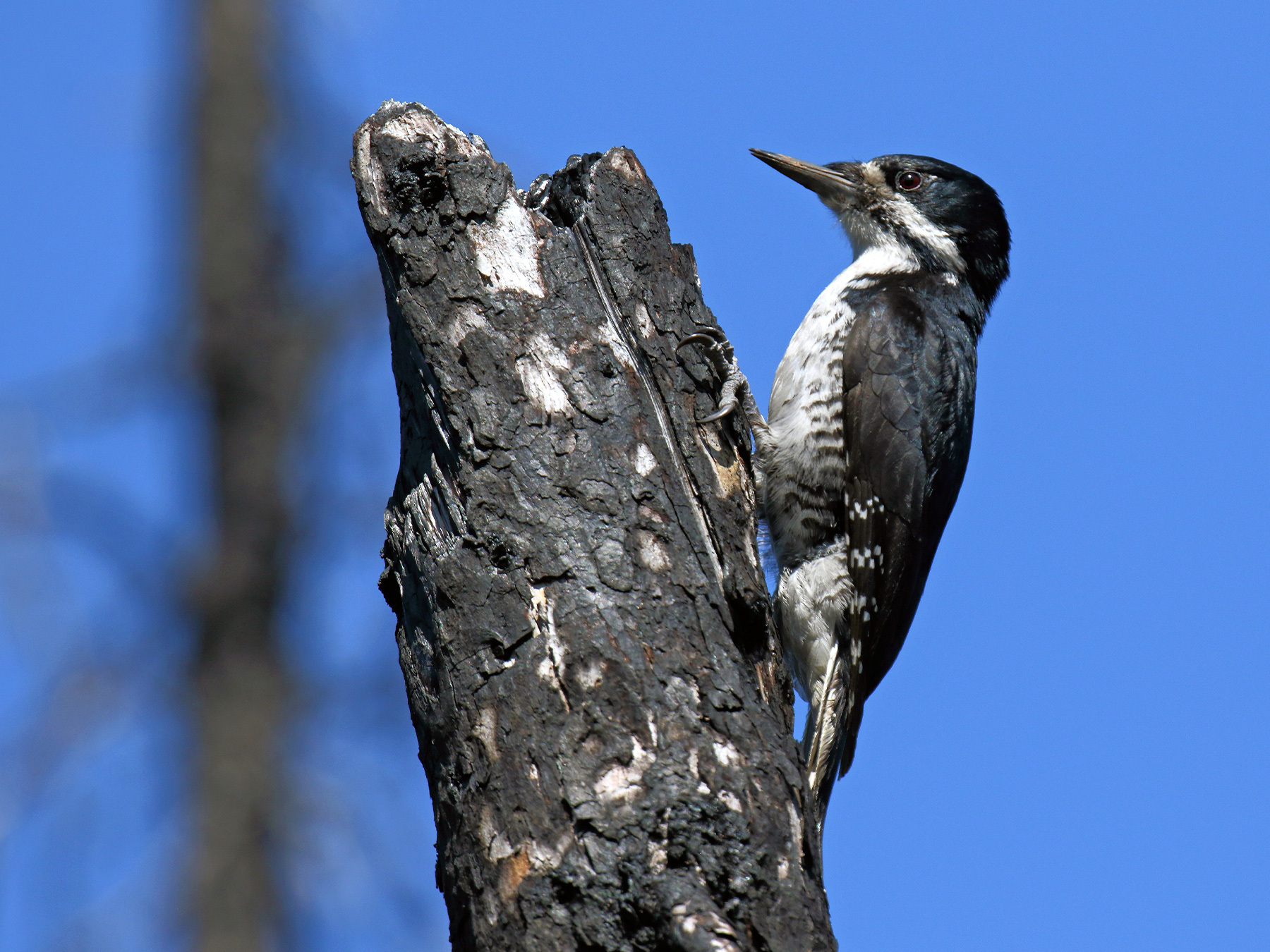
Quick facts
- Length
- 21–24 cm
- Wingspan
- 40–44 cm
- Weight
- 61–88 g
- Lifespan
- 6–8 years
- Family
- Woodpeckers
- Migration
- Resident
- Global status (IUCN)
- Least Concern
- World population
- 1,700,000 mature individuals
- Population trend
- Stable
- Also called
- Arctic Three-toed Woodpecker
- Scientific name
- Picoides arcticus
Questions
5What attracts Black-backed Woodpeckers?
The main prey of black-backed woodpeckers is the larvae of wood-boring beetles, so they thrive in habitats with concentrations of dead or dying trees.
Forested landscapes recovering after extensive fires are closely associated with the species, with black-backed woodpeckers quick to take advantage of the wide availability of insects among the decaying wood.
What trees do Black-backed Woodpeckers prefer?
Coniferous forests are a favorite of black-backed woodpeckers, with a variety of different species used for nesting. These include Douglas-fir, ponderosa pine, lodgepole pine, spruce, fir, and hemlock. Larch, aspen, and cedar may also be chosen.
Do Black-backed Woodpeckers harm trees?
Many of the trees in the most common habitats of black-backed woodpeckers have already sustained significant damage, particularly those that have been burned in wildfires, so their presence and excavation of nesting chambers won’t contribute a significant level of extra harm.
In some cases, the opposite is true, with the arrival of black-headed woodpeckers to areas that have been razed by flames bringing new life and being an important part of the woodland regeneration process.
Do Black-backed Woodpeckers go to bird feeders?
Black-backed woodpeckers do not visit backyard feeders. They are able to meet all of their dietary requirements in the wild, particularly in burned forests and other wooded landscapes ravaged by fire.
How do Black-backed woodpeckers benefit from fires?
In the aftermath of forest fires across the US, it has been noted that black-backed woodpeckers quickly colonize these burned expanses of woodland and thrive in the charred remains of trees.
Trees that are killed or damaged by fire offer an ideal nesting habitat for black-backed woodpeckers to carve out their cavities. Such areas also prove to be a magnet for wood-boring beetles to feast on the decaying trunks and branches of burned trees, which in turn leads to a booming food resource for woodpeckers.
Sources
3- 1BirdLife International. 2016. Picoides arcticus. The IUCN Red List of Threatened Species 2016: e.T22681181A92895828. Source (opens in a new tab)
- 2BirdLife International. 2016. Picoides arcticus. The IUCN Red List of Threatened Species 2016: e.T22681181A92895828. Source (opens in a new tab)
- 3Partners in Flight (2022) Source (opens in a new tab)

Checked by
Nathan Cope, founder and editor
Nathan founded Birdfact and leads its writers and contributors in the UK, the US and Canada. He has watched and studied birds for more than ten years, and checks every article and species guide before it’s published.