



European Bee-eater
Bee-eater, Eurasian Bee Eater · Merops apiaster
By the Birdfact teamChecked by Nathan Cope
On this page11 sections
How to recognise it
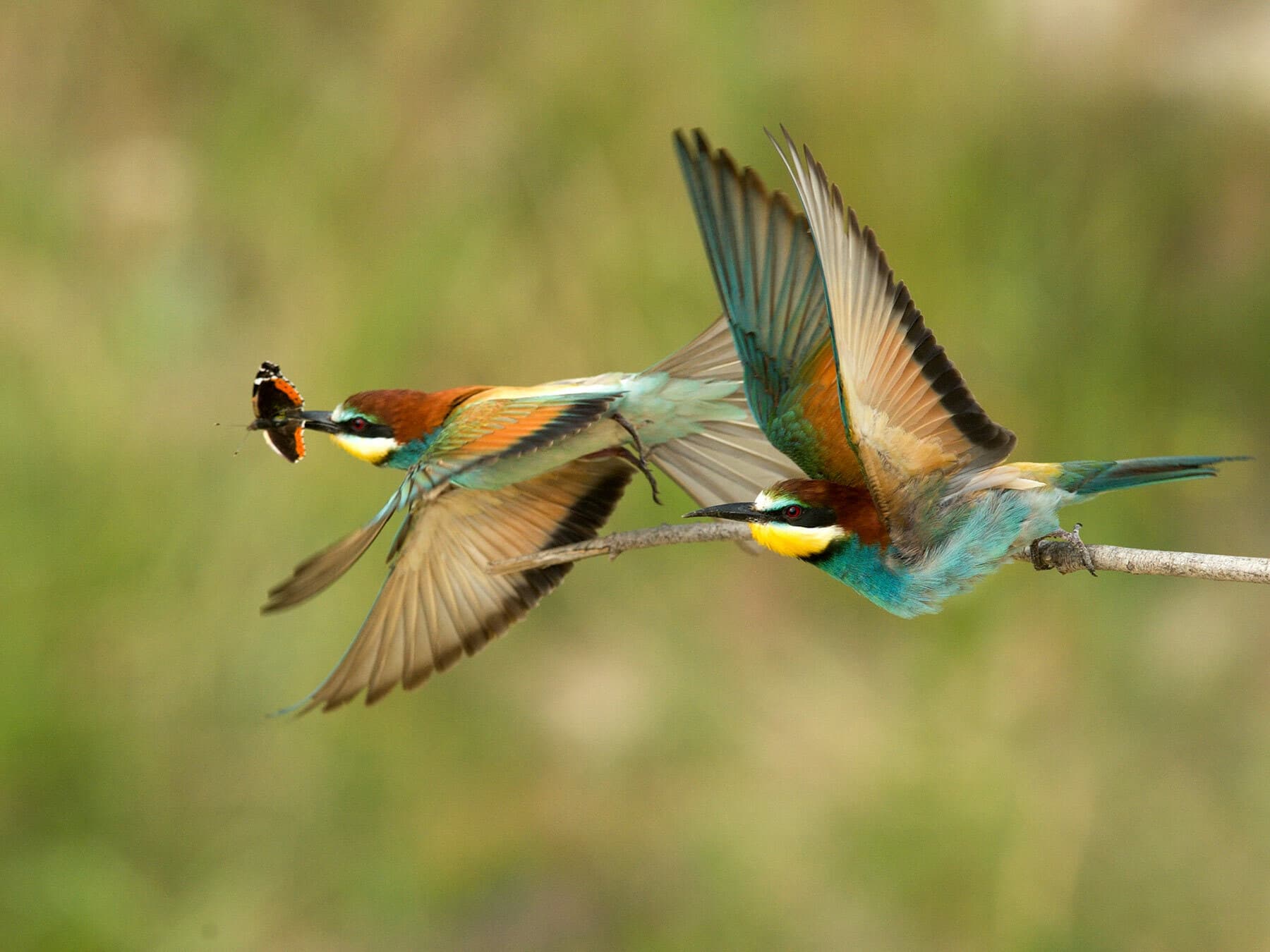
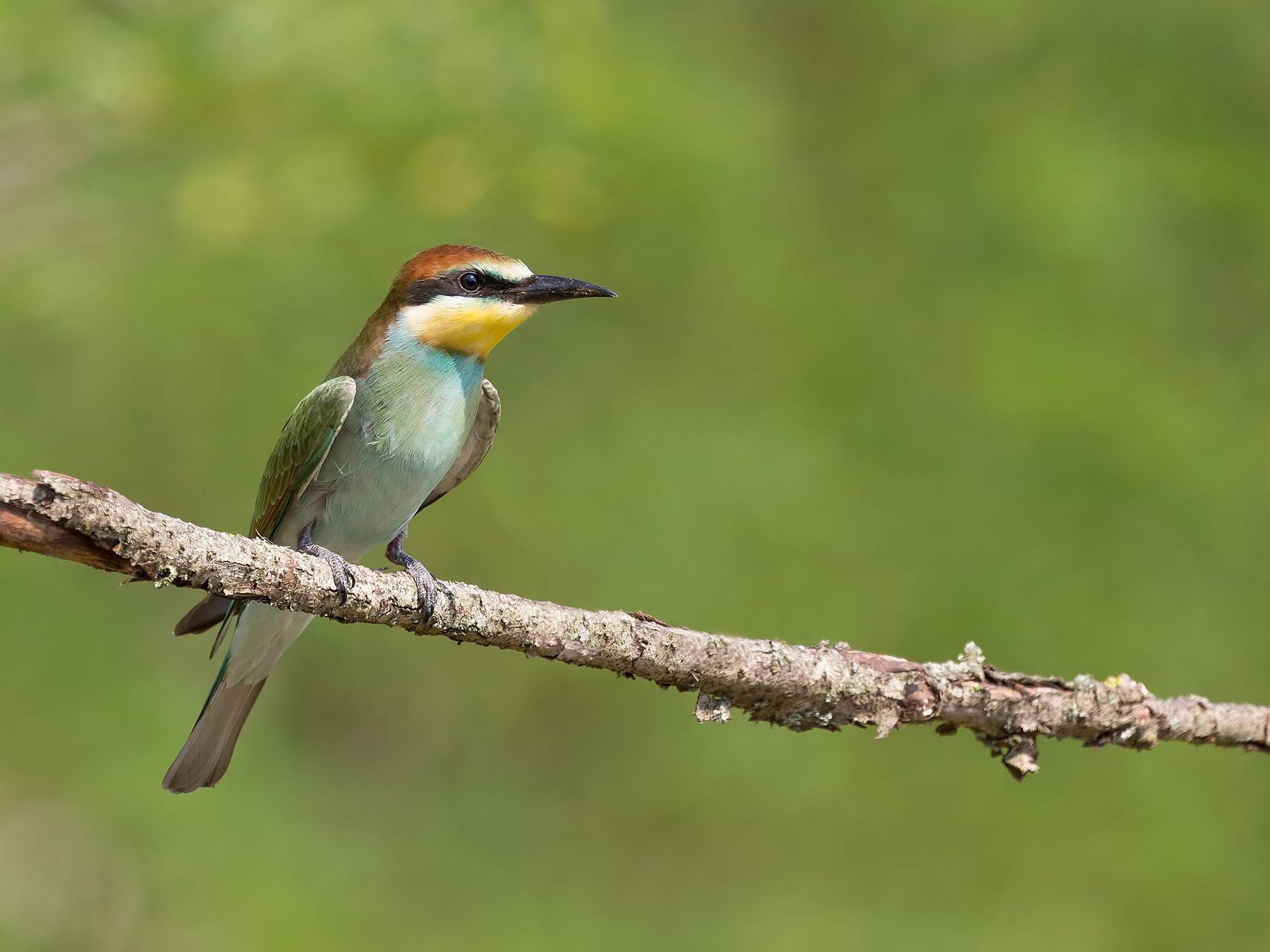
Roughly the same size as a Starling, the European Bee-eater is a strikingly colourful bird with a slender body. Its back and wings are chestnut and gold, contrasting with a turquoise belly and throat. The face is marked with a black eye stripe and yellow cheeks.
Both sexes are similar, though males may have slightly brighter plumage. Juveniles are duller, with a green-tinged back and lack adults' elongated central tail feathers.
Its size
Adults- Length
- 27–29 cm
- Wingspan
- 44–49 cm
- Weight
- 45–80 g
Its song and calls
European bee-eaters are social birds frequently in flocks during flight or roosting whilst uttering a cacophony of deep toned ‘prrroop, prrrooop’ sounds often repeated many times.
- Song0:00 / 0:45
Recorded in Wallis, Switzerland · July 2026
- Call0:00 / 1:49
Recorded in Grand Est, France · August 2024
When and where to see it
OctoberLeaving
Most recorded in October
- 1. Shetland Islandsunder 0.1%
Each dot is a county, state or province: the bigger and darker, the larger the bird’s share of that place’s bird records that month. Grey dots: no regular records. The ringed point is the centre of the bird’s records this month; the arrow shows how it moved since last month, and the dashed loop its path through the year. “Arrivals” colours places where it becomes regular this month (orange) or is in its last regular month (grey). GBIF eBird Observation Dataset, 2019–2024. Map data: Natural Earth, US Census Bureau; place centres © OpenStreetMap contributors.
In your area
See when the European Bee-eater is recorded in your county, state or province.
How often the European Bee-eater turns up in the UK through the year, from birdwatchers' records.
United Kingdom
Passage migrant · regularly Aug–Sep · most records in August
Show as a table
| Month | United Kingdom |
|---|---|
| January | – |
| February | – |
| March | – |
| April | <0.001% |
| May | – |
| June | <0.001% |
| July | <0.001% |
| August | 0.004% (regular) |
| September | 0.002% (regular) |
| October | <0.001% |
| November | – |
| December | – |
Recorded regularly in
Worldwide: recorded regularly in 92 countries
Countries where it was recorded in at least 3 of the 6 years 2019–2024. Linked countries have their own bird list.
Europe (36)
Africa (30)
Asia (26)
- Armenia
- Azerbaijan
- Bahrain
- China
- Cyprus
- Georgia
- India
- Iran
- Iraq
- Israel
- Jordan
- Kazakhstan
- Kuwait
- Kyrgyzstan
- Lebanon
- Mongolia
- Oman
- Pakistan
- Palestinian Territories
- Qatar
- Saudi Arabia
- Sri Lanka
- Tajikistan
- Turkey
- United Arab Emirates
- Uzbekistan
Data: EOD – eBird Observation Dataset (Cornell Lab of Ornithology), accessed via GBIF.org, CC BY 4.0. Records from 2019–2024, aggregated and filtered by Birdfact. How these lists are made
European bee-eaters breed from Portugal and Spain in the west of the continent along the Mediterranean and north African coast and into the Caucasus and the Middle East, migrating south to South Africa during the northern hemisphere winter.

Signs and Spotting tips
Not only distinctive due to its breeding plumage, the adult European bee-eater is also identifiable by its physique and actions. Often seen perched shoulder to shoulder on overhead cables or branches or simply moving in large flocks calling to each other or swooping down to catch flying insects. They inhabit most terrains but prefer broad river valleys, river banks, meadows and olive groves and can often be seen outside their burrows built on the ground or in sandy banks.
What it eats
Roughly the same size as a starling, the adult male European bee-eater’s breeding plumage is distinctive. The head has a brown cap with a yellow forehead and prominent bright yellow throat. There is a broad black eye band starting at the base of the long pointed bill and extending above and below the eye almost to the nape of the neck. The eyes are a medium red. A thinner black band separates the base of the throat from the top of the breast which is a greenish blue extending along the underparts as far as the long tail. The tail has a central spike caused by two elongated feathers which is prominent during flight and at rest. The underwing area is a copper colour mixed with translucent silver and a black tipped trailing edge. Scapulars and rump are a greyish yellow in colour and the upper wing marginal, lesser, median and greater coverts are mid brown. The rest of the wing, including the primary coverts are green as is the tail. The trailing edge of the upper wing is tipped with a dark almost black hue. The female is similar to the male although the scapulars and back are greener and the throat and breast colouration paler than the male. In eclipse plumage, outside of the breeding season, the central spike to the tail is absent and the bird’s back is more of a greeny blue and altogether more dull overall. Juveniles are mainly coloured green in the areas normally brown in their parents and generally paler all over.

What does a European Bee-eater eat?
Bee-eaters are insectivorous and as well as feeding off bees also take many other insects including wasps, dragon flies and locusts. They tend to catch their food on the wing by swooping down from above and grasping their prey in their strong slim bills which they then take back to their perch. Prior to consuming bees and wasps in particular the bee-eater strikes or rubs its prey against a branch in order to remove the insects sting before consumption.

How long do European Bee-eaters live for?
The average life expectancy for a European bee-eater is between five to ten years.
Nesting and breeding
Burrowing into soft sandy banks or cliff top soil they build their nest with their lifelong partner sometimes with the assistance of one of their juvenile offspring. Dependent upon location, females will lay one brood annually of between 4 – 10 eggs from April through to July in the northern hemisphere or October to November in South Africa. Incubation takes up to twenty days with both parents taking turns in one hour shifts throughout the day and the female only at night. Fledging occurs approximately one month from hatching.
Behaviour
European Bee-eaters are highly social, often seen perching in groups on wires or bare branches. When hunting, they perform acrobatic aerial displays, catching insects mid-flight with remarkable agility. During courtship, males offer females insects as gifts, strengthening pair bonds.
Conservation
While currently listed as Least Concern, European Bee-eaters face threats from habitat loss and pesticide use. Climate change may affect their migration patterns and breeding success. Conservation efforts focus on protecting breeding sites and reducing pesticide use in their habitats.
More photos
2 photos
Quick facts
- Length
- 27–29 cm
- Wingspan
- 44–49 cm
- Weight
- 45–80 g
- Lifespan
- 5–7 years
- Family
- Bee-eaters
- Migration
- Long-distance Migrant
- Global status (IUCN)
- Least Concern
- World population
- 14,000,000 - 25,250,000 mature individuals
- Population trend
- Stable
- Also called
- Bee-eater, Eurasian Bee Eater
- Scientific name
- Merops apiaster
Sources
3- 1BirdLife International. 2019. Merops apiaster (amended version of 2016 assessment). The IUCN Red List of Threatened Species 2019: e.T22683756A155512816. Source (opens in a new tab)
- 2BirdLife International. 2019. Merops apiaster (amended version of 2016 assessment). The IUCN Red List of Threatened Species 2019: e.T22683756A155512816. Source (opens in a new tab)
- 3BirdLife International. 2019. Merops apiaster (amended version of 2016 assessment). The IUCN Red List of Threatened Species 2019: e.T22683756A155512816. Source (opens in a new tab)

Checked by
Nathan Cope, founder and editor
Nathan founded Birdfact and leads its writers and contributors in the UK, the US and Canada. He has watched and studied birds for more than ten years, and checks every article and species guide before it’s published.