


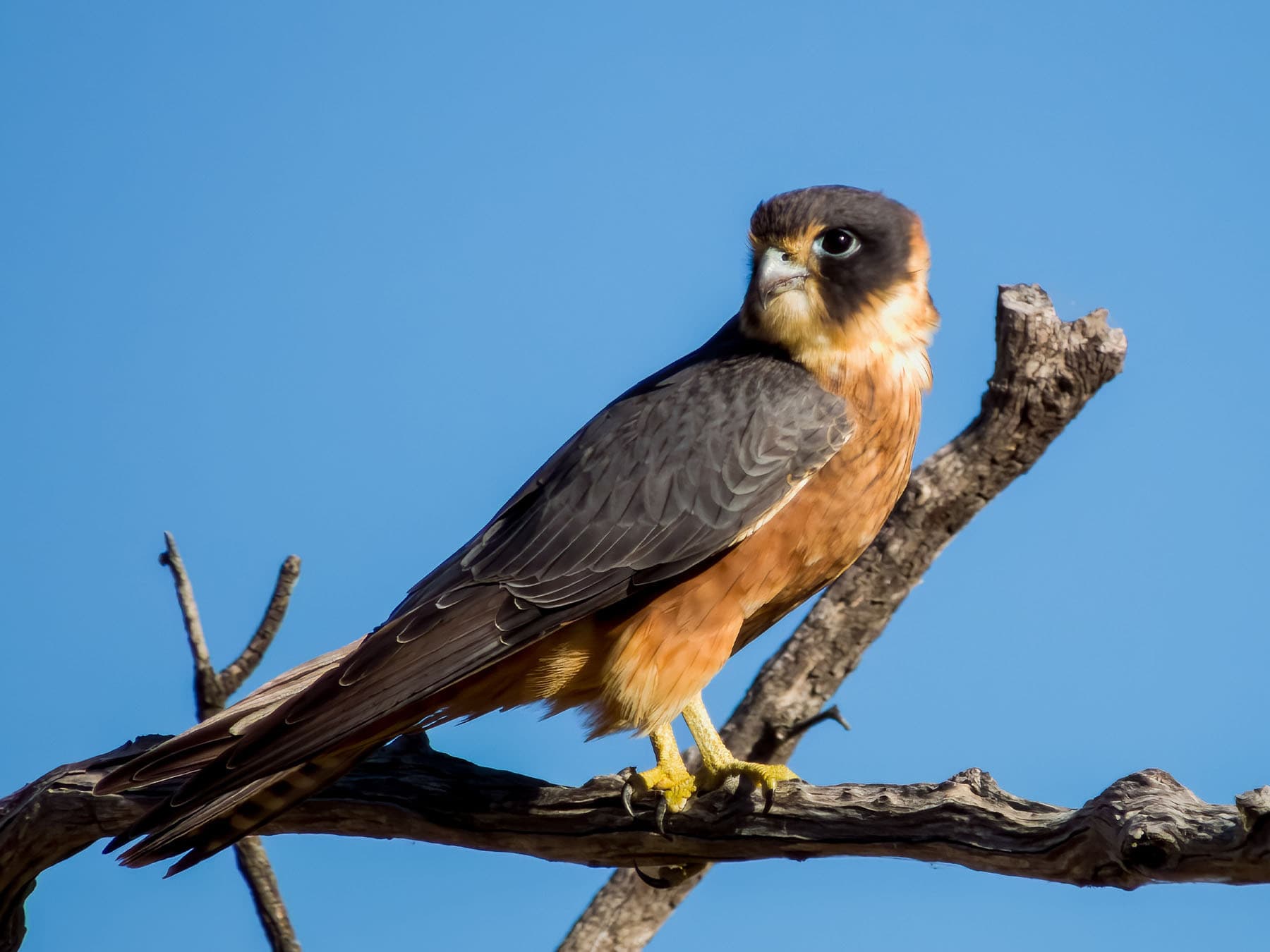
Australian Hobby
Little Falcon · Falco longipennis
By the Birdfact teamChecked by Nathan Cope
On this page11 sections
How to recognise it
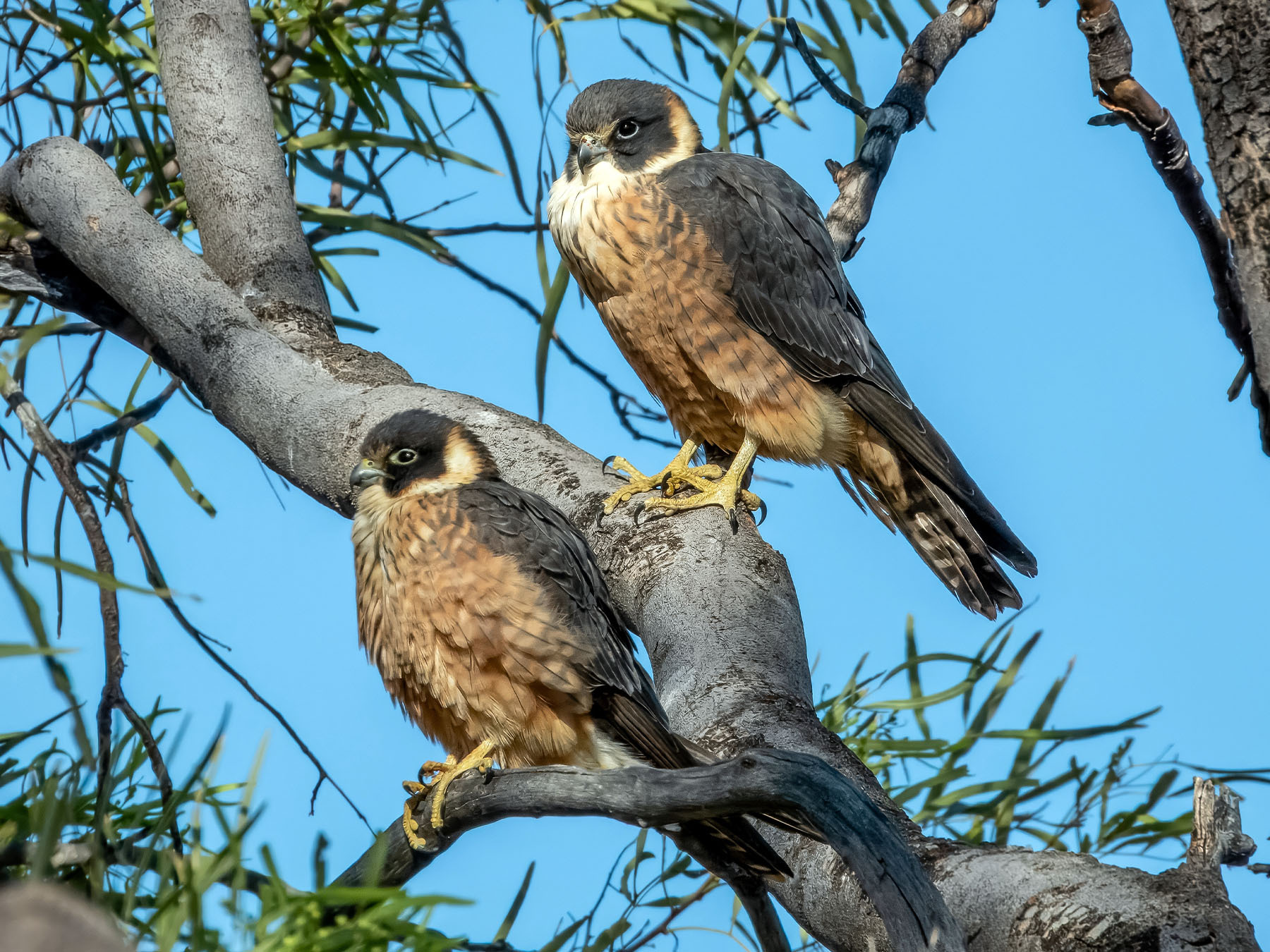
The Australian Hobby is a sleek, medium-sized falcon with a streamlined body and pointed wings. Its upperparts are dark slate-grey to blackish-brown, contrasting with a pale, streaked underside. The distinctive black 'moustache' marks and reddish-brown thighs are key identifying features.
Females are slightly larger and darker than males. Juveniles have a browner plumage with buff edges to their feathers, giving them a scaly appearance. The cere and eye-ring are blue-grey in adults, turning yellow as the bird matures.
Its size
Adults- Length
- 30–35 cm
- Wingspan
- 70–84 cm
- Weight
- 190–350 g
Its song and calls
The Australian Hobby has a distinctive, high-pitched call often described as a rapid 'kee-kee-kee' or 'kik-kik-kik'.
During the breeding season, pairs engage in noisy aerial displays, exchanging sharp, chattering calls. When alarmed or defending territory, they emit a loud, piercing 'kek-kek-kek'.
When and where to see it
The Australian Hobby is not recorded regularly in the UK, Ireland, the United States or Canada.
Worldwide: recorded regularly in 3 countries
Countries where it was recorded in at least 3 of the 6 years 2019–2024. Linked countries have their own bird list.
Asia (1)
- Indonesia
Oceania (2)
Data: EOD – eBird Observation Dataset (Cornell Lab of Ornithology), accessed via GBIF.org, CC BY 4.0. Records from 2019–2024, aggregated and filtered by Birdfact. How these lists are made
Tips for seeing it
- Look for Australian Hobbies perched on exposed branches or power lines
- Observe their distinctive rapid wing beats and agile flight patterns
- Listen for their sharp, chattering calls, especially during breeding season
- Watch for their hunting behaviour near open areas at dawn and dusk
What it eats
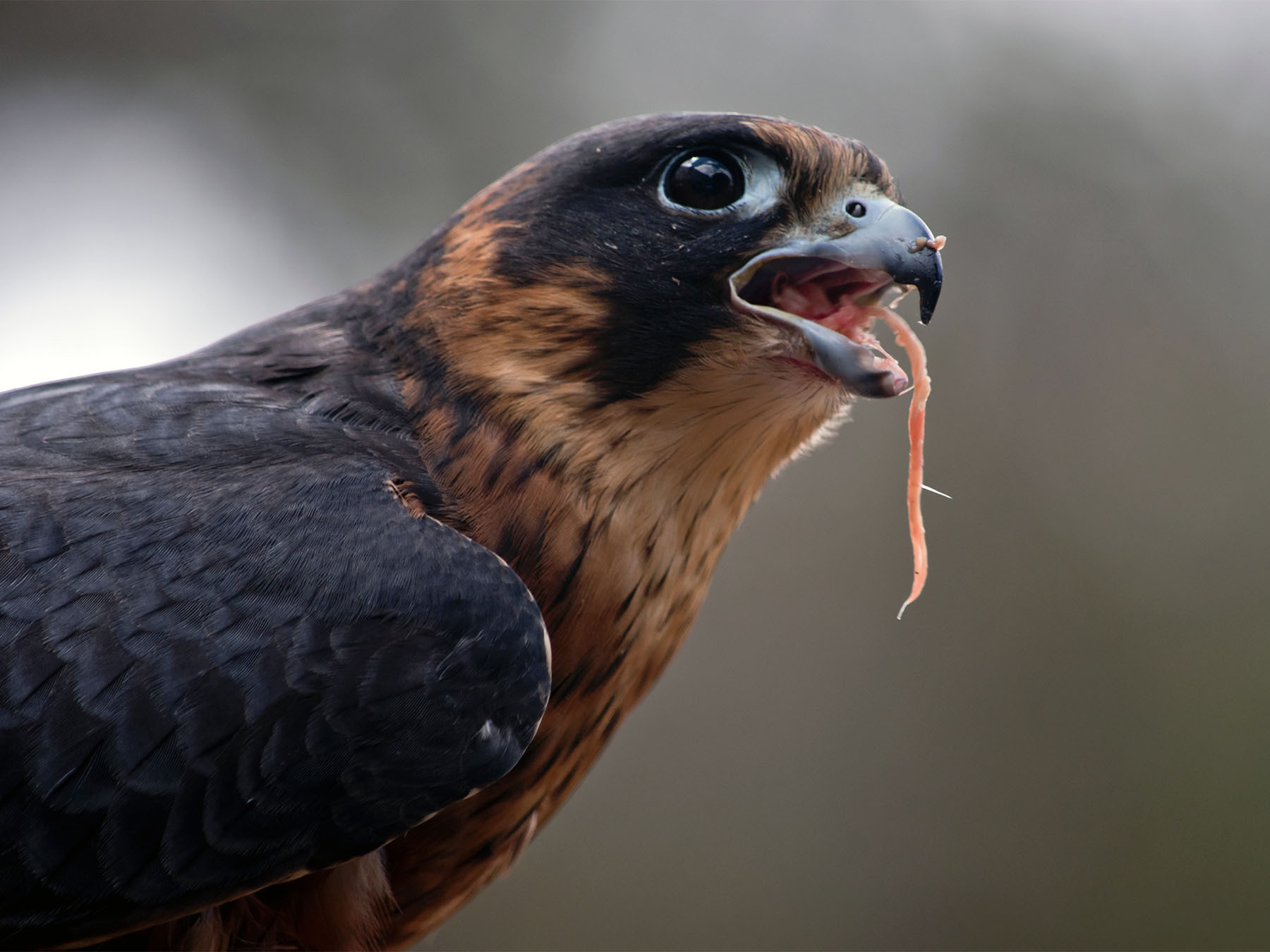
Australian Hobbies primarily feed on small to medium-sized birds, often targeting introduced species like House Sparrows and Starlings.
They also prey on large insects, particularly moths and beetles, which they may catch and eat on the wing. Bats are occasionally hunted during twilight hours.
Nesting and breeding
Breeding occurs from August to January in southern Australia and earlier in northern regions. Australian Hobbies form monogamous pairs and often reuse the same nesting site year after year.
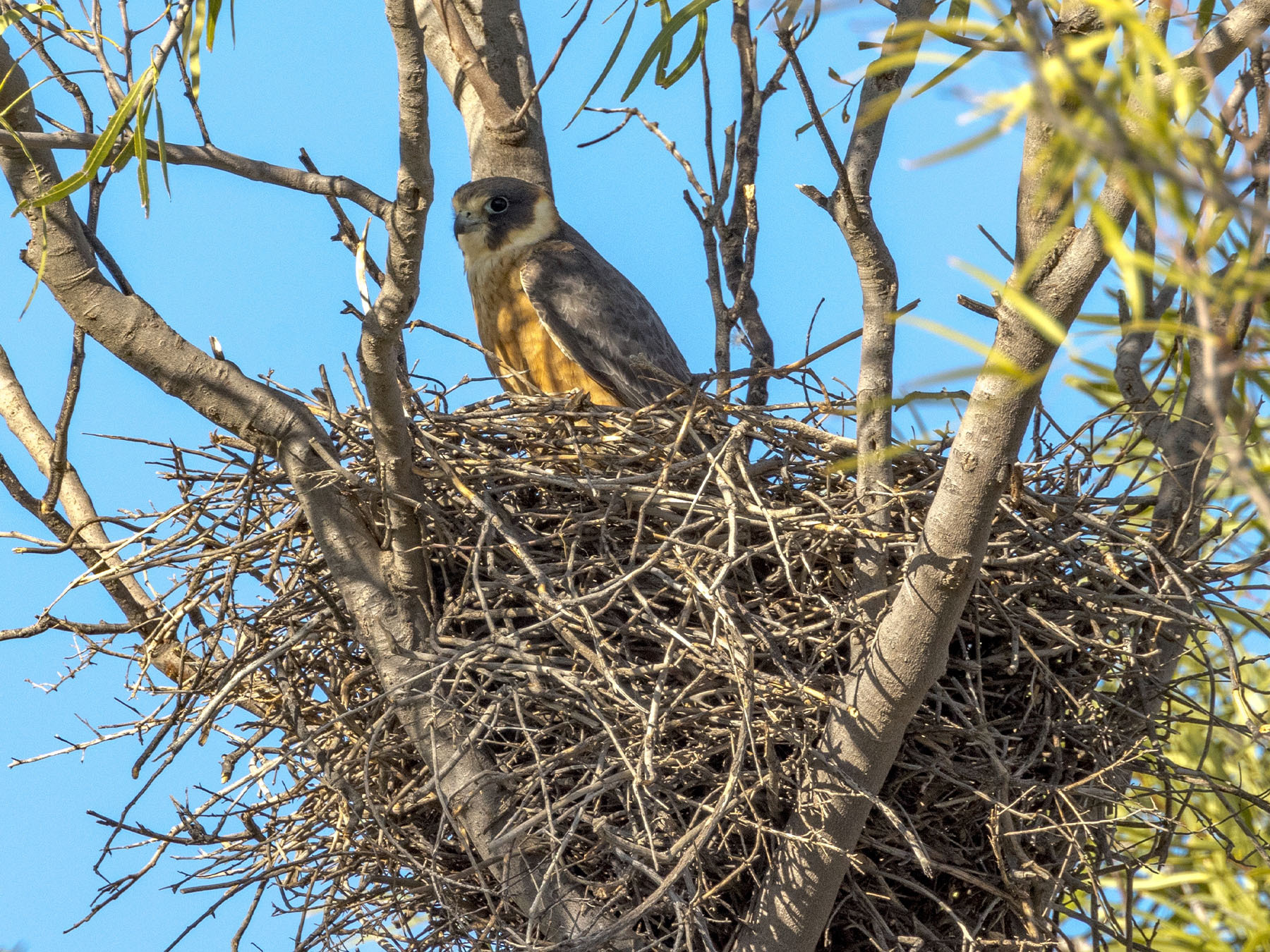
They do not build their own nests but instead take over old nests of other birds, particularly those of crows or ravens. The female typically lays 2-4 eggs, which are pale buff in colour with reddish-brown spots.
Incubation lasts about 35 days, primarily by the female, while the male provides food. Chicks fledge after 35-42 days but remain dependent on their parents for several weeks.
Behaviour
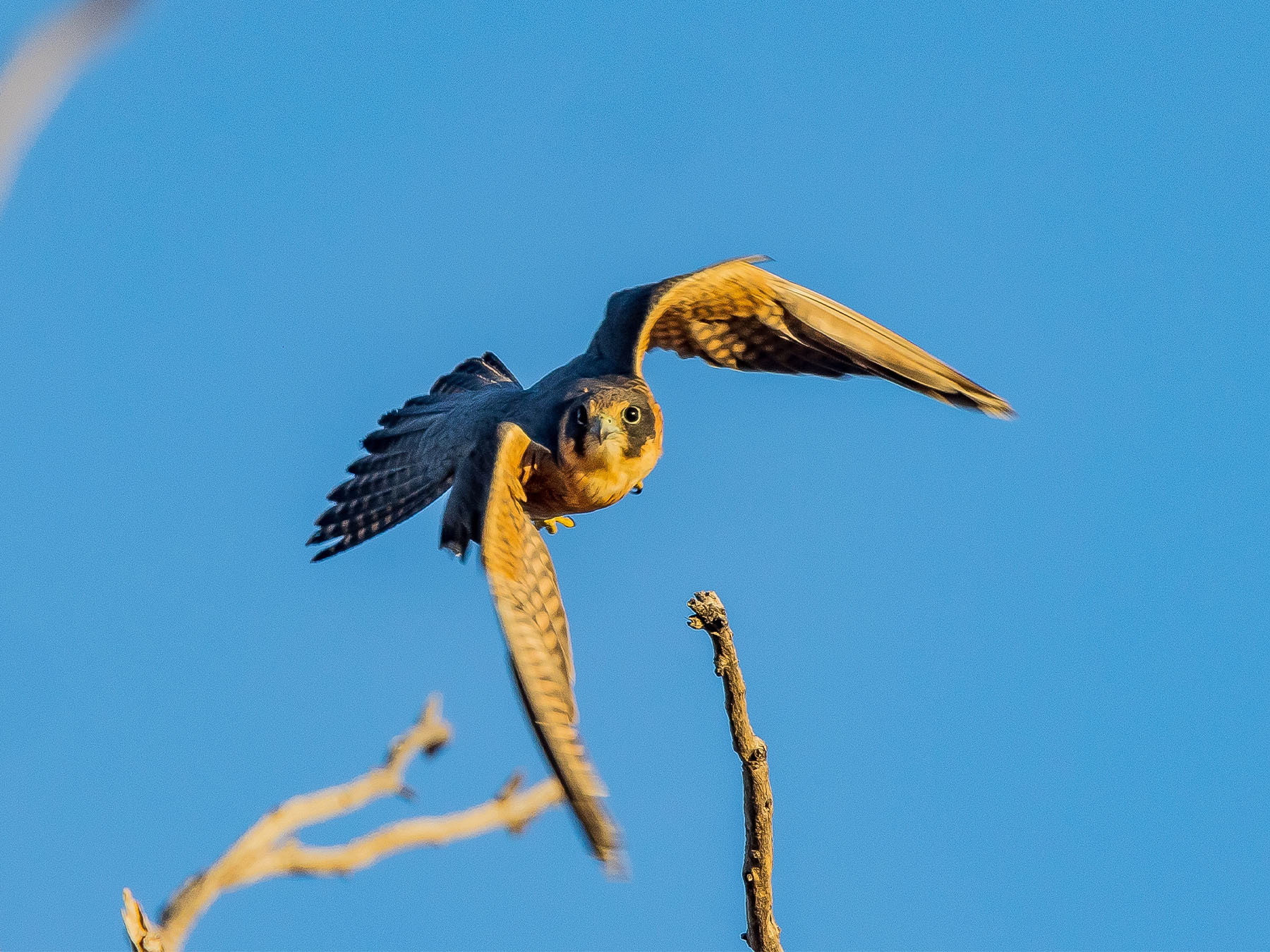
Australian Hobbies are swift and agile flyers, often seen pursuing prey in high-speed aerial chases. They frequently hunt at dawn and dusk, taking advantage of low light conditions.
These falcons are generally solitary but may form loose pairs during the breeding season, engaging in spectacular aerial displays and vocalisations.
Conservation
The Australian Hobby is currently listed as Least Concern by the IUCN. While its population appears stable, the species faces threats from habitat loss due to urbanisation and agricultural intensification.
Conservation efforts focus on preserving woodland habitats and maintaining suitable nesting sites in urban areas.
More photos
5 photos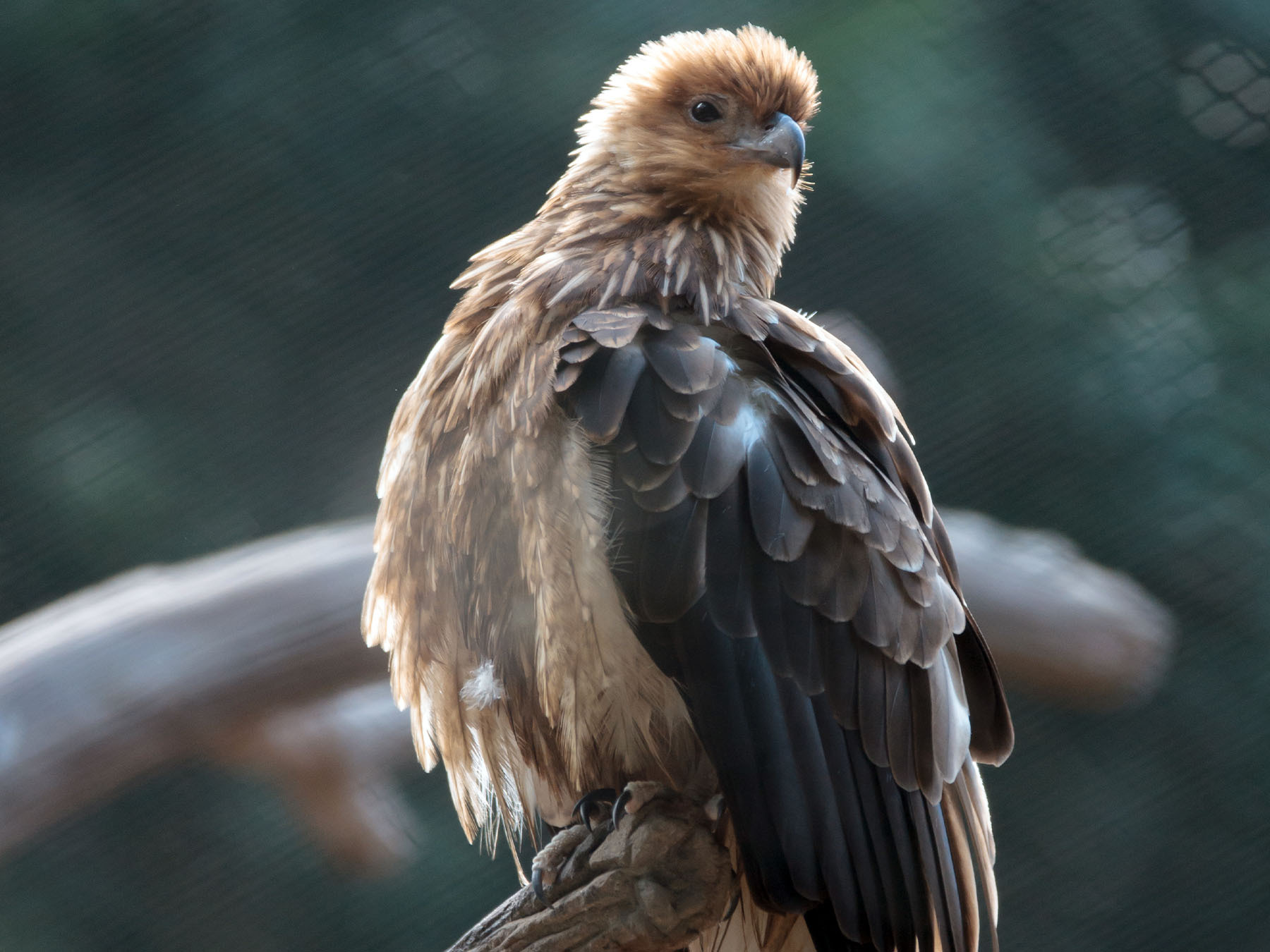
Quick facts
- Length
- 30–35 cm
- Wingspan
- 70–84 cm
- Weight
- 190–350 g
- Lifespan
- 7–10 years · oldest recorded 10.2 years
- Family
- Falcons
- Migration
- Partial migrant
- Global status (IUCN)
- Least Concern
- World population
- Not quantified
- Population trend
- Increasing
- Also called
- Little Falcon
- Scientific name
- Falco longipennis
Sources
3- 1BirdLife International. 2016. Falco longipennis. The IUCN Red List of Threatened Species 2016: e.T22696473A93566304. Source (opens in a new tab)
- 2Ferguson-Lees and Christie (2001)
- 3ABBBS - Australian Bird and Bat Banding Scheme Source (opens in a new tab)

Checked by
Nathan Cope, founder and editor
Nathan founded Birdfact and leads its writers and contributors in the UK, the US and Canada. He has watched and studied birds for more than ten years, and checks every article and species guide before it’s published.