


Australian Bustard
Plains Turkey, Bush Turkey · Ardeotis australis
By the Birdfact teamChecked by Nathan Cope
On this page14 sections
How to recognise it
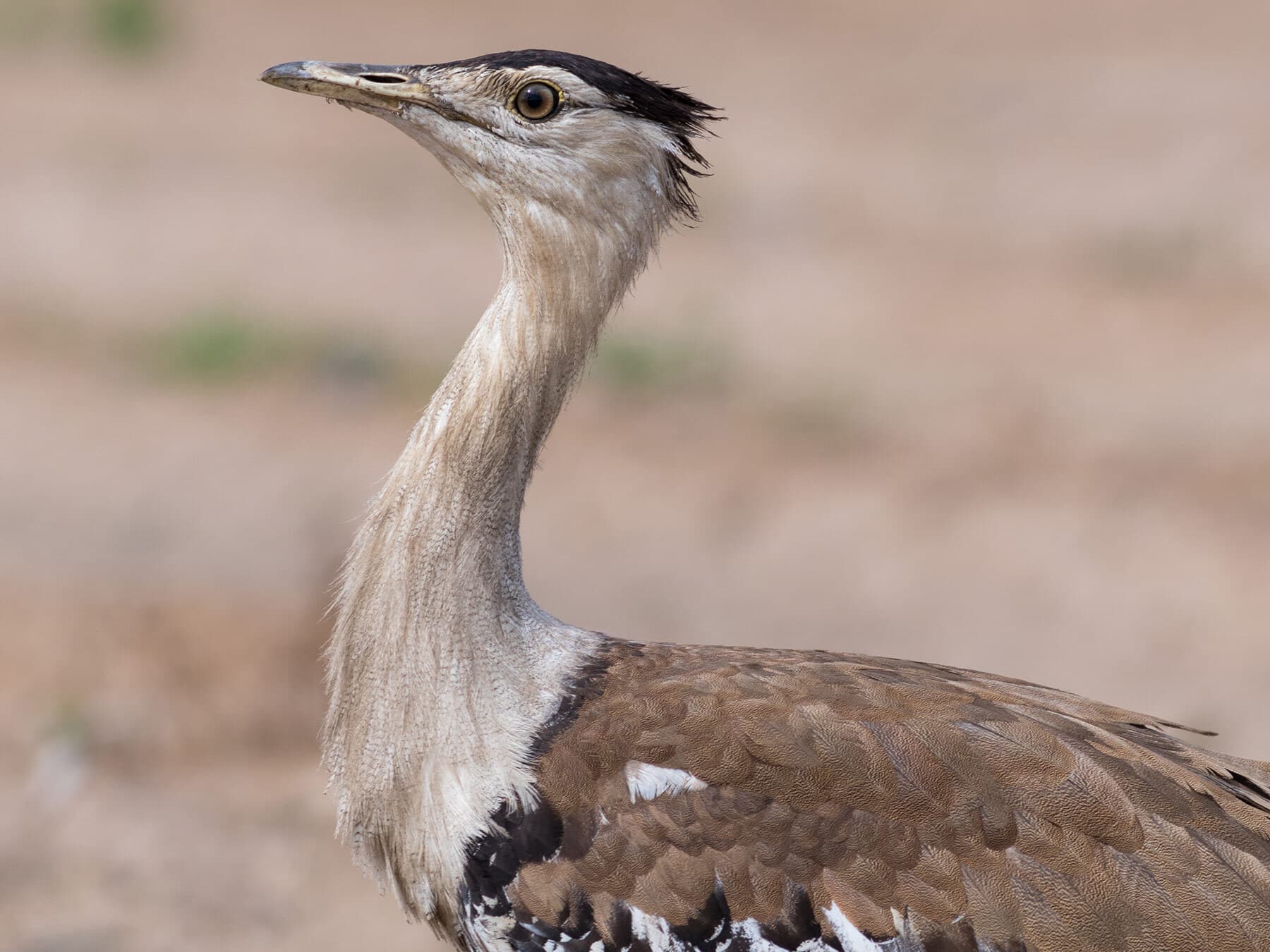
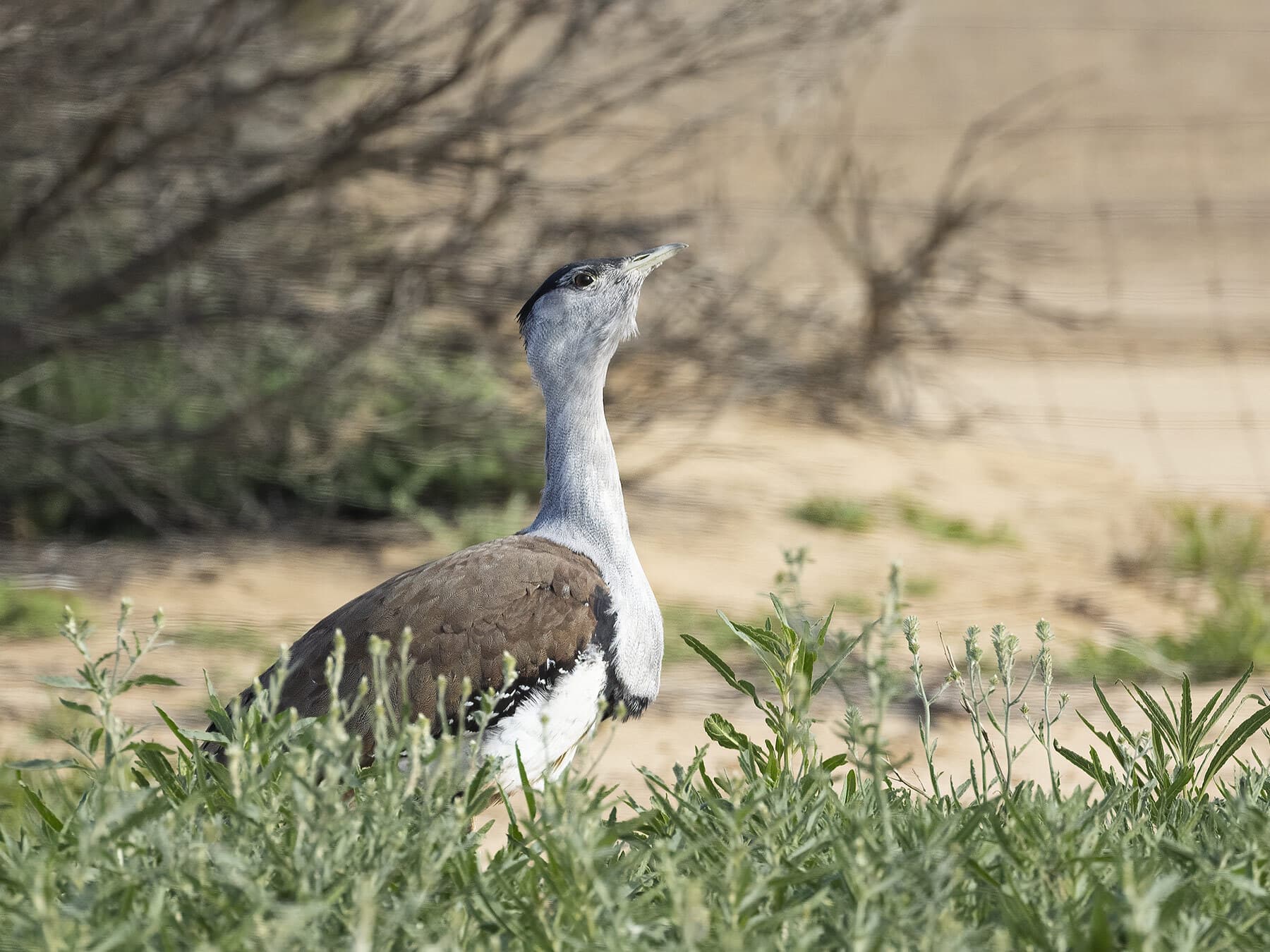
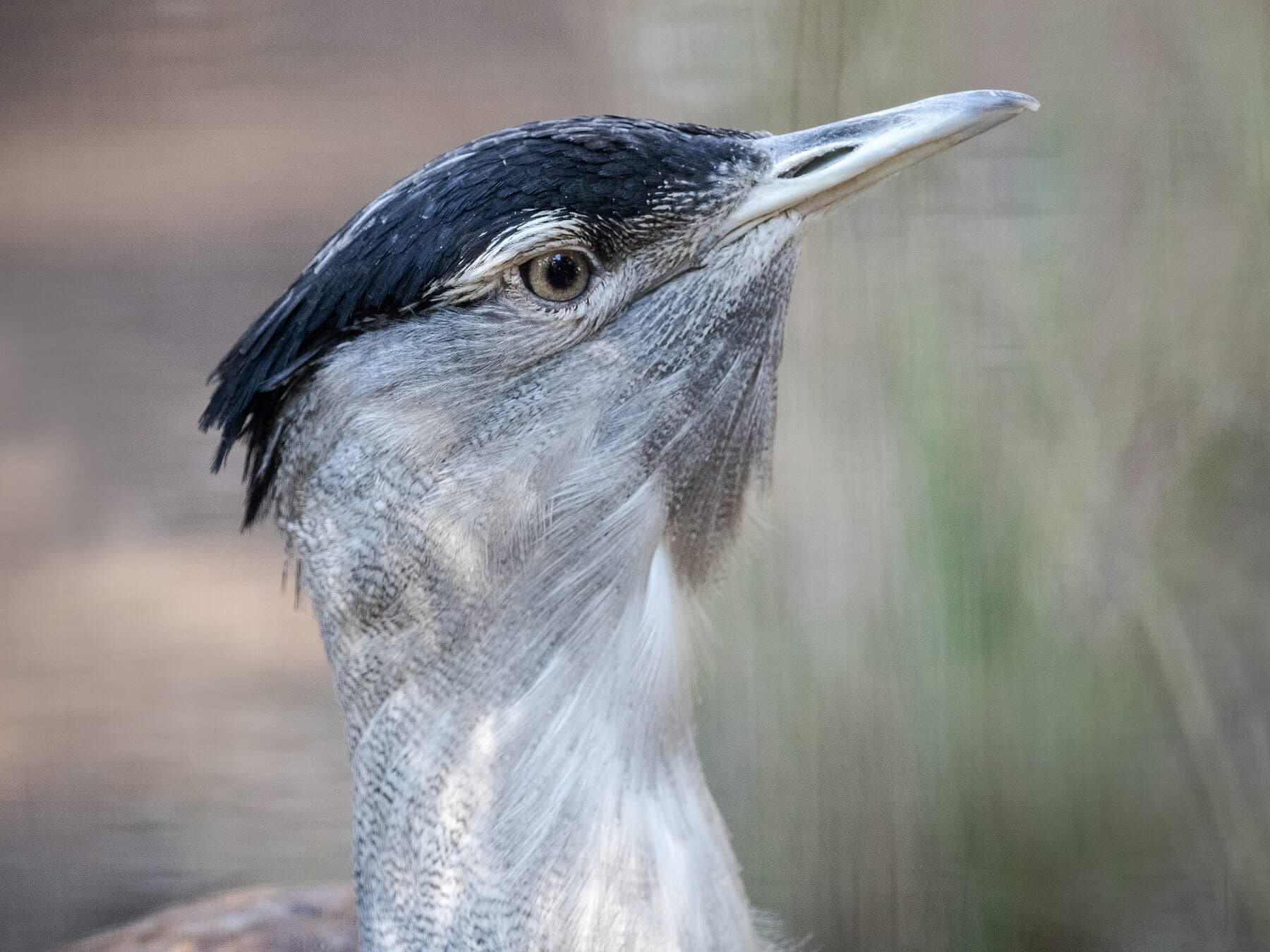
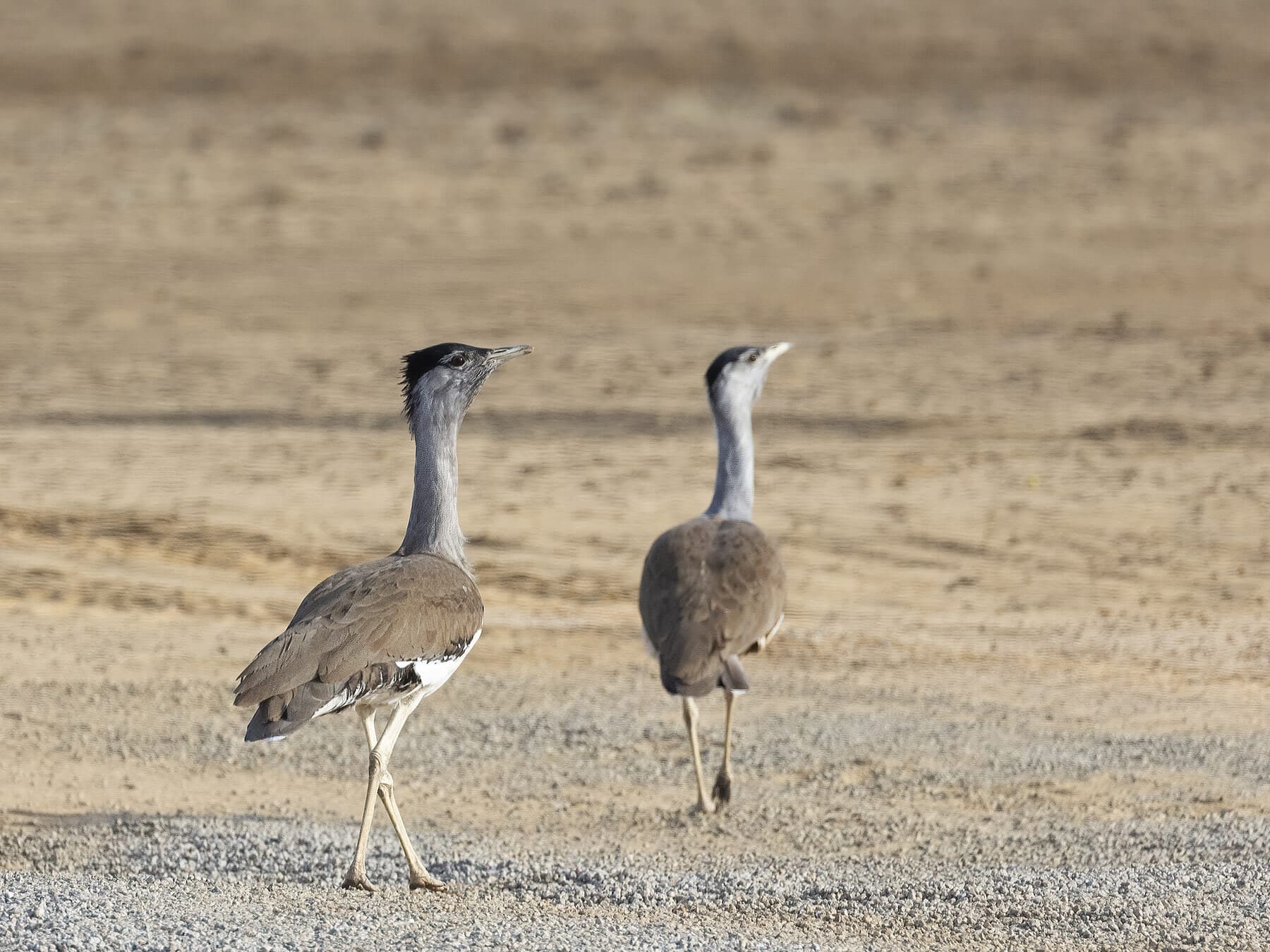
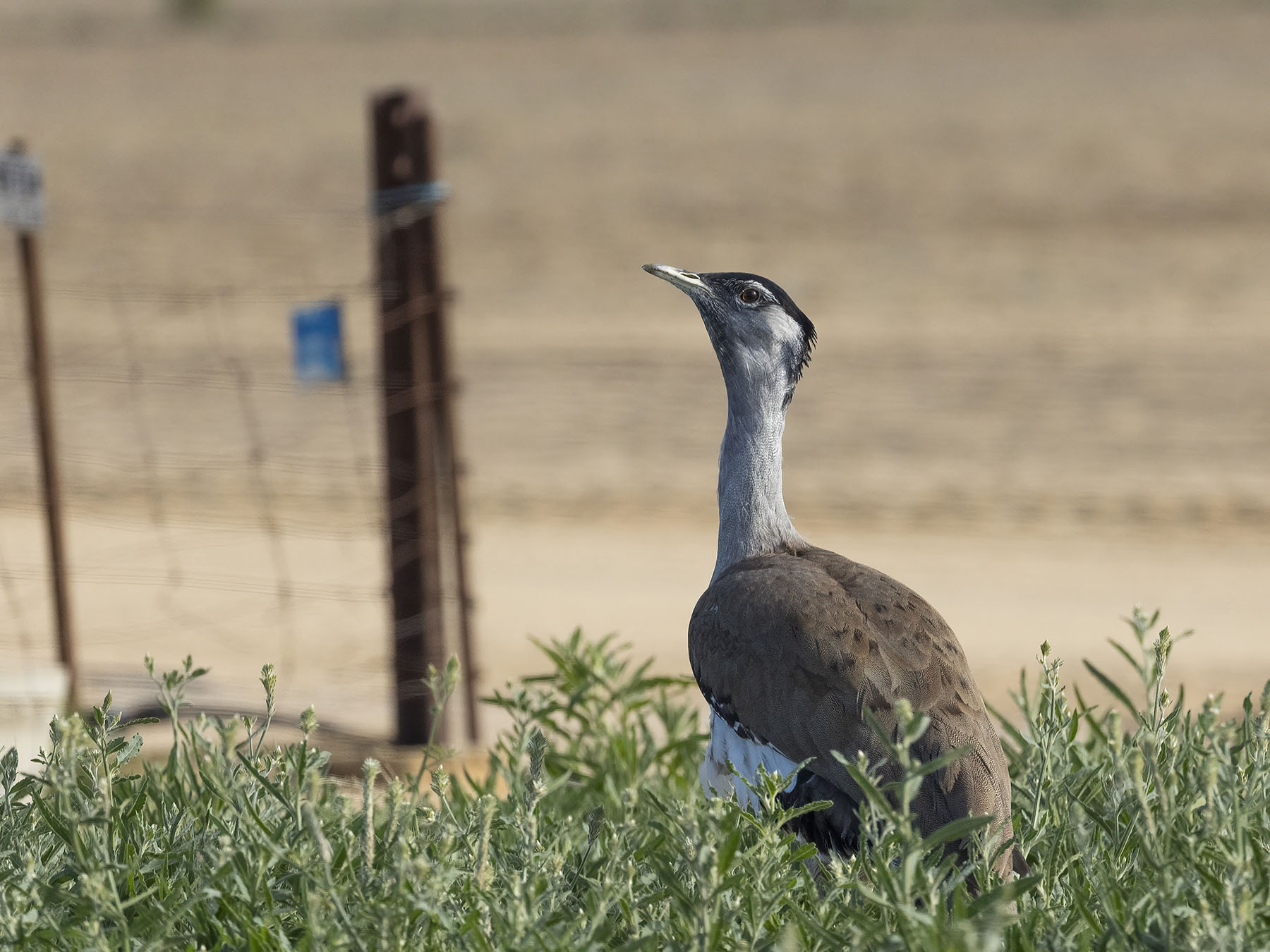
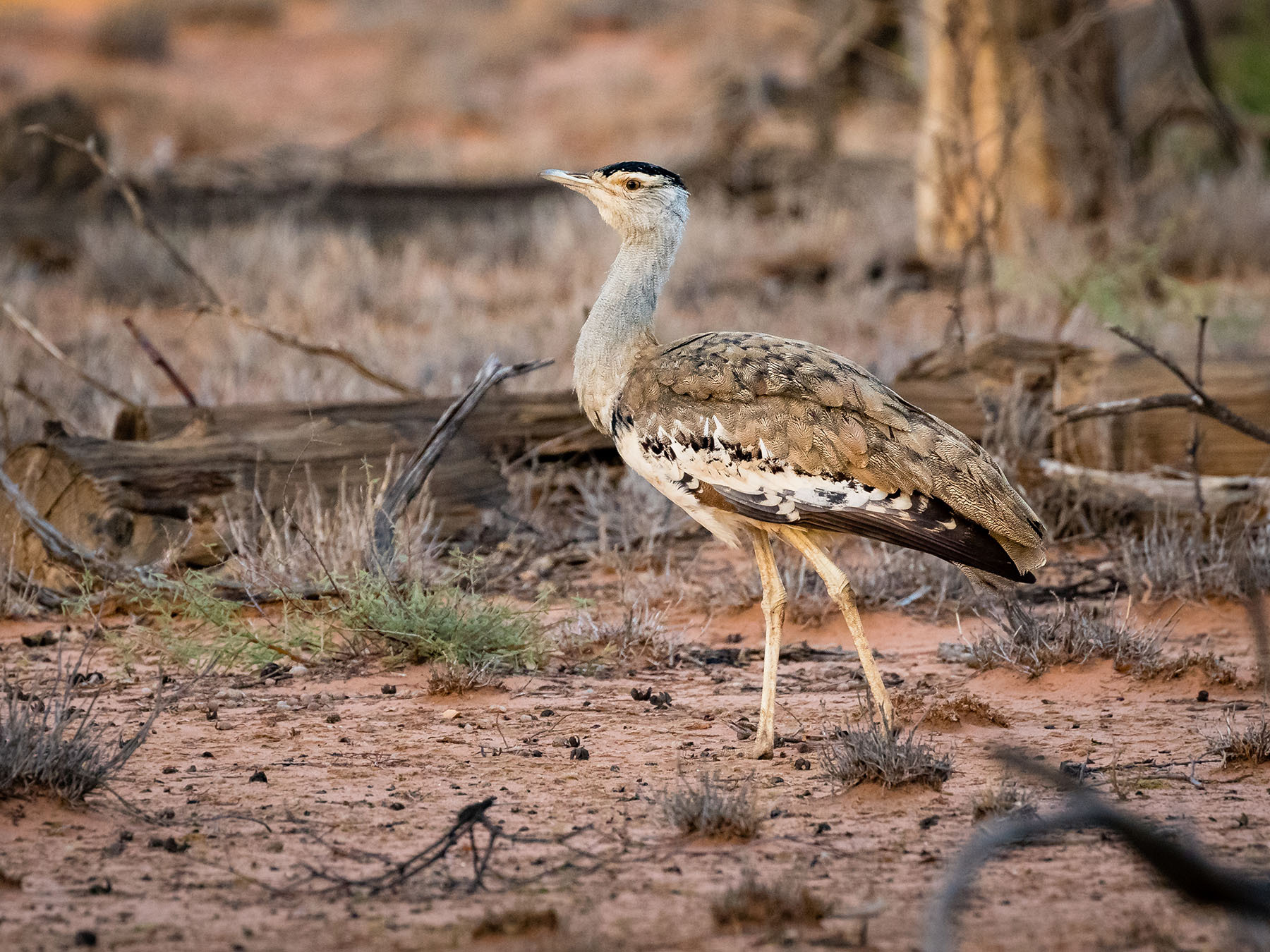
The Australian Bustard is a large, ground-dwelling bird with long legs and a slender neck. Males are significantly larger, reaching up to 1.2 meters in height. They sport a distinctive black cap, white eyebrows, and a black breast band that contrasts with their grey-brown plumage.
Females are smaller and less conspicuous, with mottled brown and grey feathers providing excellent camouflage. Both sexes have a pale grey beak and long, yellow legs. Juveniles resemble females but have more streaking on their upperparts.
Its size
Adults- Length
- 100–140 cm
- Wingspan
- 190–230 cm
- Weight
- 4500–12000 g
Its song and calls
Australian Bustards are predominantly quiet birds, but when alarmed or under threat, will produce a sharp barking noise.
Males will inflate the throat and the sound made has been likened to a 'distant roaring lion'. They will often emit a croaking sound whilst feeding.
These birds are also vocal during the breeding season whilst males are performing their courtship display. This sound made is more of a low pitched boom or roar.
When and where to see it
The Australian Bustard is not recorded regularly in the UK, Ireland, the United States or Canada.
Worldwide: recorded regularly in 1 country
Countries where it was recorded in at least 3 of the 6 years 2019–2024. Linked countries have their own bird list.
Oceania (1)
Data: EOD – eBird Observation Dataset (Cornell Lab of Ornithology), accessed via GBIF.org, CC BY 4.0. Records from 2019–2024, aggregated and filtered by Birdfact. How these lists are made
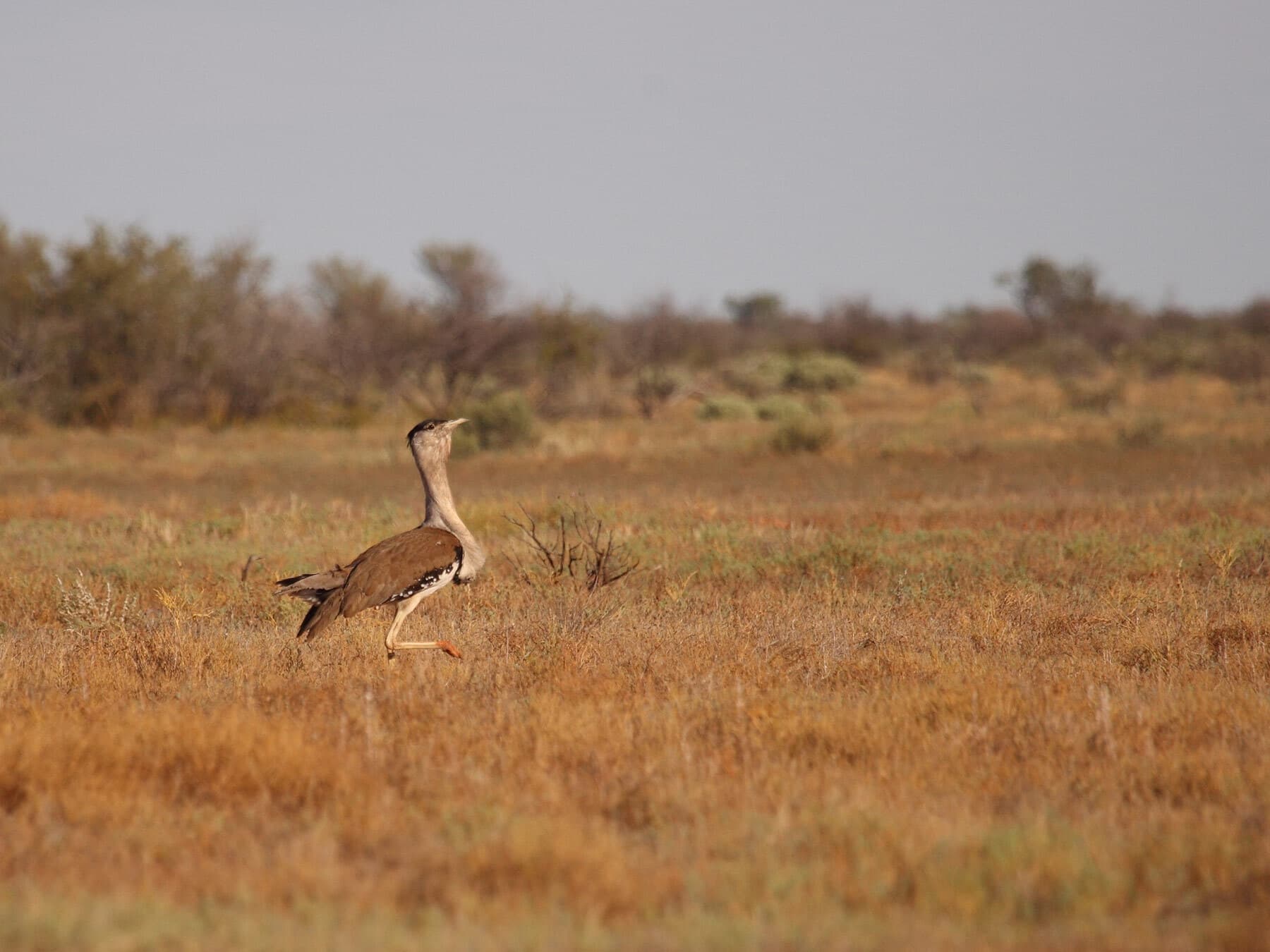
Australian Bustards can be found in each state of Australia, but are less common in both the south and south-eastern regions. They can also be found in southern parts of New Guinea. Preferred habitats are on open grassed plains, low shrubbed areas and in woodland.
Most birds are sedentary, but those in lower rainfall areas, may travel further distances from the drying area.
Signs and Spotting tips
These birds are primarily nomadic and will often travel vast distances following the rains in search of food.
As previously mentioned, they are mostly silent, so if you are hoping to track and spot them by listening out for them, then the breeding season is most definitely the best time for this.
In New South Wales, these birds are listed as 'Endangered' due to their declining population. This decline is down to several factors such as illegal hunting, human disturbances and predation of cats and foxes. However, in most parts of northern Australia, they are much more common.
What it eats
Australian Bustards are omnivores meaning they have varied diets. They will feed on seeds, berries, roots, leaves, insects (especially caterpillars, grasshoppers and beetles), young birds, reptiles and small rodents such as mice.
These birds are ground feeders and mainly feed during the morning and later in the afternoon. When they find food, they use their short bills to grab things and then swallow them whole.
Can you eat Australian Bustards?
These birds are still eaten today in parts of central Australia. They are an important source of food for Aboriginal people.
Nesting and breeding
The start and end of the breeding season vary depending on the range. In the south, this is between April and November. Arid areas do not have any set breeding season, so it can occur all year round - but will generally be in relation to rainfall.
As with other bustards in the breeding season, males will gather in areas referred to as 'display arenas'. The males will be spaced well apart from one another (100 - 1,000m) to enable them to display and attract a female.
Displaying males inflate their throat sacs which then allows the long throat feathers to be utilised as a fan. This display produces a sound that is often likened to 'a distant roaring lion'. Males can get rather aggressive when defending their 'display arenas' and will often fight with other birds on the ground.
As they are able to perform more elaborate displays, larger males tend to have more success in attracting females to his 'arena' for mating.
Nests are constructed on bare ground or sometimes in tall grass. One clutch of 1-2 olive eggs is laid and then incubated solely by the female for up to 23 days. The plumage helps to deter predators as it mostly camouflages with the surroundings, whilst the female bird is sitting low on the nest. Once hatched, the chicks are only cared for and fed by the female, as the male will not help with nesting duties.
Behaviour
Australian Bustards are known for their elaborate courtship displays, where males inflate a large throat sac and strut with fanned tail feathers. They are generally solitary but may form small groups when food is abundant.
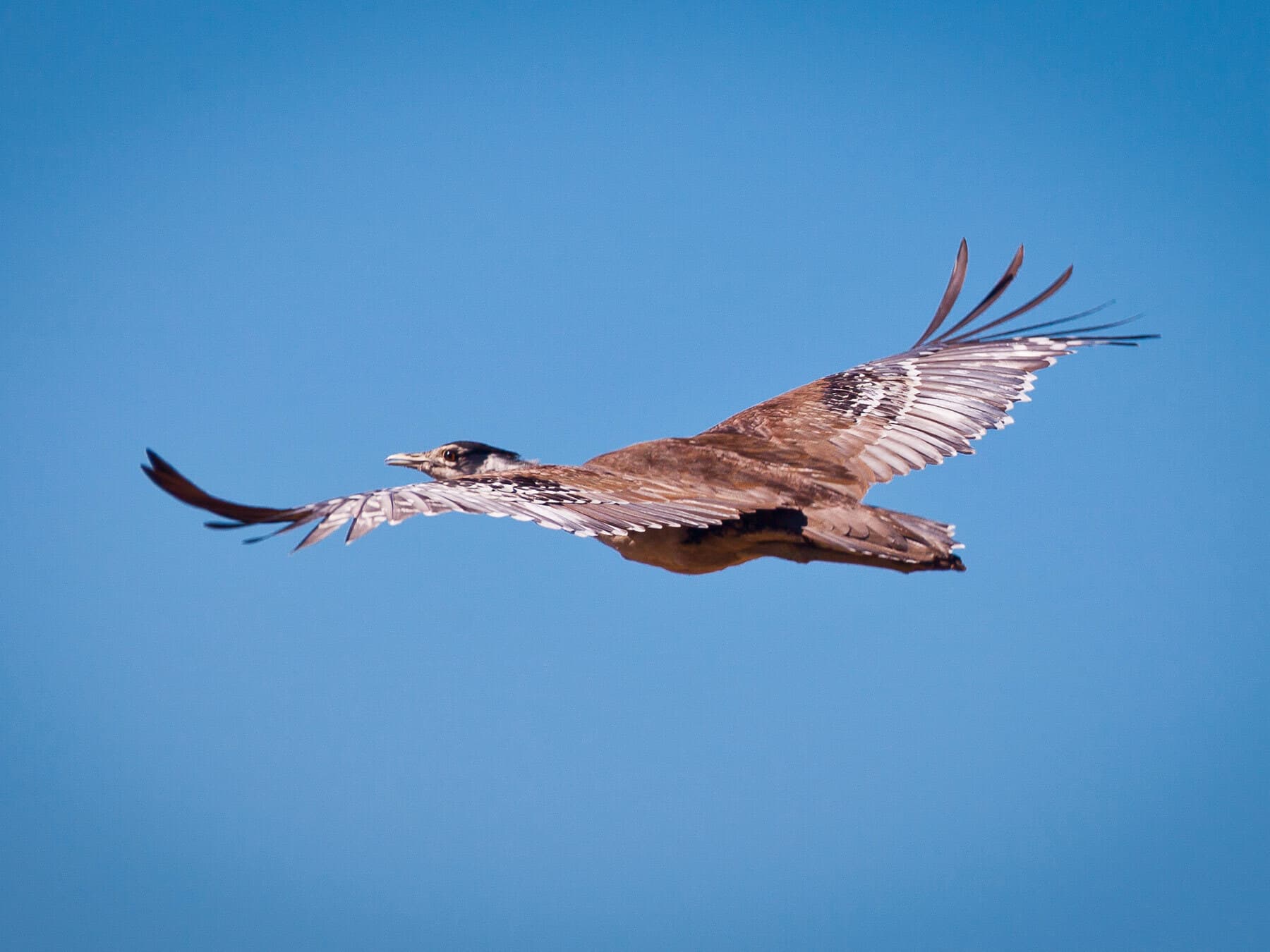
These birds are mainly terrestrial, preferring to walk or run rather than fly, but are capable of swift flight when necessary.
Lifespan and predators
The average lifespan for these birds is around 25 years, which means they are regarded as a long-lived species. However, in captivity, birds have been recorded to reach ages over 30 years old.
Because of their long life span, it takes young birds a considerable amount of time (5-6 years) to reach full sexual maturity, when they are then able to reproduce.
Conservation
While listed as Least Concern globally, the Australian Bustard has experienced local declines due to habitat loss, hunting, and predation by introduced species.
Conservation efforts focus on habitat protection and management, particularly in areas where agricultural expansion threatens their range.
What does an Australian Bustard look like?
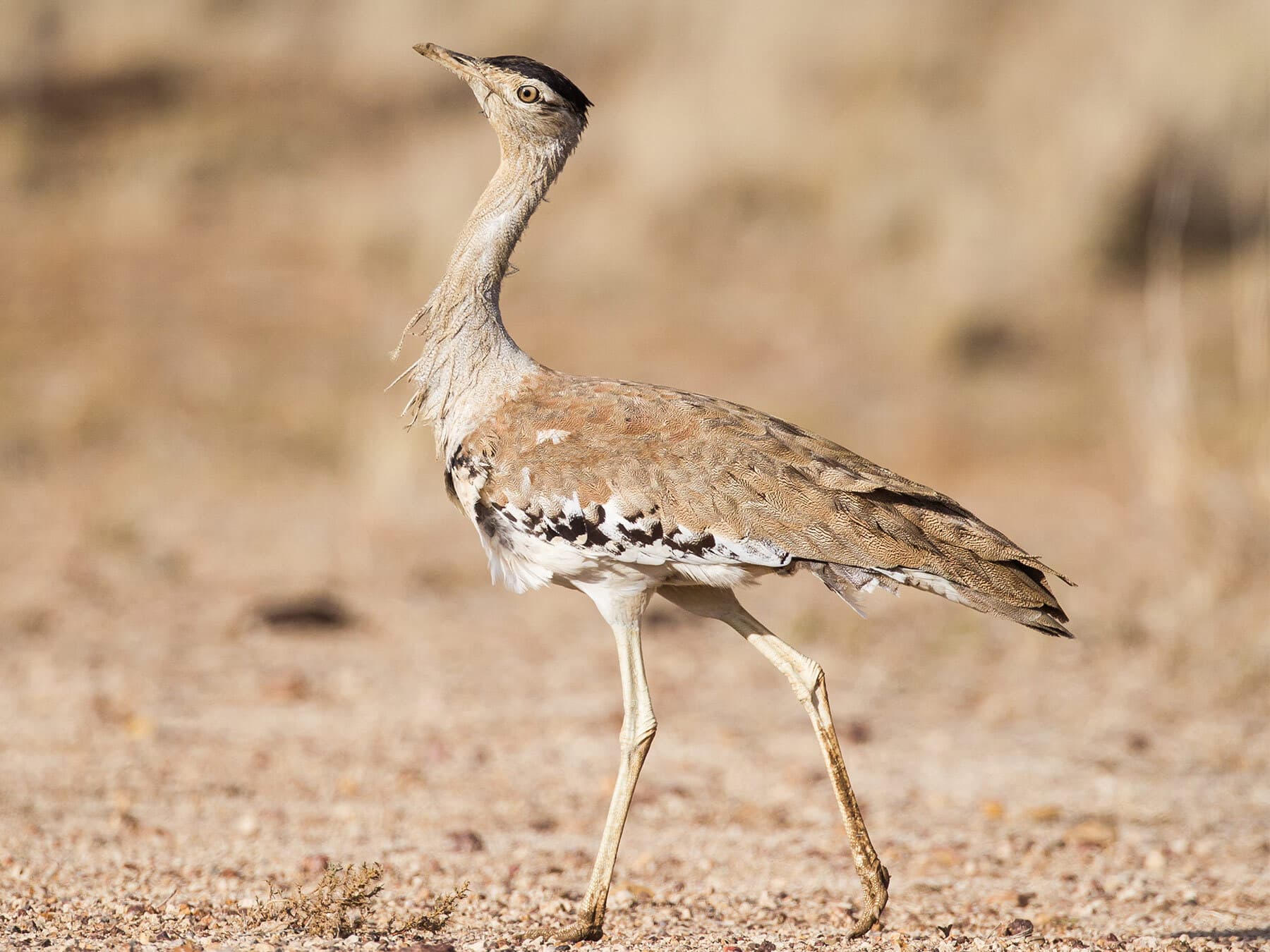
Adults have short brown tails, long yellowish-grey legs and feet and long light-coloured necks. The upper parts are mainly a light, dullish-brown with fine buff streaking. The upper wing coverts display black mottling with accompanying white bend.
Both the head and breast are greyish-white with finely barred dark greys. The forehead and crown are black, with a line joining the peak behind the eyes to where the eyebrow is white. Underbody parts are primarily white, with a black band across the breast. The bill is whitish, and the eyes are brown.
Females are considerably smaller than male birds and generally have slightly duller plumages and thinner bands on the breast, but other than that are mostly similar. Females generally weigh up to 3.2kg with males reaching weights of 8.2kg in some cases.
Juvenile birds look similar to adults but have less black detailing.
Can Australian Bustards fly?
Yes, Australian Bustards are the heaviest bird capable of flying in Australia, although they prefer to walk most of the time. If you are lucky enough to see one of these birds in flight, it can be an extremely fascinating sight.
More photos
3 photos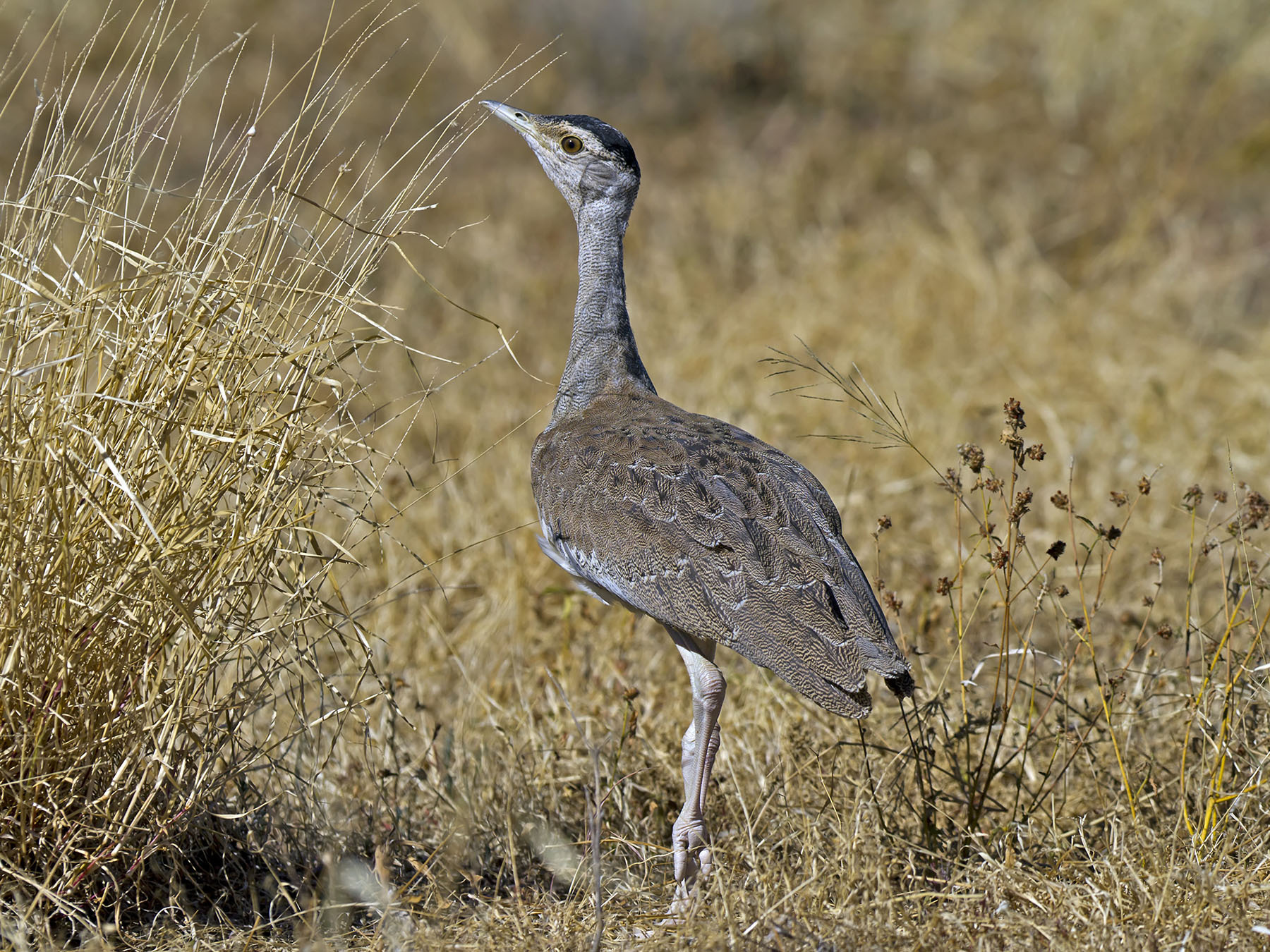
Quick facts
- Length
- 100–140 cm
- Wingspan
- 190–230 cm
- Weight
- 4500–12000 g
- Lifespan
- 10–15 years
- Family
- Bustards
- Migration
- Nomadic
- Global status (IUCN)
- Least Concern
- World population
- 6,700 - 67,000 mature individuals
- Population trend
- Decreasing
- Also called
- Plains Turkey, Bush Turkey
- Scientific name
- Ardeotis australis
Sources
3- 1BirdLife International. 2016. Ardeotis australis. The IUCN Red List of Threatened Species 2016: e.T22691940A93330335. Source (opens in a new tab)
- 2BirdLife International. 2016. Ardeotis australis. The IUCN Red List of Threatened Species 2016: e.T22691940A93330335. Source (opens in a new tab)
- 3BirdLife International. 2016. Ardeotis australis. The IUCN Red List of Threatened Species 2016: e.T22691940A93330335. Source (opens in a new tab)

Checked by
Nathan Cope, founder and editor
Nathan founded Birdfact and leads its writers and contributors in the UK, the US and Canada. He has watched and studied birds for more than ten years, and checks every article and species guide before it’s published.