


American Three-toed Woodpecker
Northern Three-toed Woodpecker · Picoides dorsalis
By the Birdfact teamChecked by Nathan Cope
On this page13 sections
How to recognise it
What do American Three-toed Woodpeckers look like?
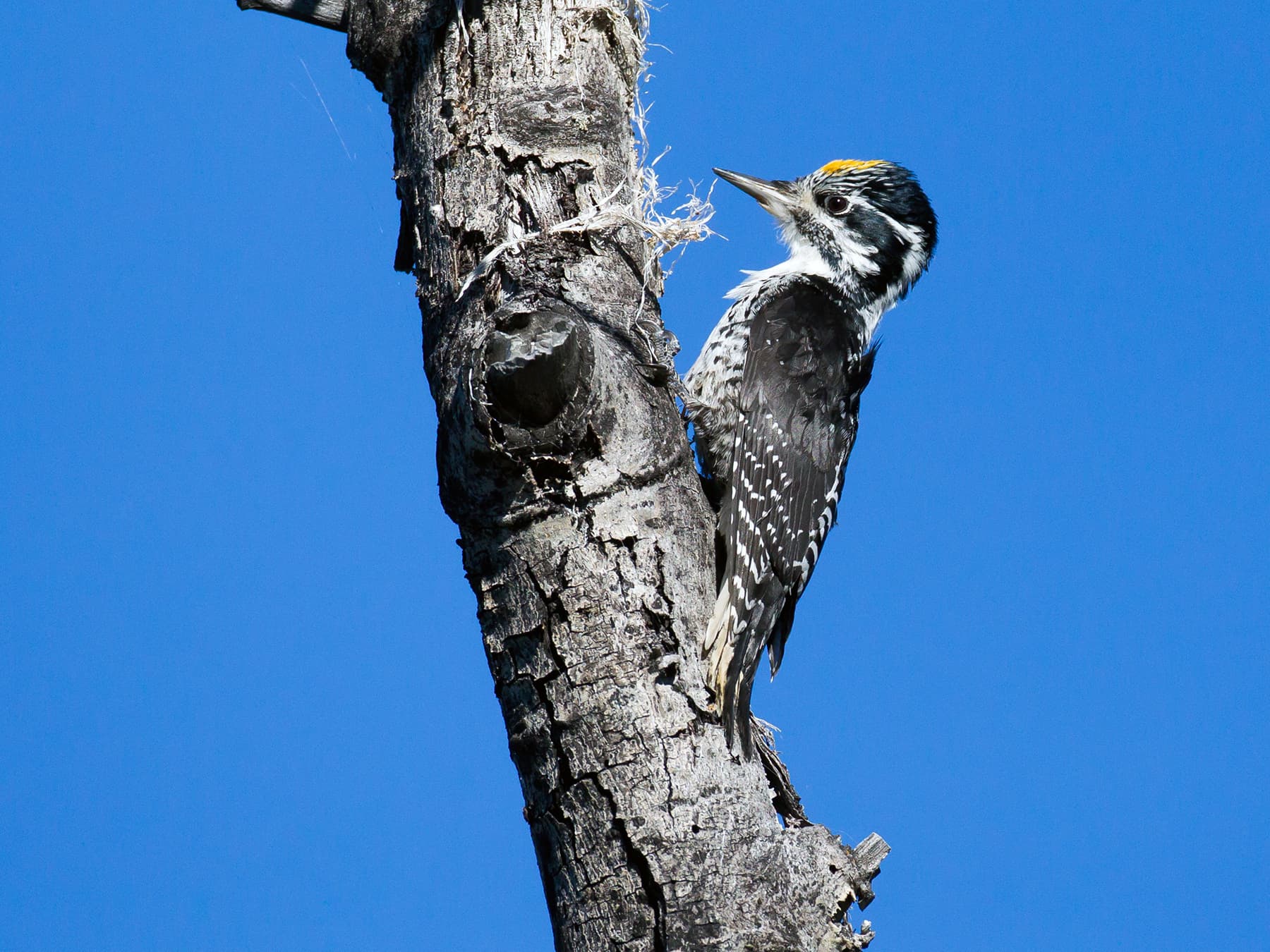
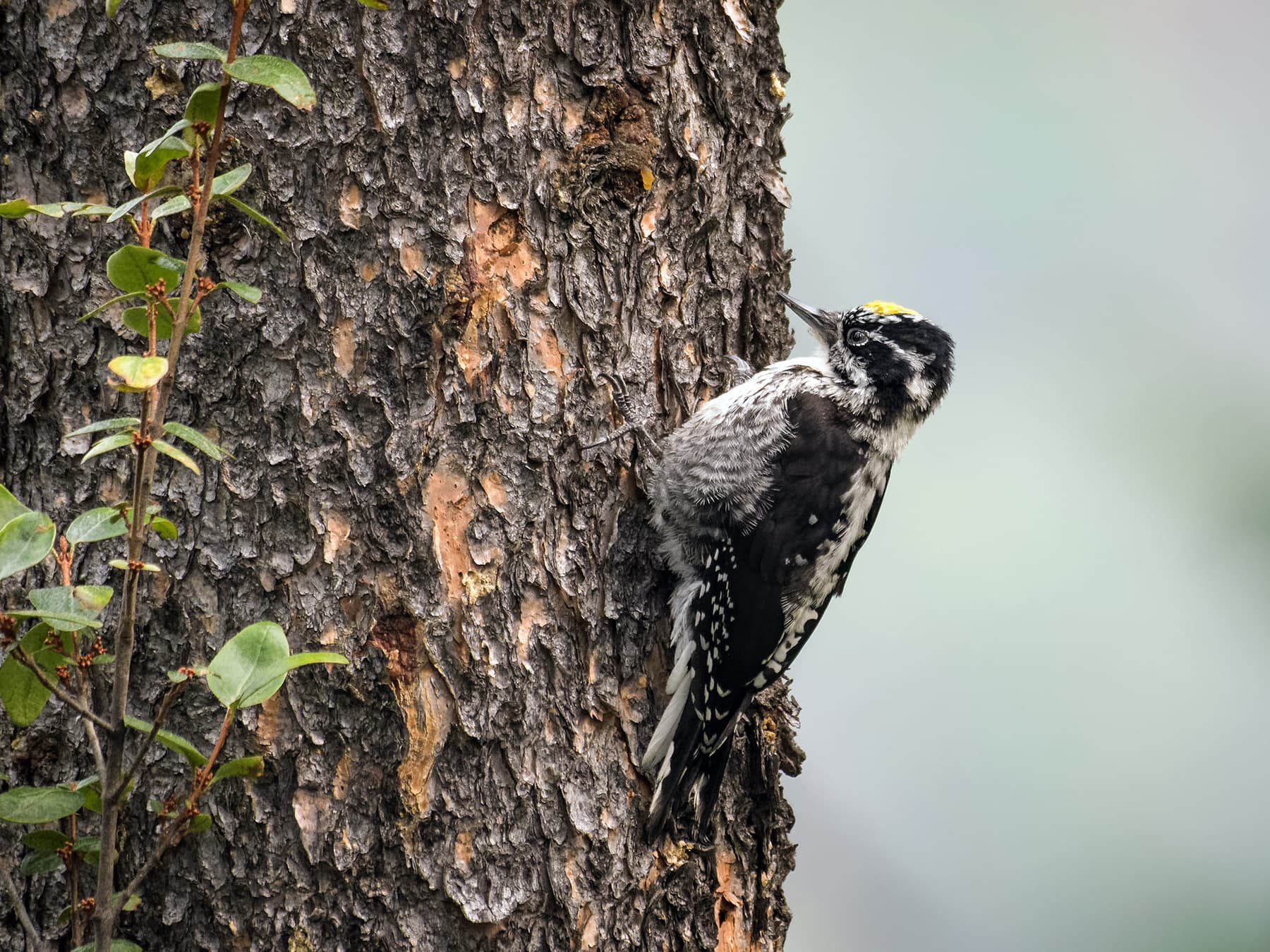
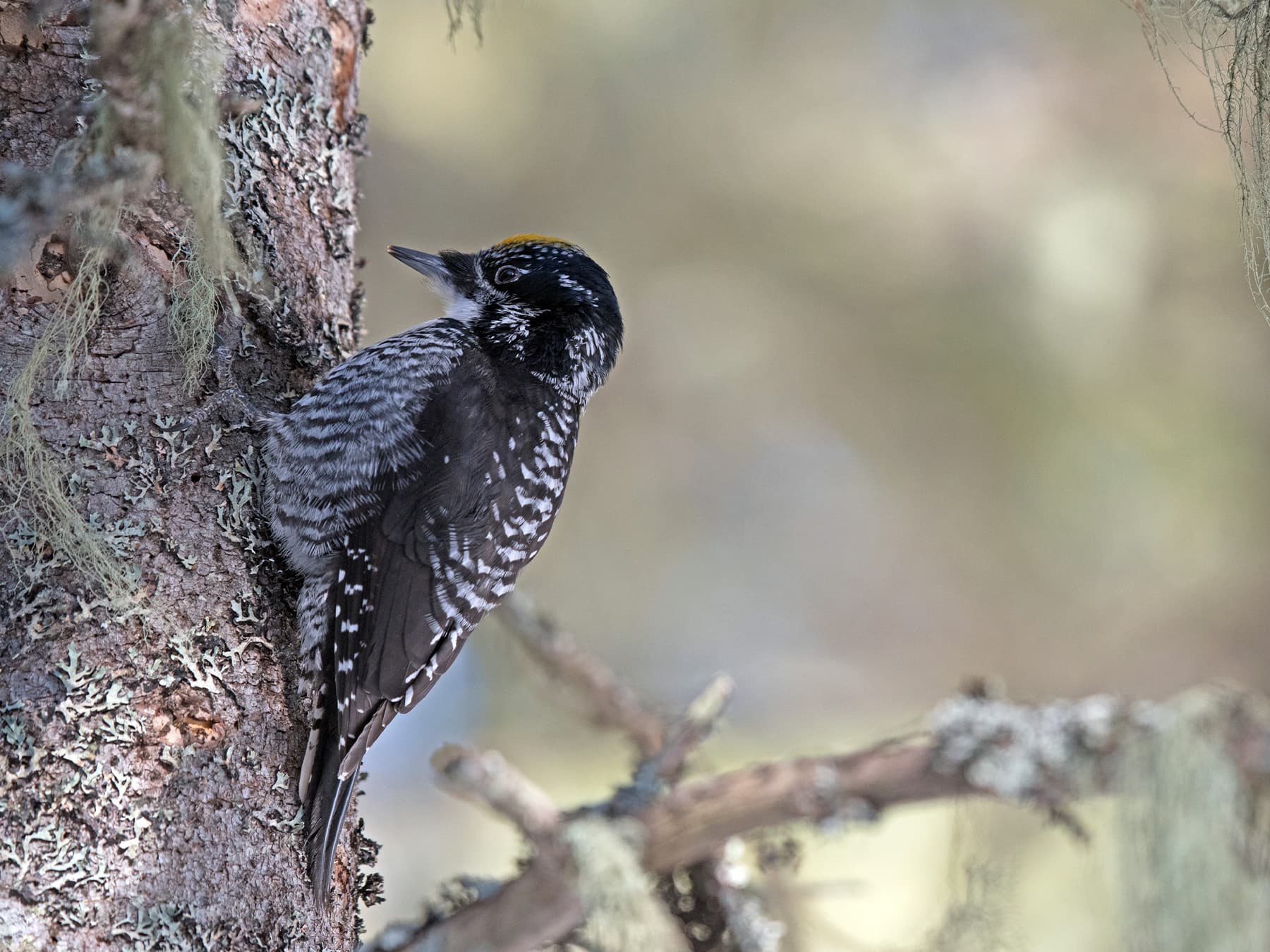
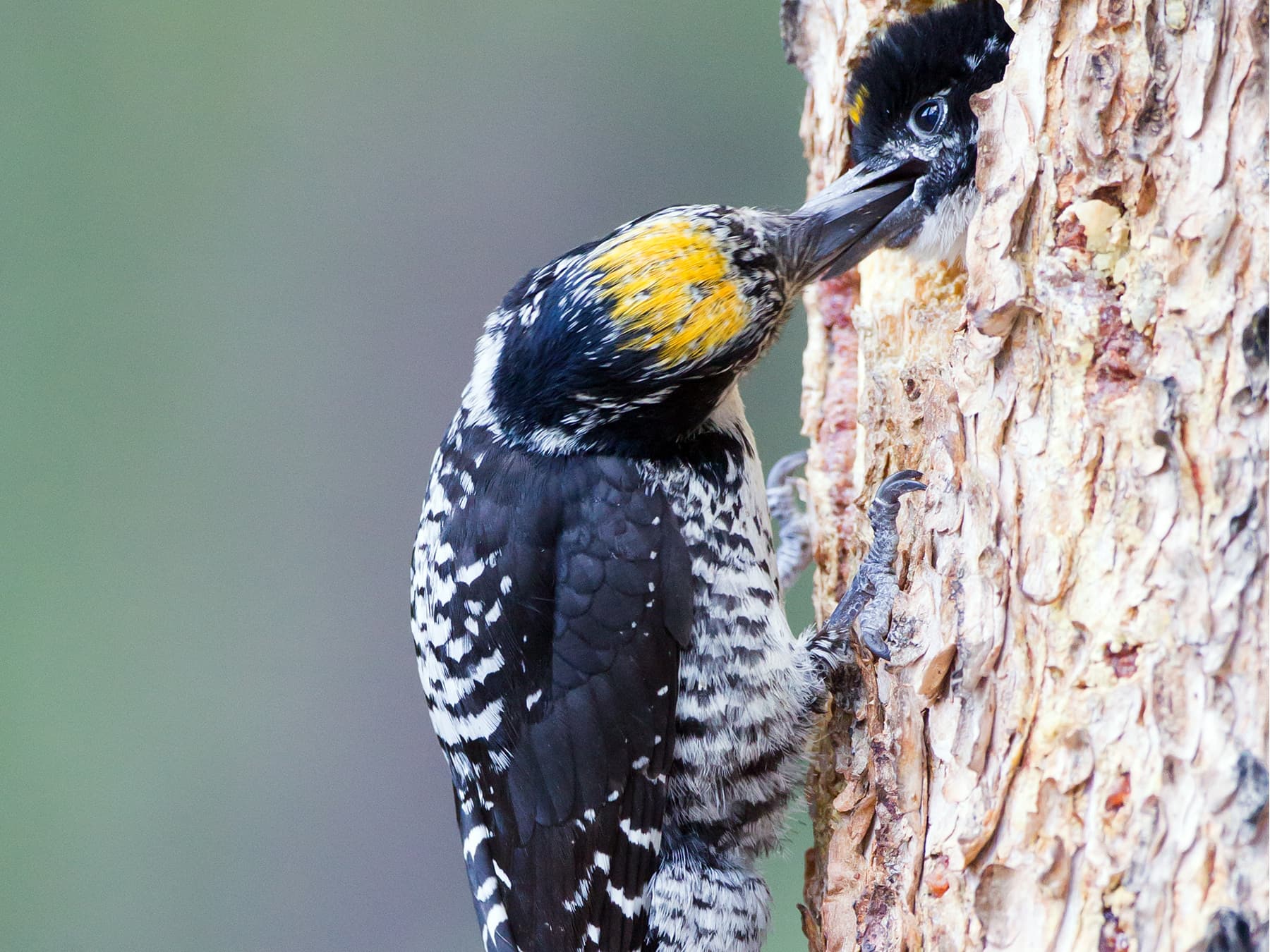
Male American three-toed woodpeckers have a vivid yellow cap, which contrasts against their black and white markings.
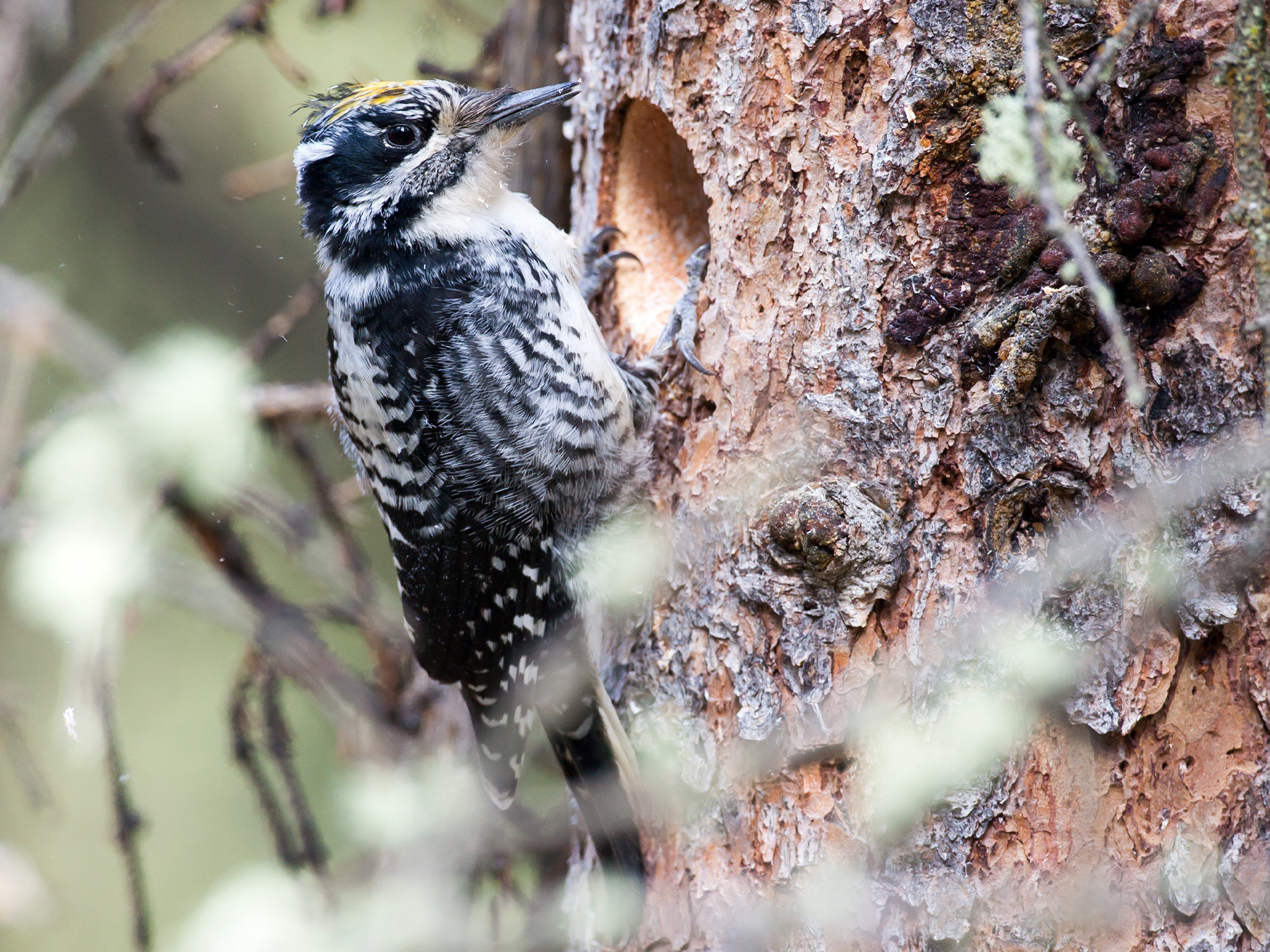
Slightly smaller than North America’s other three-toed, yellow-capped woodpecker species which is present in the same regions – the black-backed woodpecker – they can also be told apart by looking at their plumage. American three-toed woodpeckers have a barred black and white back, while in black-backed woodpeckers, the back, nape, and wings are solid black.
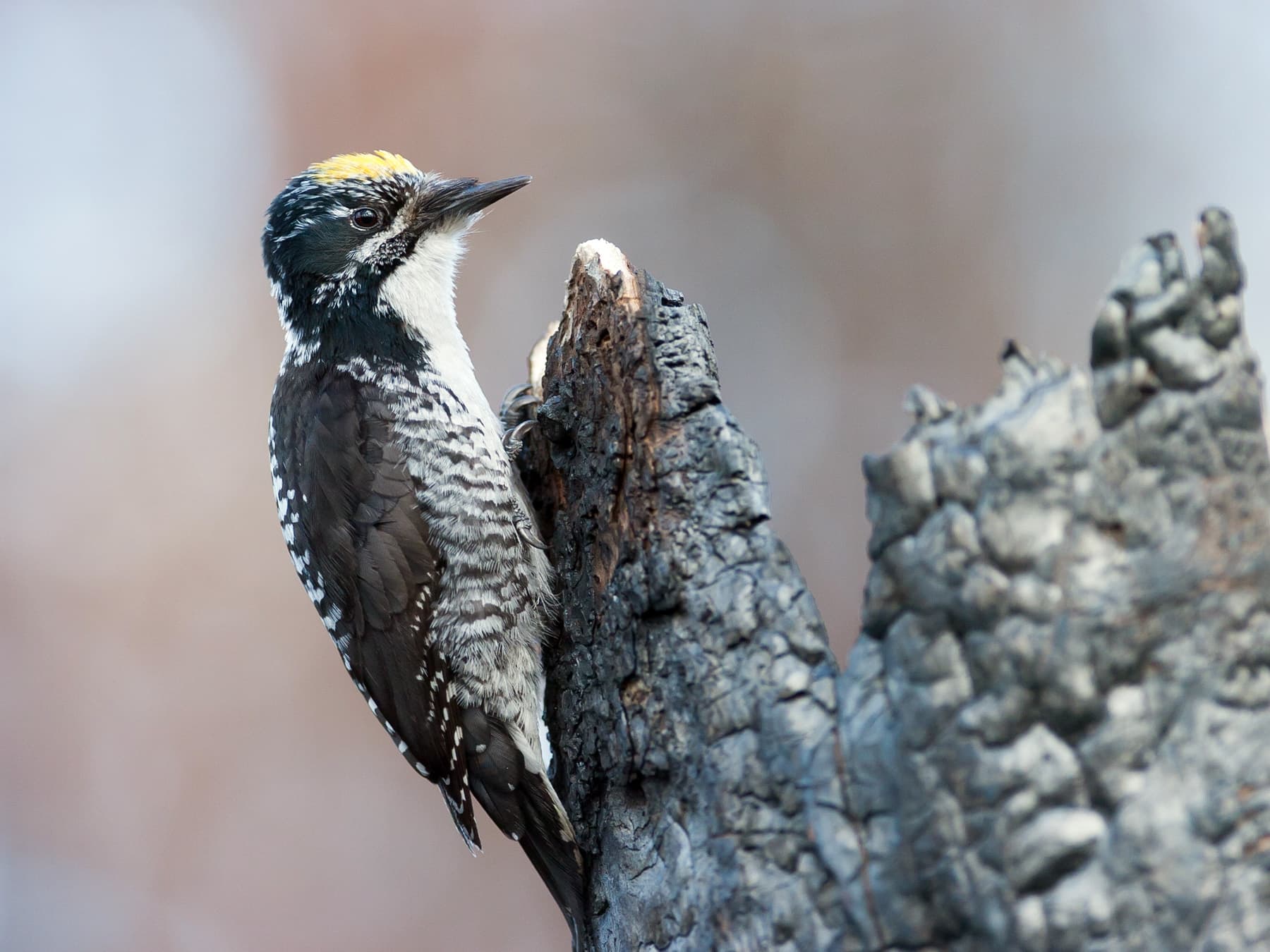
American three-toed woodpeckers have a black streak that runs down the back of the head, with a narrower white streak below. Otherwise, their face is largely black, with a smaller white mustache stripe and a white chin and throat. Sides, flanks, and wing edges are heavily barred with white and black markings. Underwings are marked with well-defined dotted patterning. The breast, belly, and undertail are pure white, while the upper tail is black, fringed with black and white bars.
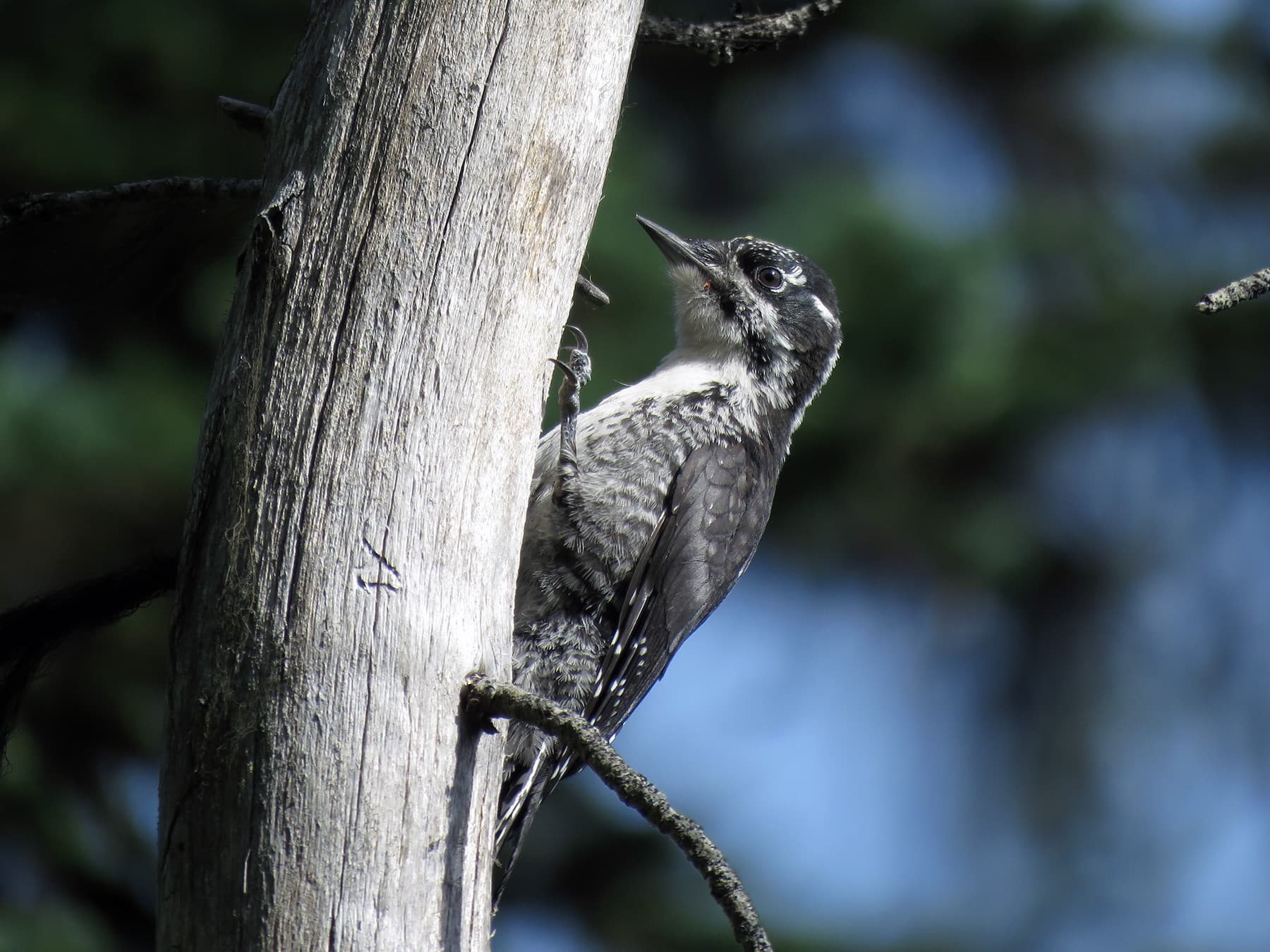
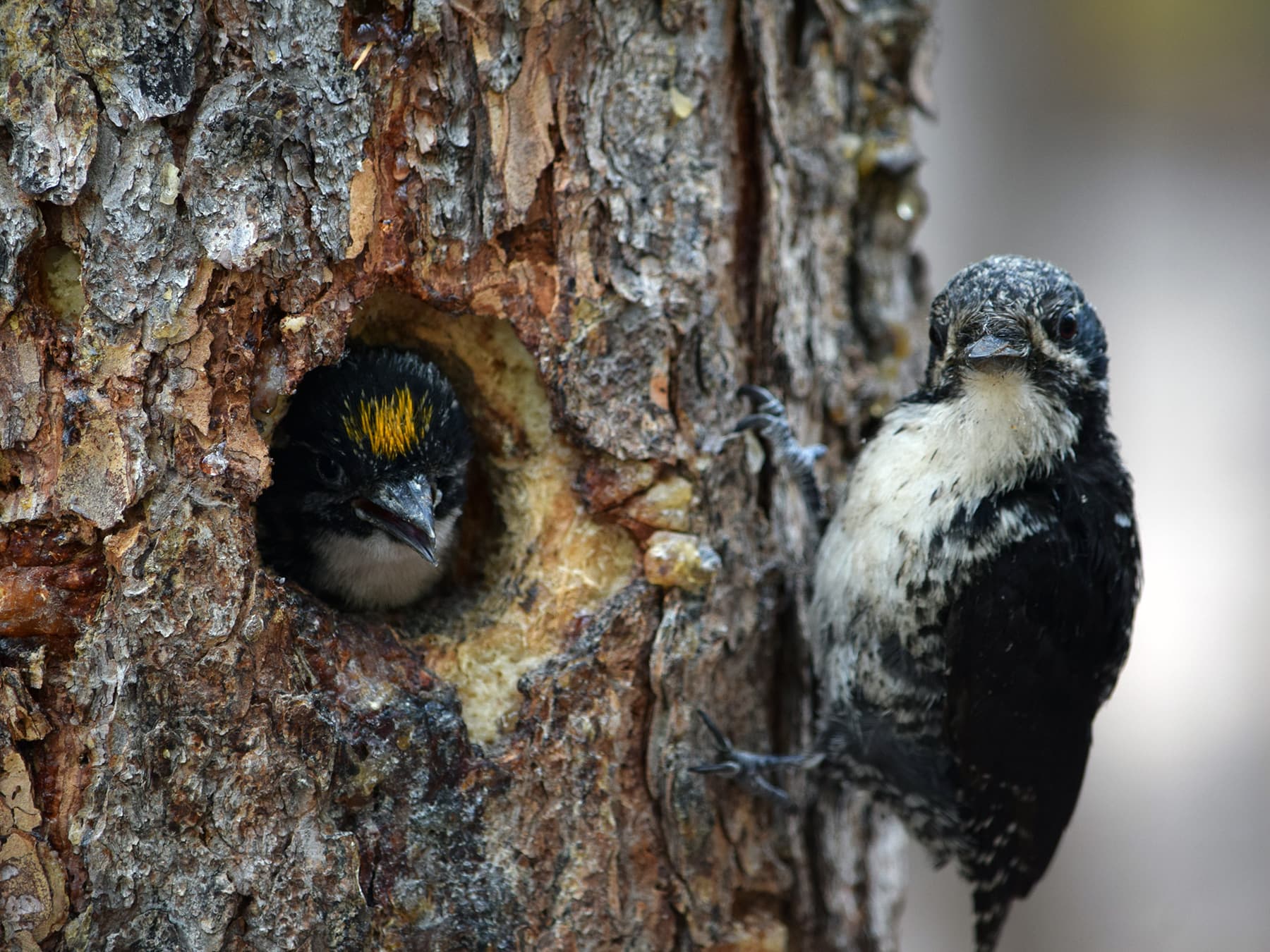
Females are similar, but the yellow cap is absent, replaced with a black cap dotted with thin white markings. Both sexes have reddish-brown eyes, gray legs, and a gray-horn-colored bill.
How big are American Three-toed Woodpeckers?
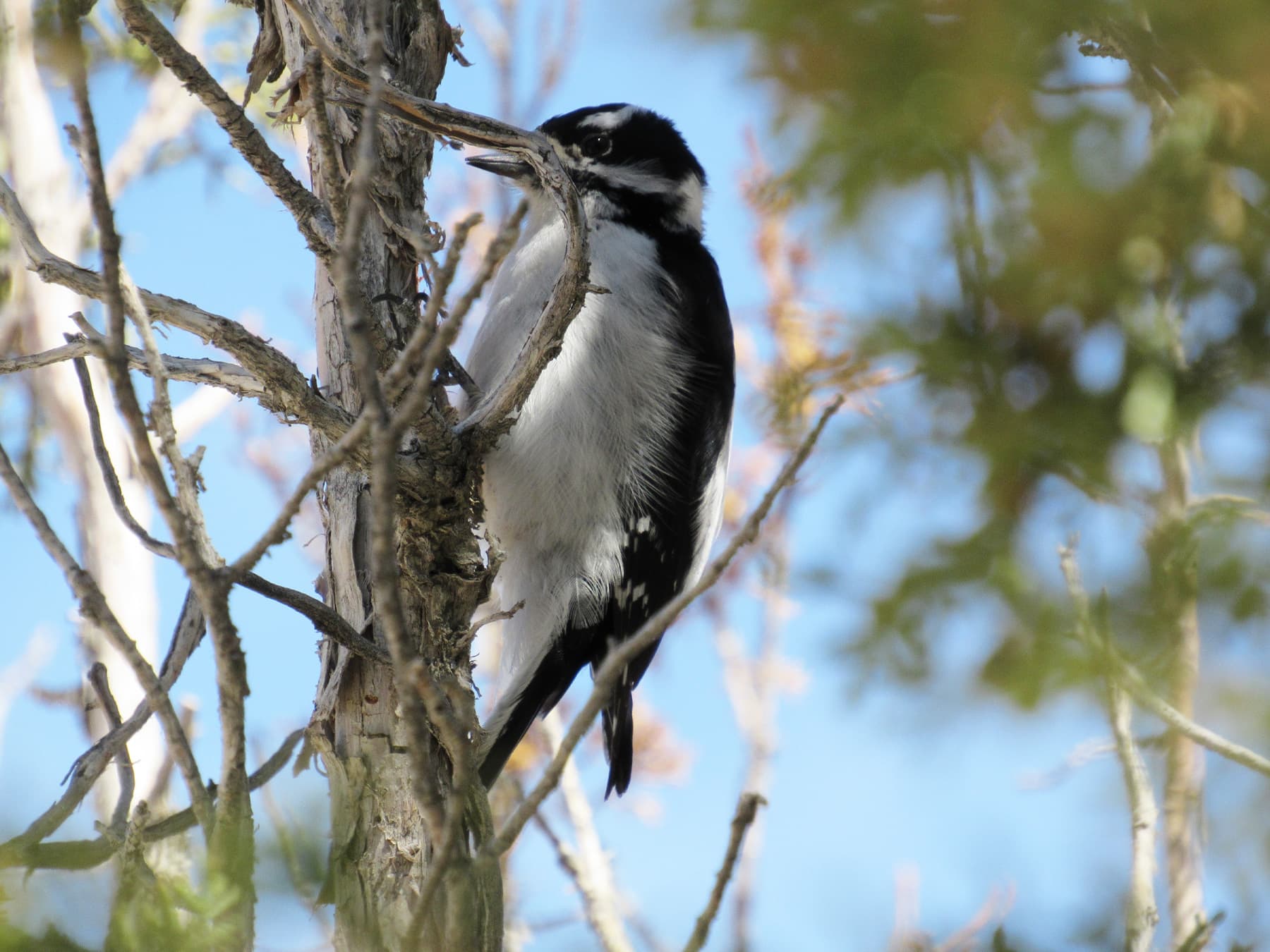
American three-toed woodpeckers are small-medium species of woodpecker, smaller than hairy woodpeckers and slightly larger than downy woodpeckers. For this species, males and females are the same size and weight but can be told apart visually as their markings are unalike.
- Length: 21 cm to 23 cm (8.3 in to 9.1 in)
- Wingspan: 37 cm to 39 cm (14.6 in to 15.3 in).
- Weight: 45 g to 68 g (1.6 oz to 2.4 oz)
Its size
Adults- Length
- 21–24 cm
- Wingspan
- 38–42 cm
- Weight
- 50–70 g
Its song and calls
What sound does an American Three-toed Woodpecker make?
A high-pitched descending ‘klee-yer’ call is heard during territorial clashes between American three-toed woodpeckers, as well as as a contact call between pairs. A short, sharp ‘tik’ is used to signal a warning or impending threat.
Drumming is heard as a form of communication and territorial defense and is characteristically rapid and evenly spaced.
- Call0:00 / 0:21
Recorded in Newfoundland and Labrador, Canada · June 2011
- Drumming0:00 / 0:04
Recorded in Newfoundland and Labrador, Canada · June 2013
When and where to see it
OctoberArriving
Most recorded in October
- 1. Yukon Territory0.49%
- 2. Northwest Territories0.34%
- 3. Alaska0.18%
- 4. Albertaunder 0.1%
- 5. Wyomingunder 0.1%
Each dot is a county, state or province: the bigger and darker, the larger the bird’s share of that place’s bird records that month. Grey dots: no regular records. The ringed point is the centre of the bird’s records this month; the arrow shows how it moved since last month, and the dashed loop its path through the year. “Arrivals” colours places where it becomes regular this month (orange) or is in its last regular month (grey). GBIF eBird Observation Dataset, 2019–2024. Map data: Natural Earth, US Census Bureau; place centres © OpenStreetMap contributors.
In your area
See when the American Three-toed Woodpecker is recorded in your county, state or province.
How often the American Three-toed Woodpecker turns up in the United States and Canada through the year, from birdwatchers' records.
United States
Summer visitor · all year · most records in July
Canada
Resident · all year · most records in February
Show as a table
| Month | United States | Canada |
|---|---|---|
| January | 0.002% (regular) | 0.029% (regular) |
| February | 0.002% (regular) | 0.031% (regular) |
| March | 0.001% (regular) | 0.019% (regular) |
| April | 0.001% (regular) | 0.007% (regular) |
| May | 0.002% (regular) | 0.007% (regular) |
| June | 0.009% (regular) | 0.020% (regular) |
| July | 0.012% (regular) | 0.018% (regular) |
| August | 0.007% (regular) | 0.015% (regular) |
| September | 0.004% (regular) | 0.014% (regular) |
| October | 0.003% (regular) | 0.018% (regular) |
| November | 0.001% (regular) | 0.021% (regular) |
| December | 0.001% (regular) | 0.018% (regular) |
Worldwide: recorded regularly in 2 countries
Countries where it was recorded in at least 3 of the 6 years 2019–2024. Linked countries have their own bird list.
North America (2)
Data: EOD – eBird Observation Dataset (Cornell Lab of Ornithology), accessed via GBIF.org, CC BY 4.0. Records from 2019–2024, aggregated and filtered by Birdfact. How these lists are made
What is the habitat of an American Three-toed Woodpecker?
Favored habitats of American three-toed woodpeckers include mature coniferous forests, with plenty of dead trees and snags. Areas with a high density of spruce, pine, and fir trees are popular, and they are also regularly found in burned forests or areas disturbed by storm damage.
What is the range of an American Three-toed Woodpecker?
American three-toed woodpeckers are widespread across most of sub-Arctic Canada and are also found across the border into the Rocky Mountain states of the US, where it has a patchy presence from Washington, through Idaho and Montana, and western Wyoming south through eastern Oregon, Utah, Colorado to northern Arizona and northwestern New Mexico in the south.
Where do American Three-toed Woodpeckers live?
American three-toed woodpeckers are most common in the western regions of Canada and the United States, with the highest concentrations in British Columbia, Alaska, Alberta, and the Rocky Mountain states.
How rare are American Three-toed Woodpeckers?
American three-toed woodpeckers are rated as a G5 species by the Nature Conservancy of North American Birds, meaning it is common, widespread, and abundant.
Compared to many other woodpecker species, they are relatively rare, with a total population across Canada and the US of around 1.4 million, and in the US sightings are more of a rarity than in its Canadian range.
Where can you see American Three-toed Woodpeckers in the US?
The Rocky Mountain states have the highest number of American three-toed woodpeckers, and ideal opportunities for sightings exist in the mountain forests at Glacier National Park in Montana and Grand Teton National Park in Wyoming. The species is also commonly reported in Yellowstone National Park’s diverse coniferous forests and meadows.
Where can you see American Three-toed Woodpeckers in Canada?
American three-toed woodpeckers are widespread throughout Canada and sightings are regularly reported in various locations across the country.
In Alberta, good opportunities for sightings are found at Jasper National Park, Banff National Park, and Kananaskis County. In British Columbia, the species is regularly spotted in the Cariboo Mountains and Wells Gray Provincial Park.
Migration
Do American Three-toed Woodpeckers migrate?
American three-toed woodpeckers are nonmigratory, remaining in their home territories all year round. Some short-distance irruptions may occur, linked to the prevalence of bark beetle outbreaks in recently disturbed woodlands.
Are American Three-toed Woodpeckers native to the US?
A native species of North America, American three-toed woodpeckers are more widespread across Canada than further south into the contiguous United States. The species can be seen in the Rocky Mountain regions of the US all year round, particularly in Idaho, Montana, Wyoming, Washington, and Oregon, as well as in Alaska.
Tips for seeing it
- Look for them in mature coniferous forests, especially areas with recent burns or beetle infestations.
- Listen for their distinctive drumming, which is slower and more irregular than other woodpeckers.
- Observe tree trunks for signs of bark scaling, a telltale sign of their presence.
- In the USA and Canada, focus on boreal forests and high-elevation coniferous woodlands.
What it eats
What do American Three-toed Woodpeckers eat?
Bark beetles and their larvae are the chief food source of American three-toed woodpeckers. Wood-boring beetles are also important.
The bark is stripped off tree trunks methodically, and insects that are exposed underneath are pecked at. Moth caterpillars, ant larvae, and spiders are also common prey. Sap wells drilled into tree trunks by sapsuckers may also be visited.
What do American Three-toed Woodpecker chicks eat?
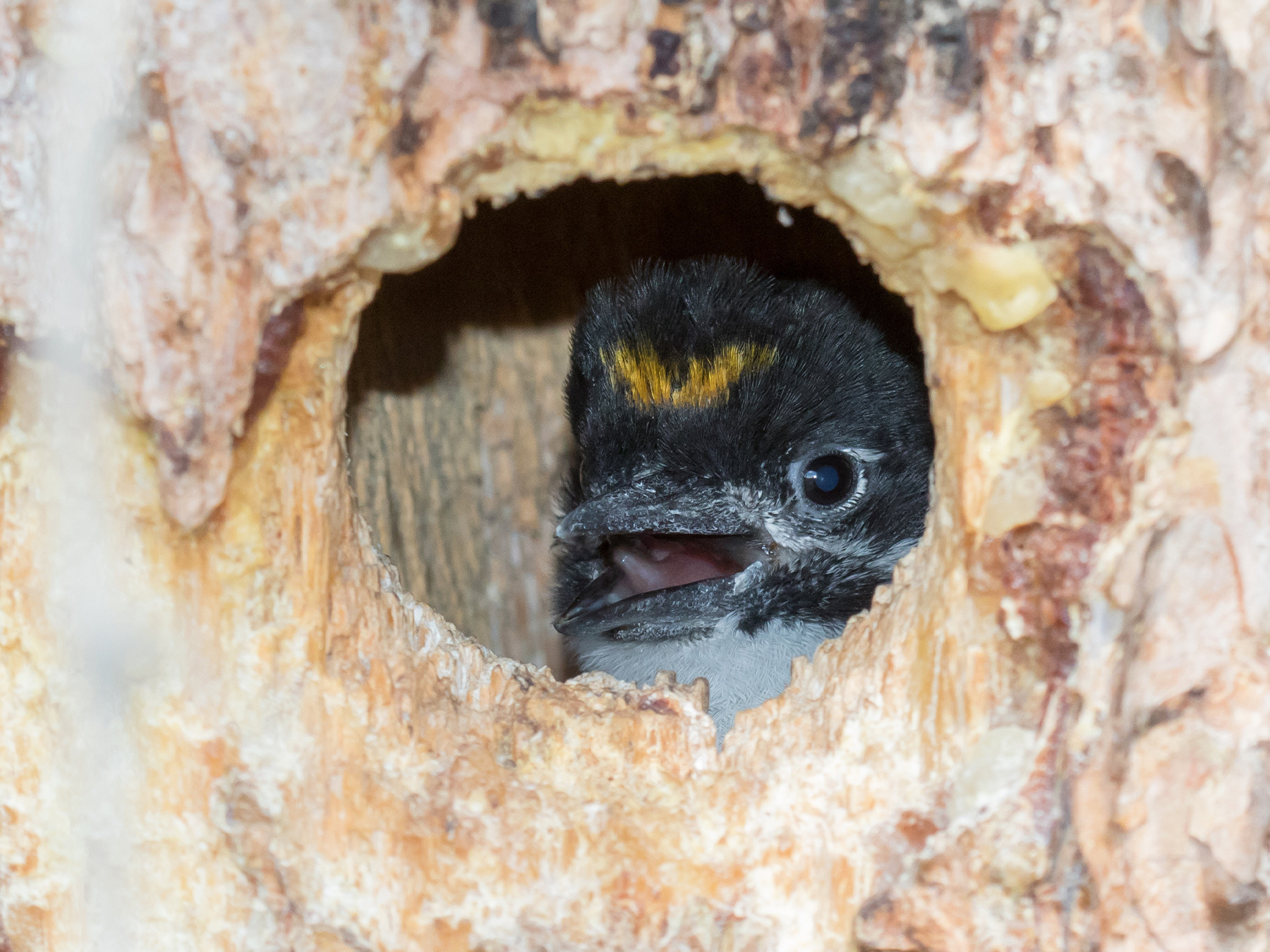
Young three-toed woodpeckers are fed on a diet of insects and larvae by their parents, including beetles, ants, caterpillars and spiders. Fruit and seeds may also be offered ahead of fledging. Once they are able to forage for themselves, juveniles follow the same mainly insect-based diet as their parents.
Nesting and breeding
Where do American Three-toed Woodpeckers nest?
Nest cavities are excavated around 6 m (20 ft) off the ground, in the trunk of a standing dead tree. Males and females both work on chiseling out the chamber, using some wood chips as a lining at the base of the chamber, apart from which no additional material is added.
When do American Three-toed Woodpeckers nest?
The earliest signs of breeding behavior are heard in early March, with the onset of daily drumming across woodland environments. Cavities are excavated between late March and June, and eggs are typically laid in May and June.
Incubation is divided between males and females and lasts between 12 and 14 days. Fledging occurs at around 24 days, usually in mid-July.
What do American Three-toed Woodpecker eggs look like?
Female American three-toed woodpeckers lay between 3 and 7 white eggs. Eggs are rounded and measure 25 mm by 18 mm (1 in by 0.7 in).
Do American Three-toed Woodpeckers mate for life?
Monogamous pair bonds form early in the season and last until young fledge. On occasions, previous mates have been documented to breed together in successive seasons, but not all pairs reunite, and a limited study showed that none of the mates observed were still together after two seasons.
Behaviour
Are American Three-toed Woodpeckers aggressive?
American three-toed woodpeckers are not an especially aggressive species and seem content to avoid interaction with other birds, foraging alone. If their nest cavity is threatened, the natural defense of their eggs and young will follow, with drumming, vocalizations, and posturing displays used to repel intruders.
Where do American Three-toed Woodpeckers sleep at night?
Overnight roosting spots are usually found in existing cavities excavated and abandoned by other woodpecker species or natural crevices in dead and decaying trees.
Lifespan and predators
How long do American Three-toed Woodpeckers live?
Around 6 years is the average life expectancy for an American three-toed woodpecker in the wild, although, in 2020, a banded individual that was 11 years old was recovered. Breeding is thought to take place for the first time at one year of age.
What are the predators of American Three-toed Woodpeckers?
Martens and squirrels are identified as possible raiders of American three-toed woodpeckers’ nest cavities. Predation by black bears and northern goshawks has also been documented.
Are American Three-toed Woodpeckers protected?
Protection across the species’ range is offered in the U.S. under the Migratory Bird Treaty Act of 1918, and in Canada under Migratory Birds Convention Act of 1994. Under these Acts, American three-toed woodpeckers cannot be knowingly killed, injured, captured, sold, or their feathers, eggs, and young traded or destroyed.
Are American Three-toed Woodpeckers endangered?
American three-toed woodpecker populations have been in decline since the 1970s, due to habitat loss caused by forest management and fire suppression techniques used in woodlands across Canada. Their current conservation status is as a species of least concern.
Conservation
While currently listed as Least Concern, the American Three-toed Woodpecker faces potential threats from habitat loss due to logging and climate change.
Conservation efforts focus on preserving mature coniferous forests and maintaining natural disturbance regimes, such as wildfires, which create ideal habitats.
More photos
3 photos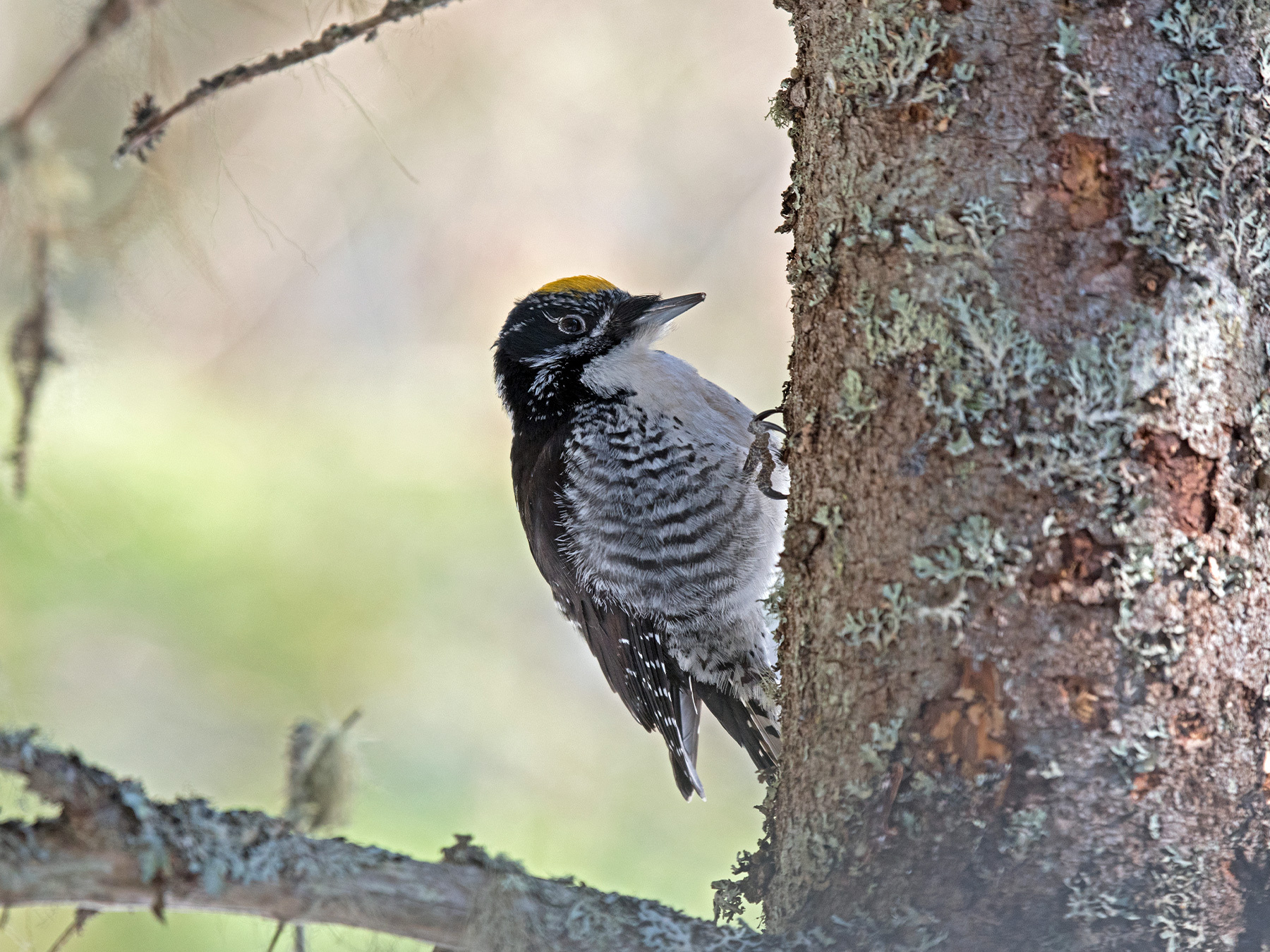
Quick facts
- Length
- 21–24 cm
- Wingspan
- 38–42 cm
- Weight
- 50–70 g
- Lifespan
- 6 years · oldest recorded 11 years
- Family
- Woodpeckers
- Migration
- Resident
- Global status (IUCN)
- Least Concern
- World population
- 1,600,000 mature individuals
- Population trend
- Stable
- Also called
- Northern Three-toed Woodpecker
- Scientific name
- Picoides dorsalis
Questions
5What attracts American Three-toed Woodpeckers?
American three-toed woodpeckers are strongly associated with infestations of western pine and spruce beetles and do particularly well in areas where large-scale outbreaks of these insects are present, traveling from considerable distances to colonize suitable new landscapes.
What trees do American Three-toed Woodpeckers prefer?
Popular tree choices for nesting sites include whitebark, lodgepole, ponderosa, jack pine, American and western larch, black and Engelmann spruce, Douglas-fir, western red Cedar, quaking aspen, paper birch and alder.
Do American Three-toed Woodpeckers harm trees?
American three-toed woodpeckers drill into tree trunks and create cavities that can potentially weaken a tree. However, excavation occurs on dead or dying trees, especially those that are infested with beetles.
The species is known to thrive in areas where beetle populations are ravaging through woodlands and are therefore a vital presence in keeping these outbreaks under control.
Do American Three-toed Woodpeckers go to bird feeders?
American three-toed woodpeckers are unlikely to be a regular at your backyard feeder, preferring instead to forage deep in woodlands for bark beetles and their larvae.
What is the difference between a black-backed woodpecker and an American three-toed woodpecker?
Both black-backed and American three-toed woodpeckers are similar in appearance and share the distinguishing feature of having three toes. Both species have mainly black and white plumage, with a bright yellow cap.
In American three-toed woodpeckers, the back is heavily barred with black and white, while in black-backed woodpeckers, the back is solid black.
Sources
3- 1BirdLife International. 2016. Picoides tridactylus. The IUCN Red List of Threatened Species 2016: e.T22727137A87304270. Source (opens in a new tab)
- 2BirdLife International. 2016. Picoides tridactylus. The IUCN Red List of Threatened Species 2016: e.T22727137A87304270. Source (opens in a new tab)
- 3Partners in Flight (2022) Source (opens in a new tab)

Checked by
Nathan Cope, founder and editor
Nathan founded Birdfact and leads its writers and contributors in the UK, the US and Canada. He has watched and studied birds for more than ten years, and checks every article and species guide before it’s published.