


African Jacana
Lily-trotter, Jesus Bird · Actophilornis africanus
By the Birdfact teamChecked by Nathan Cope
On this page16 sections
- How to recognise it
- Its size
- Its song and calls
- When and where to see it
- What it eats
- Nesting and breeding
- Behaviour
- Lifespan and predators
- Conservation
- What does an African Jacana look like?
- What is so special about the African Jacana?
- How many legs does an African Jacana have?
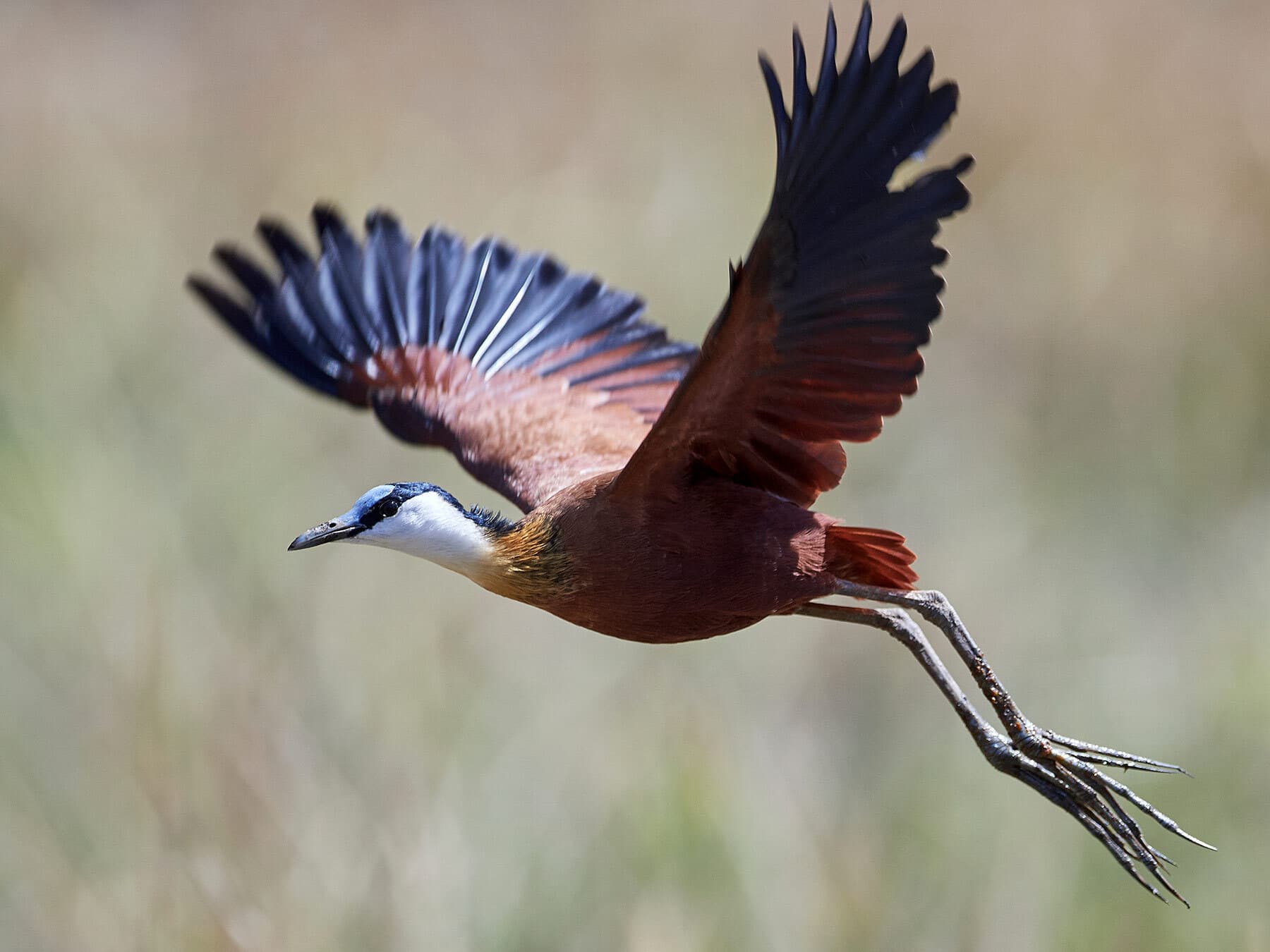
- Can an African Jacana fly?
- More photos
- Quick facts
- Sources
How to recognise it
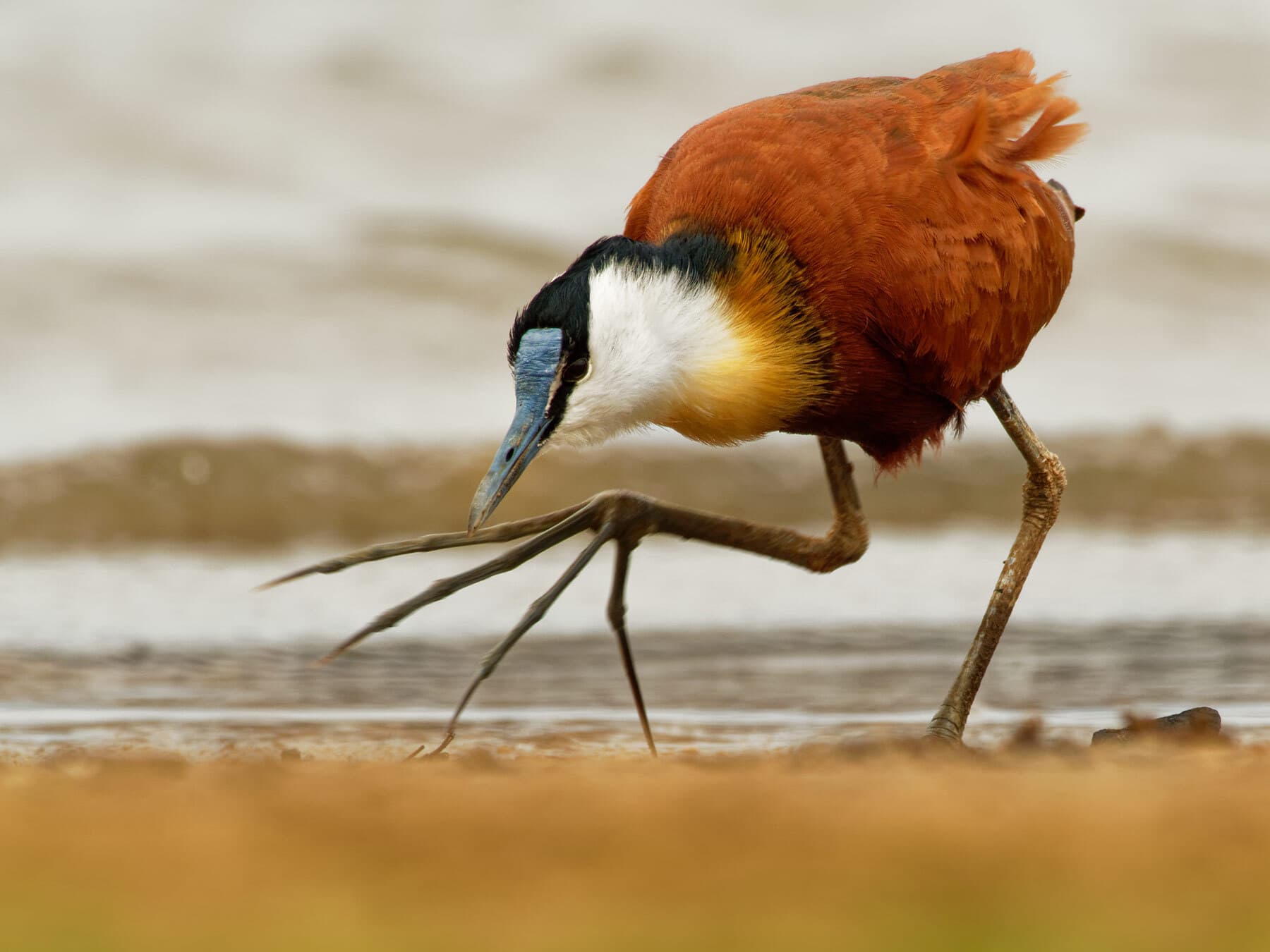
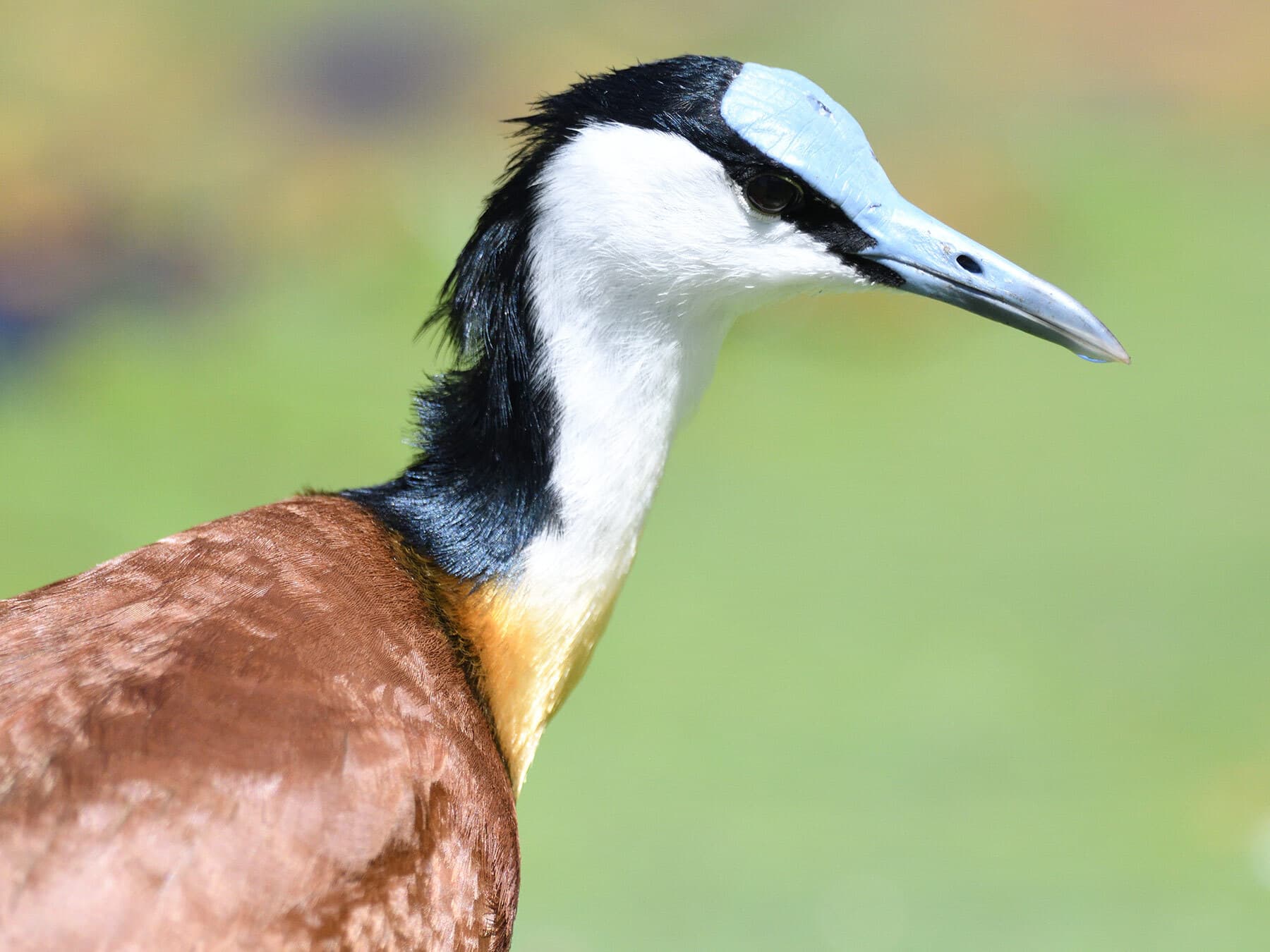
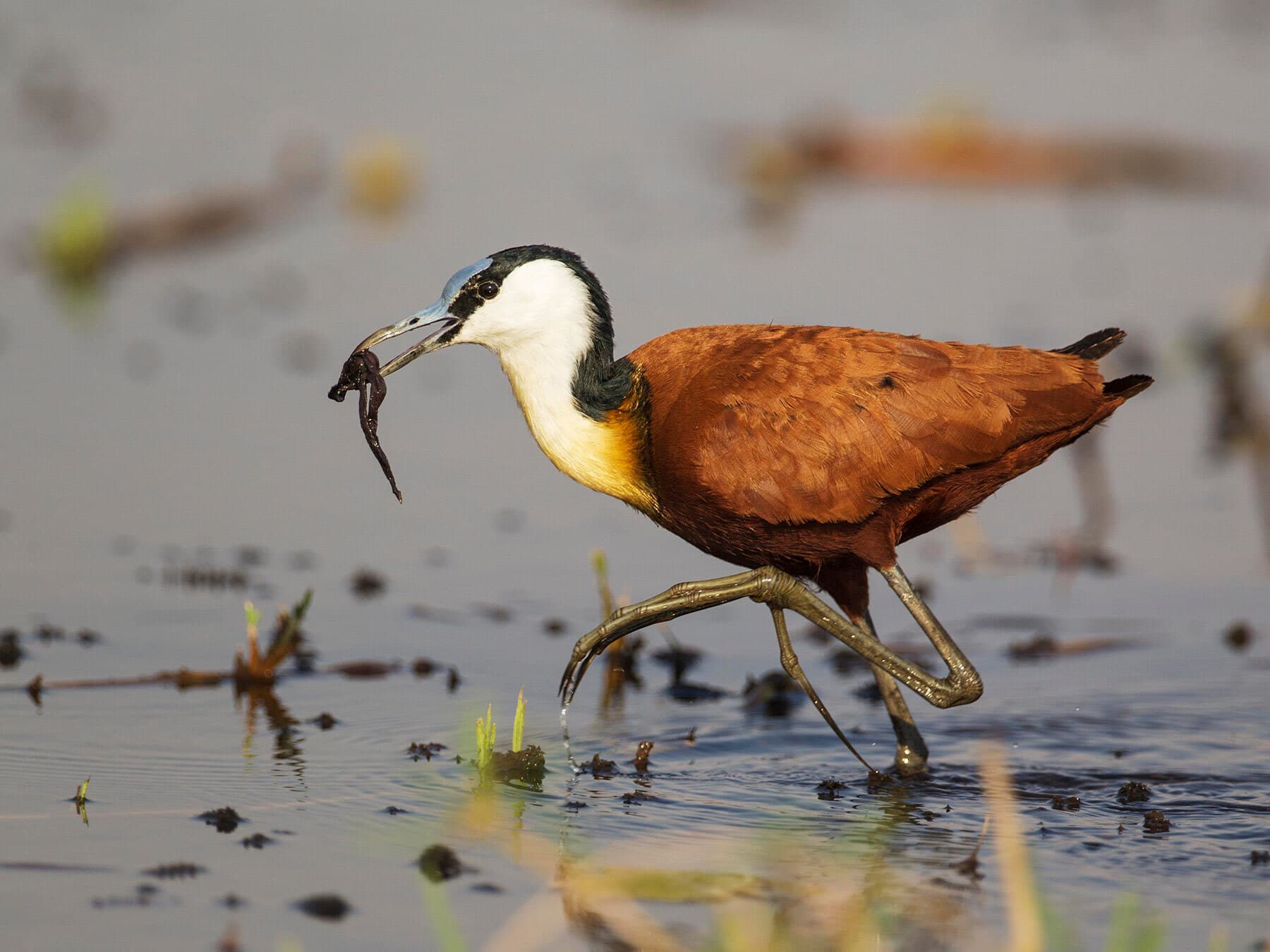
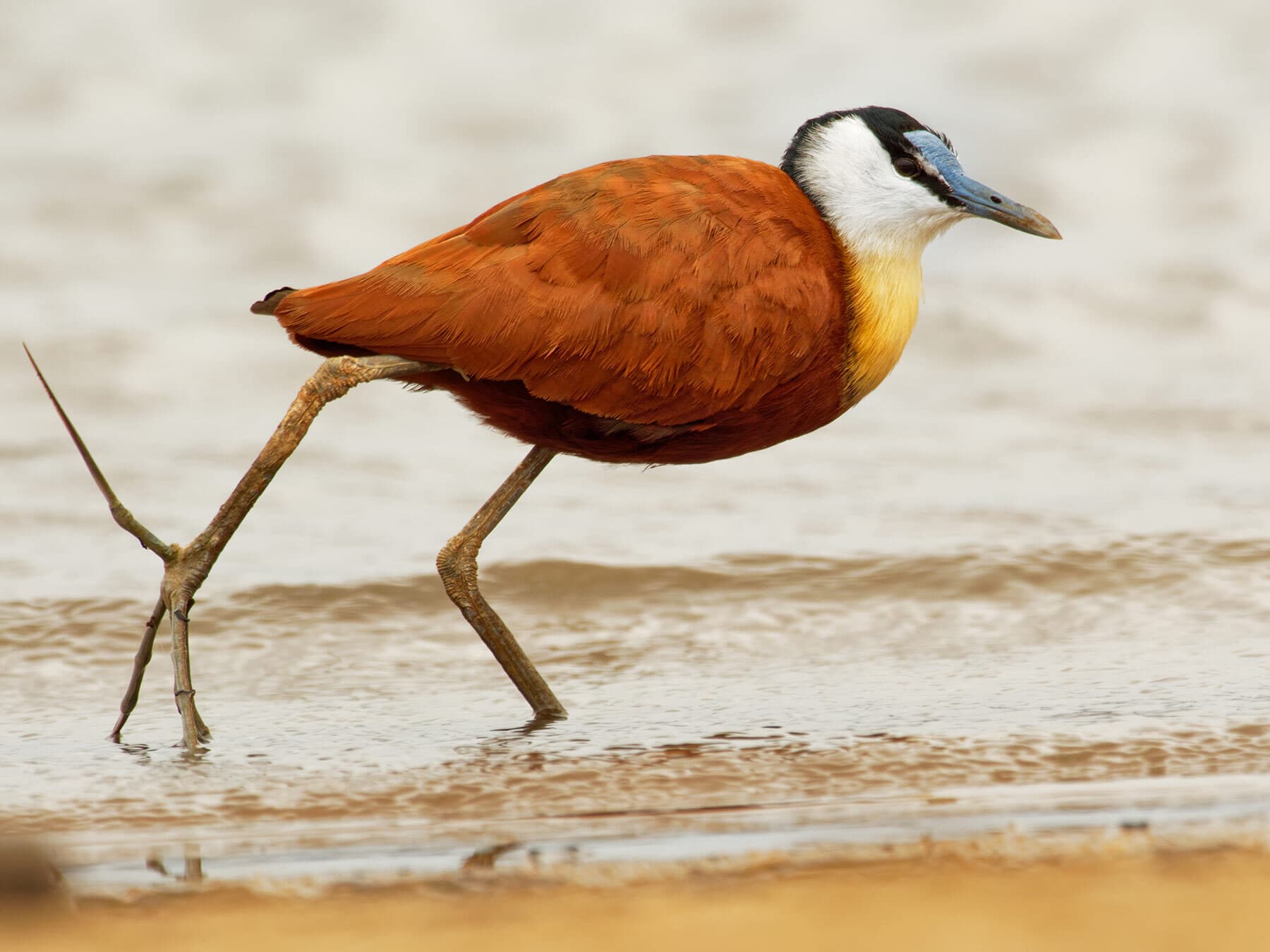
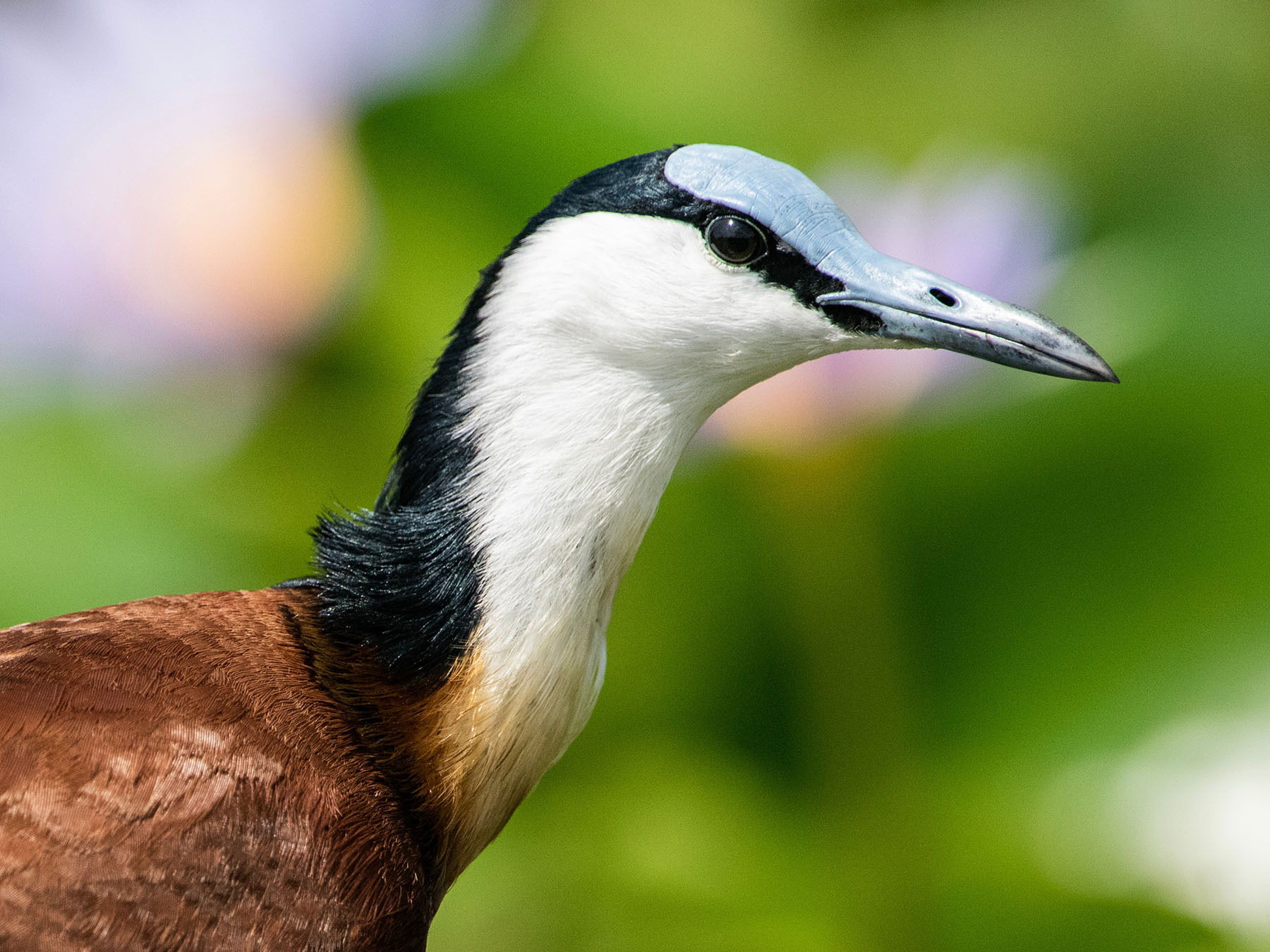
The African Jacana is a striking wader with chestnut-brown upperparts, black neck and head, and white cheeks. Its most distinctive features are its disproportionately long toes and claws, which allow it to walk on floating vegetation. The bird also has a bright blue frontal shield and beak.
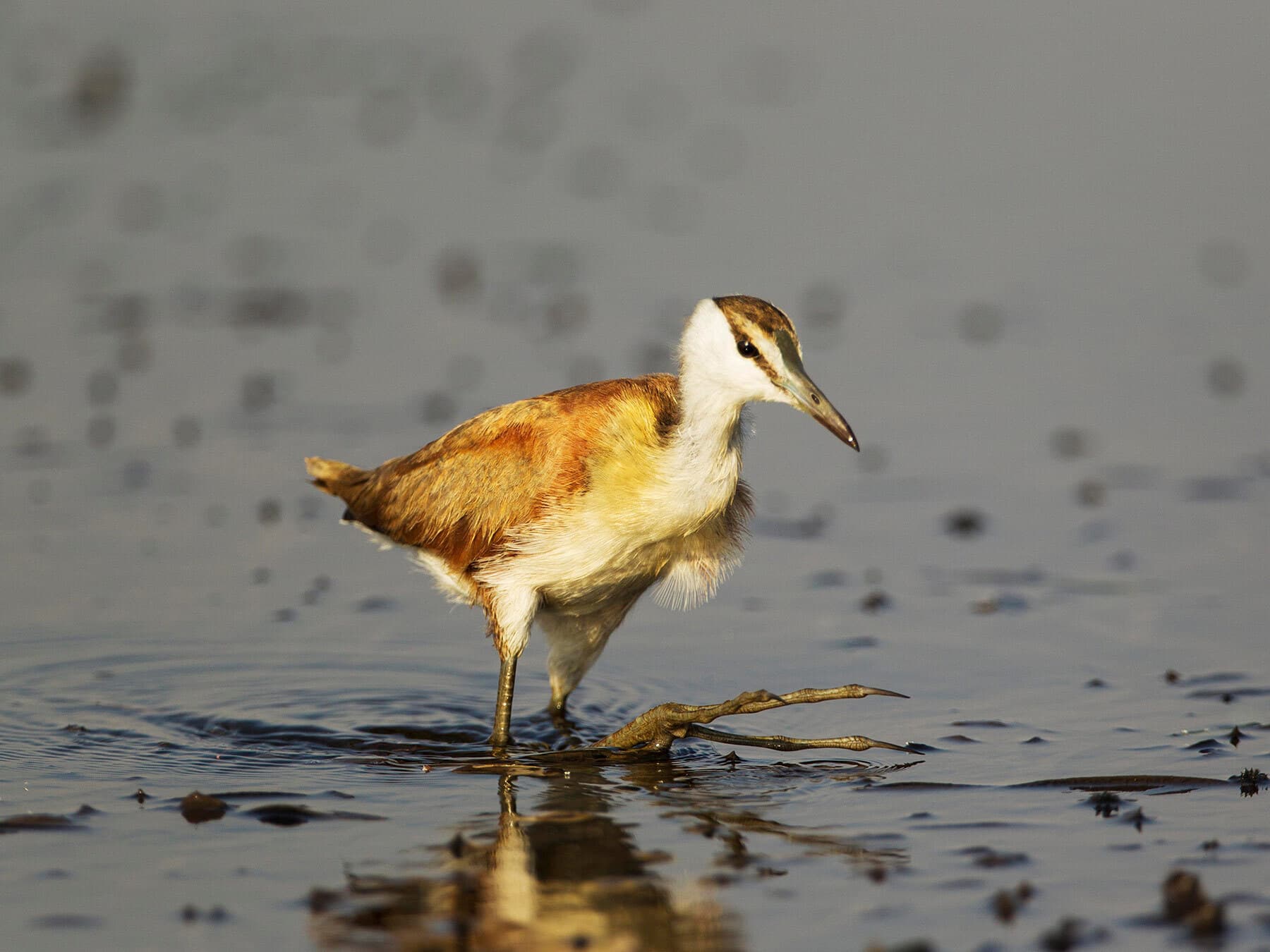
Females are noticeably larger and more brightly coloured than males, with heavier bodies and longer wings. Juveniles have a white belly and throat, brown upperparts and a less prominent frontal shield.
Its size
Adults- Length
- 23–31 cm
- Wingspan
- 50–58 cm
- Weight
- 115–270 g
Its song and calls
African jacanas are very vocal birds using a selection of raucous shrieks, moans and almost barking noises. In flight they issue a loud and fast staccato ‘kreep – kreep – kreep’, almost like a nasal trilling sound. Alarm calls are, by necessity, extremely loud and consist of sharp single notes similar to ‘kaakup’.
When and where to see it
The African Jacana is not recorded regularly in the UK, Ireland, the United States or Canada.
Worldwide: recorded regularly in 35 countries
Countries where it was recorded in at least 3 of the 6 years 2019–2024. Linked countries have their own bird list.
Africa (35)
Data: EOD – eBird Observation Dataset (Cornell Lab of Ornithology), accessed via GBIF.org, CC BY 4.0. Records from 2019–2024, aggregated and filtered by Birdfact. How these lists are made
African jacanas are widespread across the freshwater wetlands of sub-Saharan Africa from a west to east line passing through Senegal, southern Mali, Burkina Faso, Nigeria, southern Chad, South Sudan and Ethiopia and all countries south including the southern tip of South Africa. They keep away from jungle and forested areas whilst also avoiding the hot and arid areas of deserts and plains.
Signs and Spotting tips
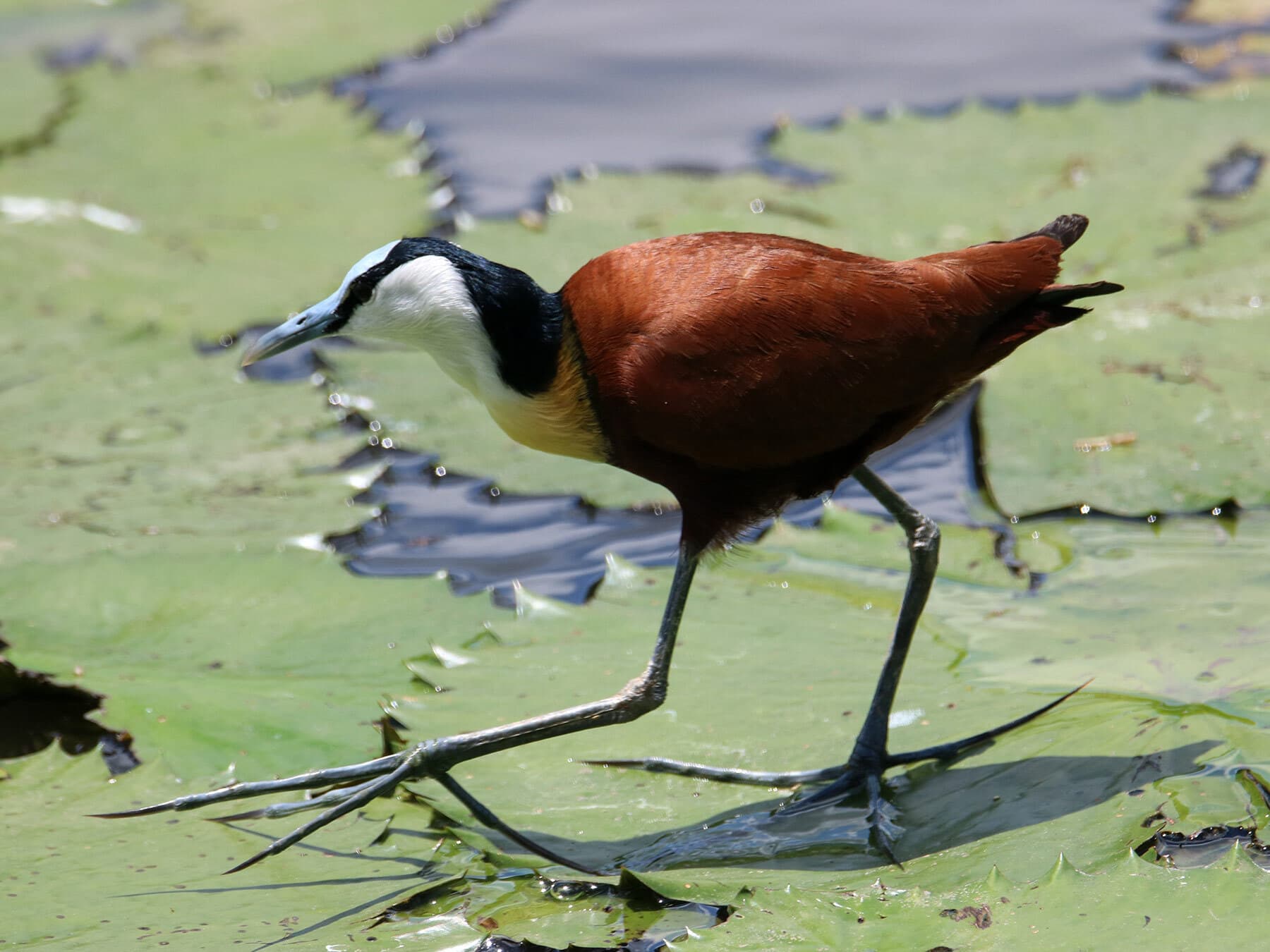
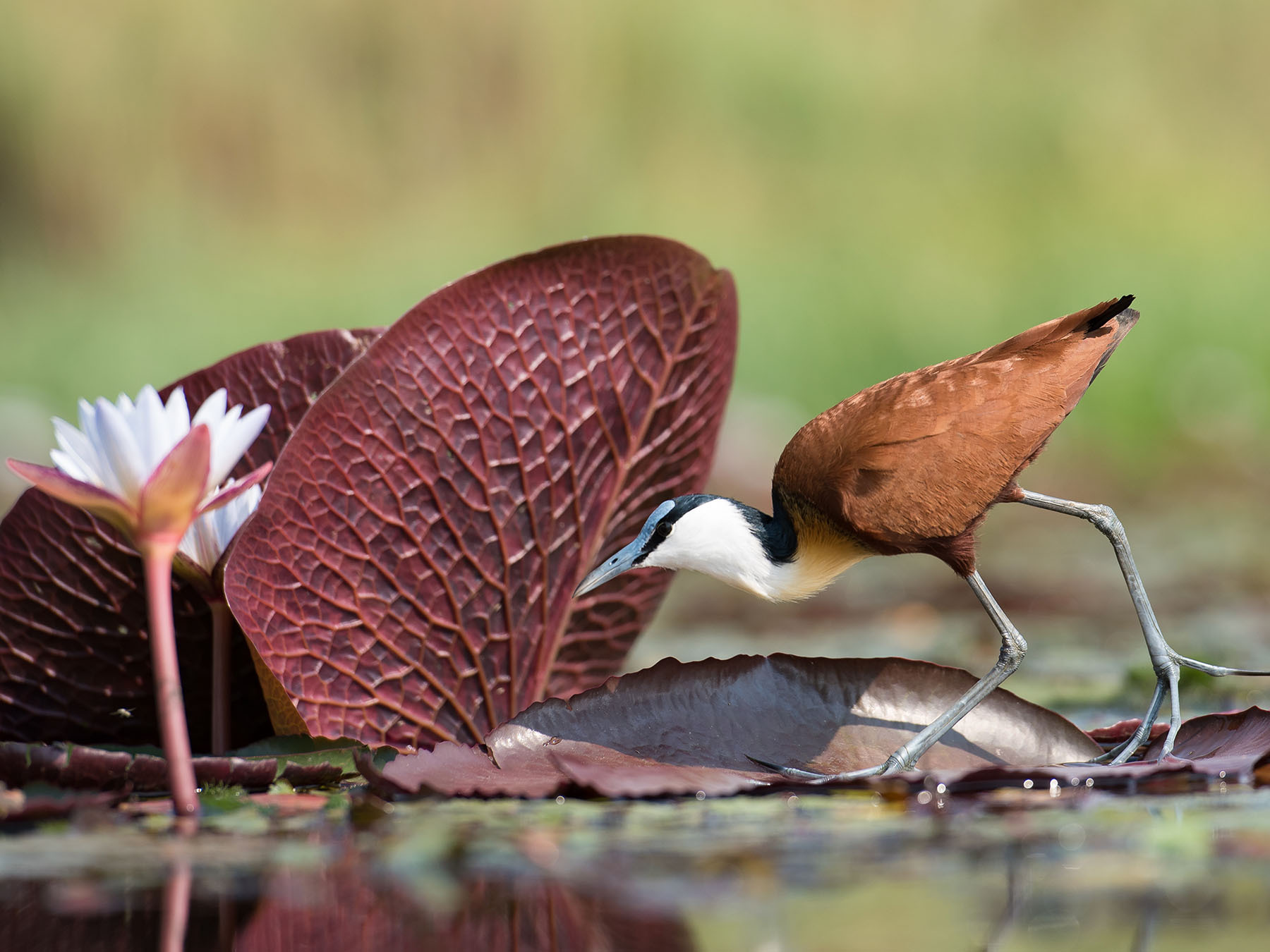
Whilst African jacanas are non migratory they are relatively nomadic and will often seek new habitats particularly during periods of drought or flooding. Their ability to appear to walk across water as they nonchalantly step across lily pads and other flimsy floating vegetation has resulted in them also being known as Jesus Birds and Lily Trotters.
Chick mortality rates can be extremely high but are counteracted by very productive females who have the ability and frequently the urge, to breed every few weeks. The fact that male parents undertake all the usual female care activities allows for this rapid egg production.
Obviously the unique plumage of the adult bird, coupled with its preferred habitat, is an excellent aid to positive identification and this, coupled with some of its more bizarre antics can lead even the most casual observer into correctly naming the species.
What it eats
Food is normally foraged whilst walking across lily pads and other floating vegetation from either the surface of the water or from the lily pads themselves.
Whilst they will occasionally choose seeds the preferred diet of an African Jacana consists of freshwater insects and larvae, spiders, crustaceans and molluscs.
Whilst they are able to swim they prefer to walk in search of their food although they are also able to catch flying insects and have been seen to pick insects from the backs of buffalo and hippopotami.
Nesting and breeding
Within permanent wetlands, African jacanas are able to breed year round although where seasons influence a fall in water levels, seasonal breeding will occur.
The male builds a semi-submerged floating nest in which its mate lays 4 brown eggs with distinct dark brown to black camouflaged markings. Occasionally the female will simply lay the eggs outside a nest on floating vegetation.
In the latter example males have been known to collect the eggs under their wings and move them to a safer location. Eggs are incubated for a period of up to twenty six days by the male alone although he is not constantly on the nest which, due to the heat, will often require shading from the hot sun as opposed to incubation.
Upon hatching, chicks are able to feed themselves and are shepherded and protected by the adult male. Chicks fledge at around thirty five days but will remain with the adult male parent for up to a further thirty five days.
Behaviour
African Jacanas are known for their unique 'lily-trotting' behaviour, using their long toes to distribute their weight while walking on floating vegetation.
They are polyandrous, with females maintaining territories and mating with multiple males. These birds are often seen foraging in small groups, probing the water and vegetation for food.
Lifespan and predators
There is little data upon this subject although it is generally believed that the live expectancy is between five to ten years.
Conservation
While the African Jacana is currently listed as Least Concern by the IUCN, it faces localised threats from habitat loss and degradation.
Wetland conservation efforts across Africa are crucial for maintaining healthy populations of this and other water-dependent species.
What does an African Jacana look like?
The adult male is a long necked, long legged, short tailed, medium sized waterbird with an almost egg shaped body. It is predominantly a rufous brown in colour across the body and upper and lower wing areas although the shade of brown is darker below. The neck and head are white with a prominent black eye stripe and black primary flight feathers. The rear of the neck is also black.
At the base of the front of the neck where it joins with the upper chest, the white feathers morph into a pale yellow to orange colour. The bill, which appears short, is blue with a continuing frontal shield extending above the eye stripe, over the face and forehead to the crown.
The legs and feet are grey with long slim toes and claws appearing far too large for a bird of its size. Irides are a dark brown. These features combine to make the African jacana easily recognisable.
The adult female is similar to the male although generally larger in size and weight. Juvenile birds are similar to adults but lack the blue bill and have a mainly brown head. Underbody parts are white with a rufous patch on the belly.
What is so special about the African Jacana?
Apart from being a beautiful and distinguished looking wading bird there are a number of characteristics and habits almost unique to the family of jacanas and of the African jacana in particular.
The first is that unlike nest building and parental care undertaken by the female of most species of birds, with the African jacana the roles are reversed.
Breeding females will often take up with a harem of males who individually and under scrutiny from the female, will build a nest and await the arrival of the eggs. Once laid, the female generally moves on to the next male whilst the male parent incubates the eggs until hatching.
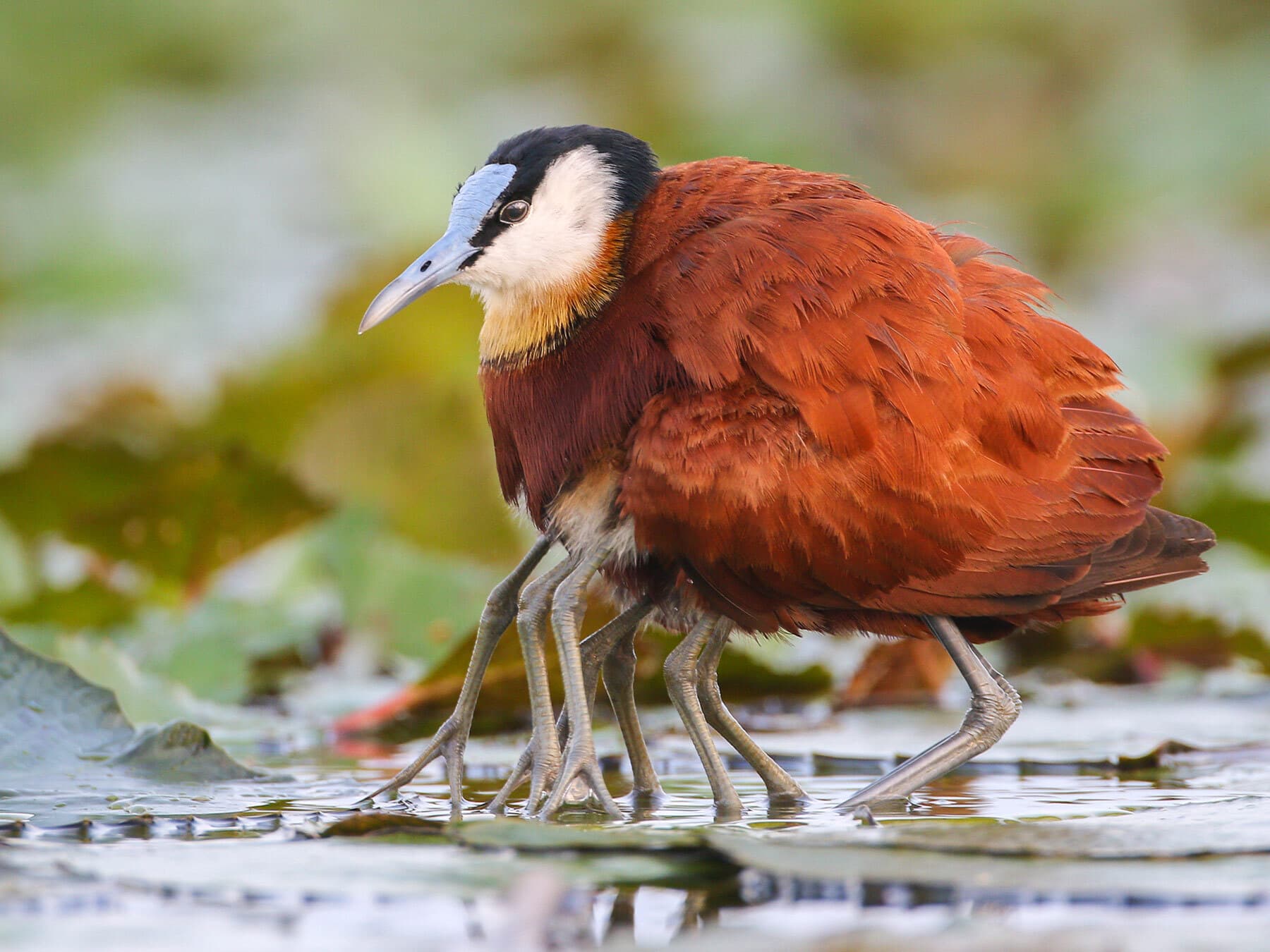
The male is particularly protective of ‘his young’ and has developed a method by which he can hide them and move them about during times of danger. Using his wings he is able to scoop up the young, holding them beneath his wings against his body and move about with just the chicks’ legs protruding and swinging below.
This manoeuvre results in a rather comical and strange looking multi-legged creature which, on occasion, will appear to have eight or more legs!
The size of the toes and claws of the bird combine to produce enormous feet designed to allow easy movement across lily pads and flimsy floating vegetation.
Both the toes and claws are extremely thin with no form of webbing between them yet the African jacana is not only an accomplished swimmer but an expert diver as well.
Chicks will often hide from predators by diving below the surface of the water and remaining there with just their beaks protruding above the water’s surface. It is indeed, a fascinating species to study.
How many legs does an African Jacana have?
Although you may have seen many pictures where it appears these birds have six legs or more, they only have 2 legs and the extra legs you can see are, in fact, the chicks hiding from danger underneath the adult bird.
Can an African Jacana fly?
Like all members of the Jacana family, African Jacanas are not very good when it comes to flying. They are weak and only capable of short-distance flight. The feathers of these birds also do moult all at the same time, which makes them unable to fly until the new feathers have grown in. This ensures the feathers stay clean and in good condition, which is important particularly for water birds.
More photos
3 photos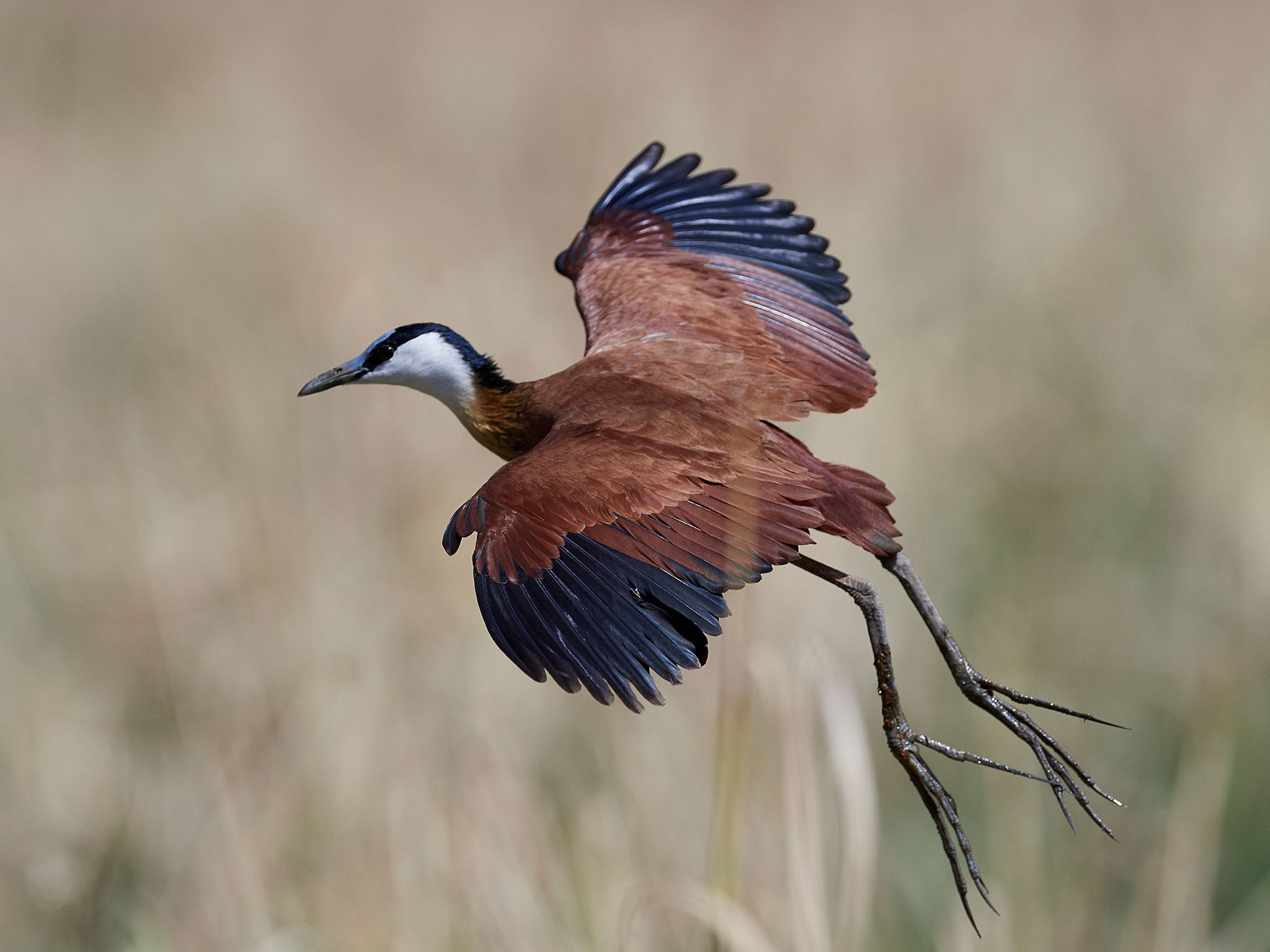
Quick facts
- Length
- 23–31 cm
- Wingspan
- 50–58 cm
- Weight
- 115–270 g
- Lifespan
- 5–10 years
- Family
- Jacanas
- Migration
- Resident
- Global status (IUCN)
- Least Concern
- World population
- Unknown
- Population trend
- Stable
- Also called
- Lily-trotter, Jesus Bird
- Scientific name
- Actophilornis africanus
Sources
2- 1BirdLife International. 2016. Actophilornis africanus. The IUCN Red List of Threatened Species 2016: e.T22693528A93410506. Accessed on 30 August 2024. Source (opens in a new tab)
- 2BirdLife International. 2016. Actophilornis africanus. The IUCN Red List of Threatened Species 2016: e.T22693528A93410506. Accessed on 30 August 2024. Source (opens in a new tab)

Checked by
Nathan Cope, founder and editor
Nathan founded Birdfact and leads its writers and contributors in the UK, the US and Canada. He has watched and studied birds for more than ten years, and checks every article and species guide before it’s published.