


Acorn Woodpecker
California Woodpecker · Melanerpes formicivorus
By the Birdfact teamChecked by Nathan Cope
On this page13 sections
How to recognise it
What do Acorn Woodpeckers look like?
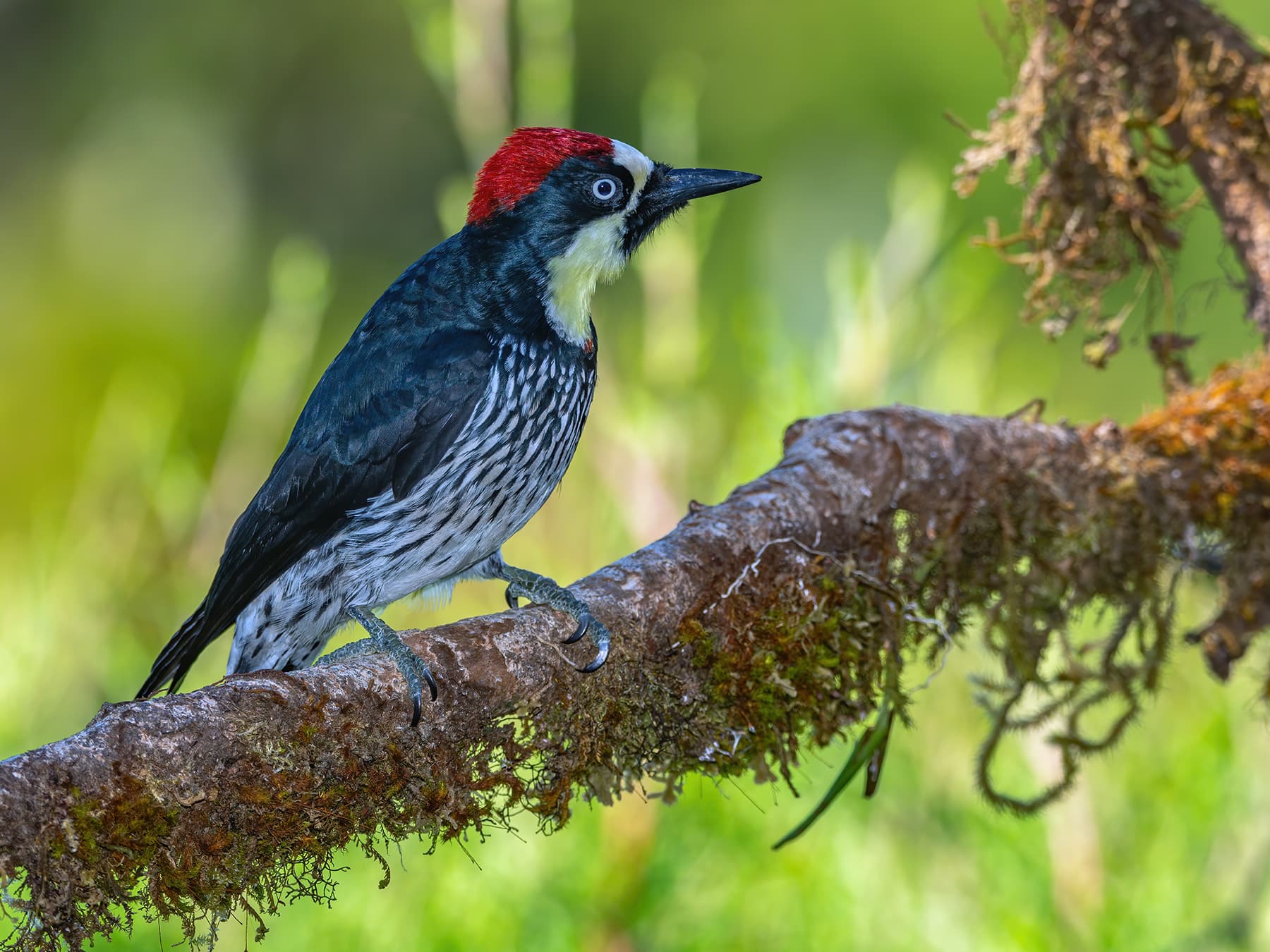
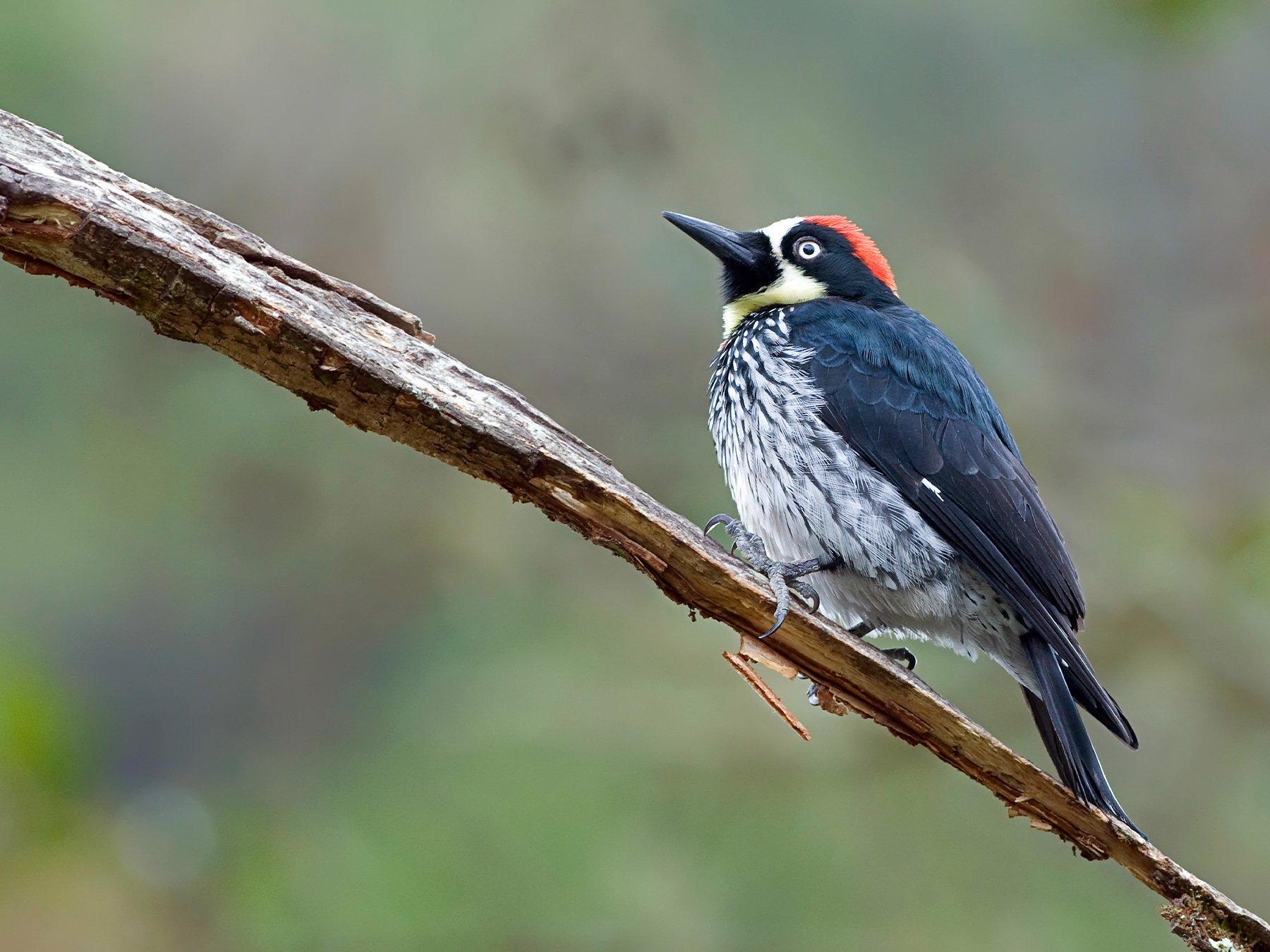
The plumage of acorn woodpeckers is unmistakable, and unlikely to be confused with other species.
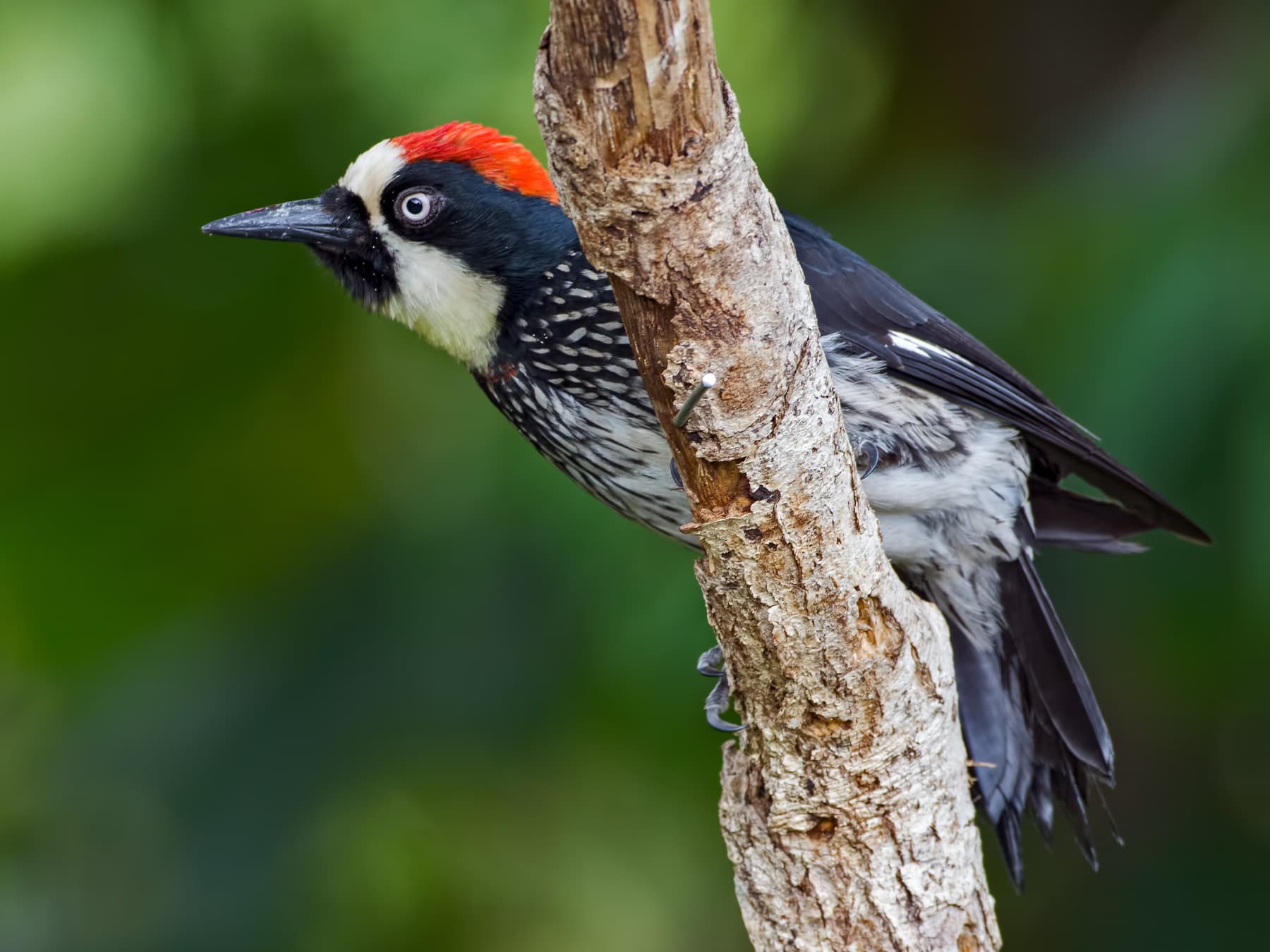
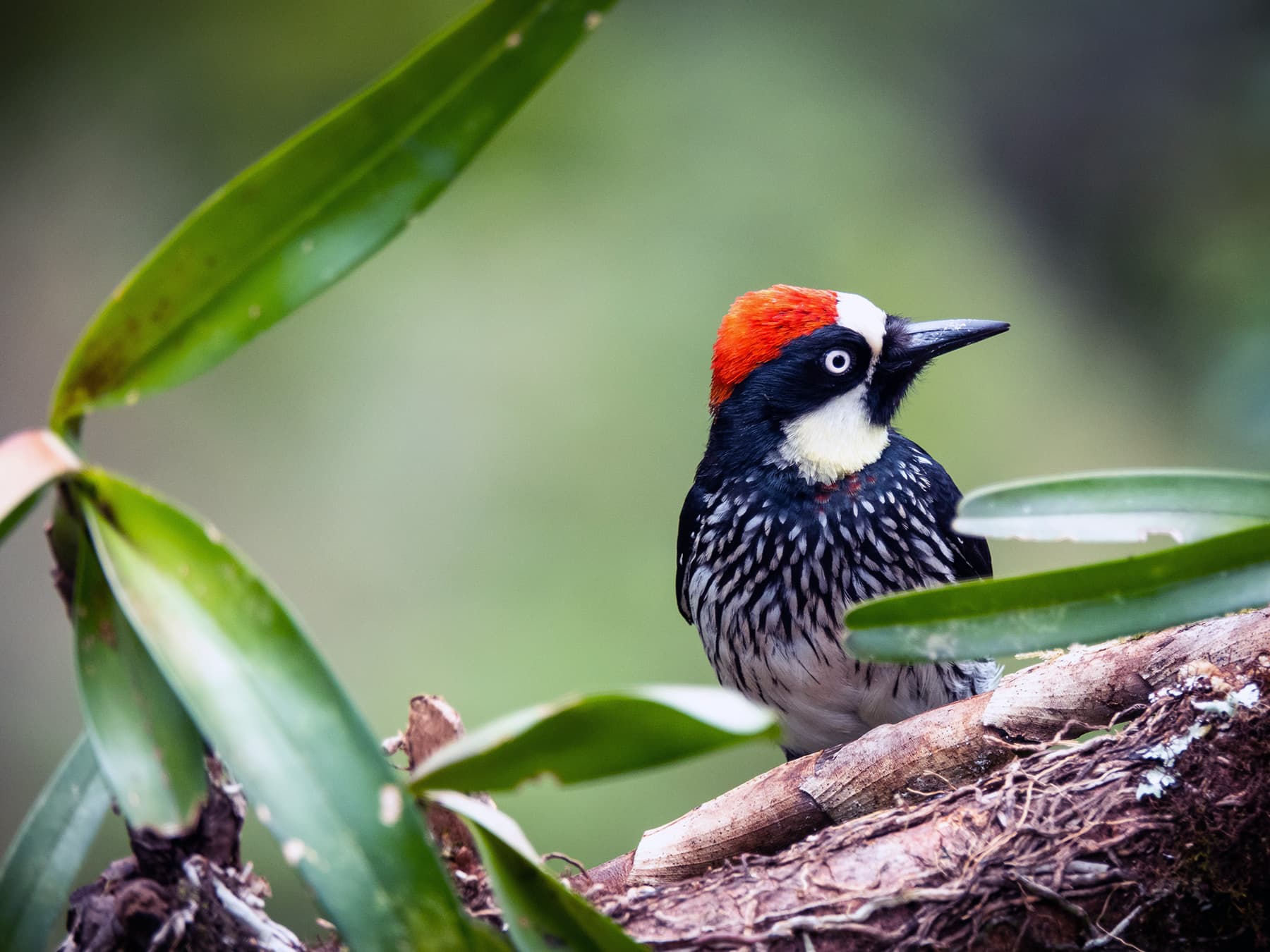
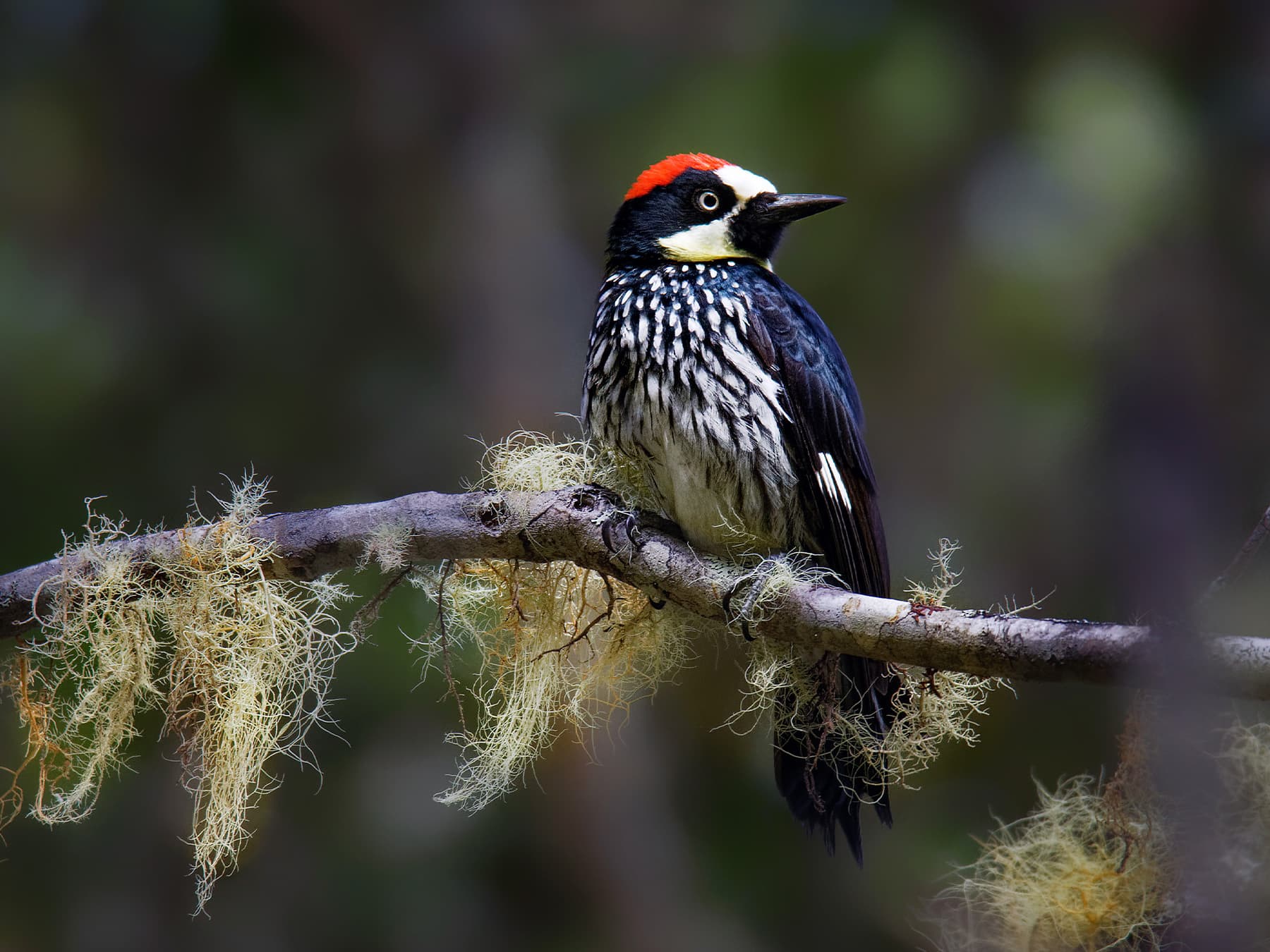
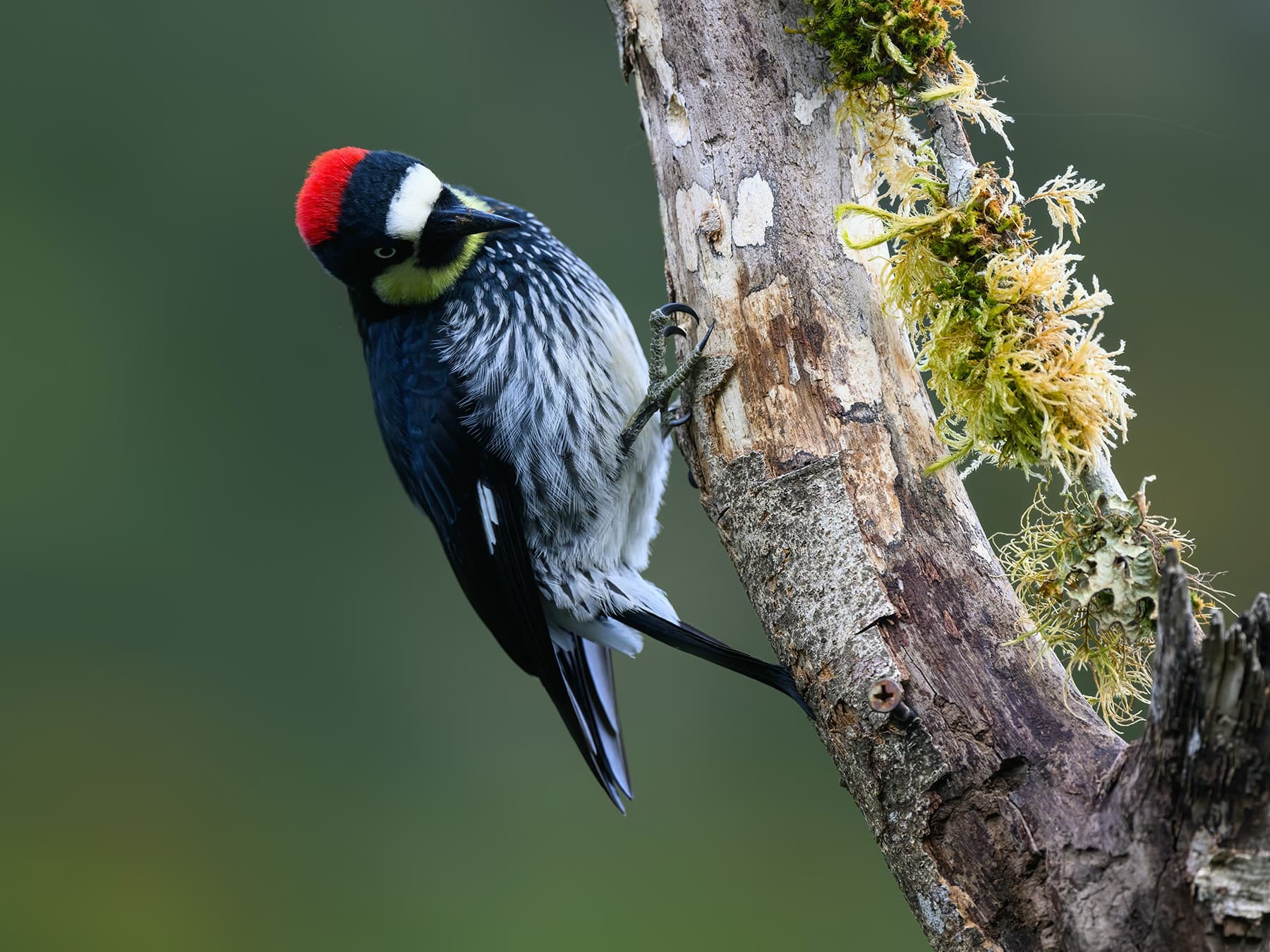
Males have a solid red cap, a rich black and white face, white eyes surrounded by a black mask, a white forehead, chin, and cheeks, and black markings around the base of the bill.
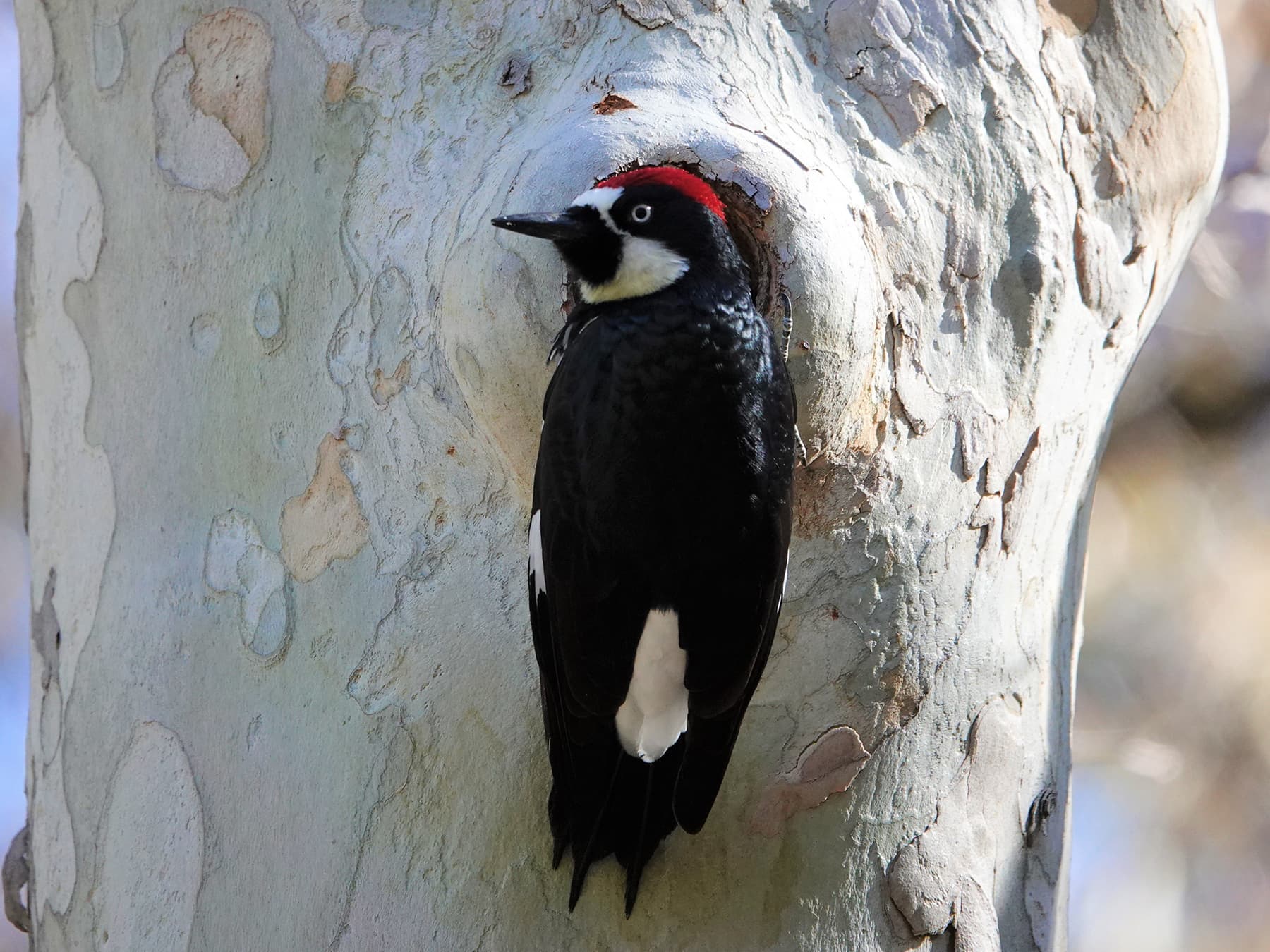
Acorn woodpeckers have a solid black back and tails are solid black, with some greenish feathers. The wings are black with a rounded white wing patch. A white rump is visible in flight. The breast is white, heavily streaked with black, particularly the upper breast, which fades into a white belly and underparts.
The acorn woodpecker has a long, sharp, black bill and black legs and feet.
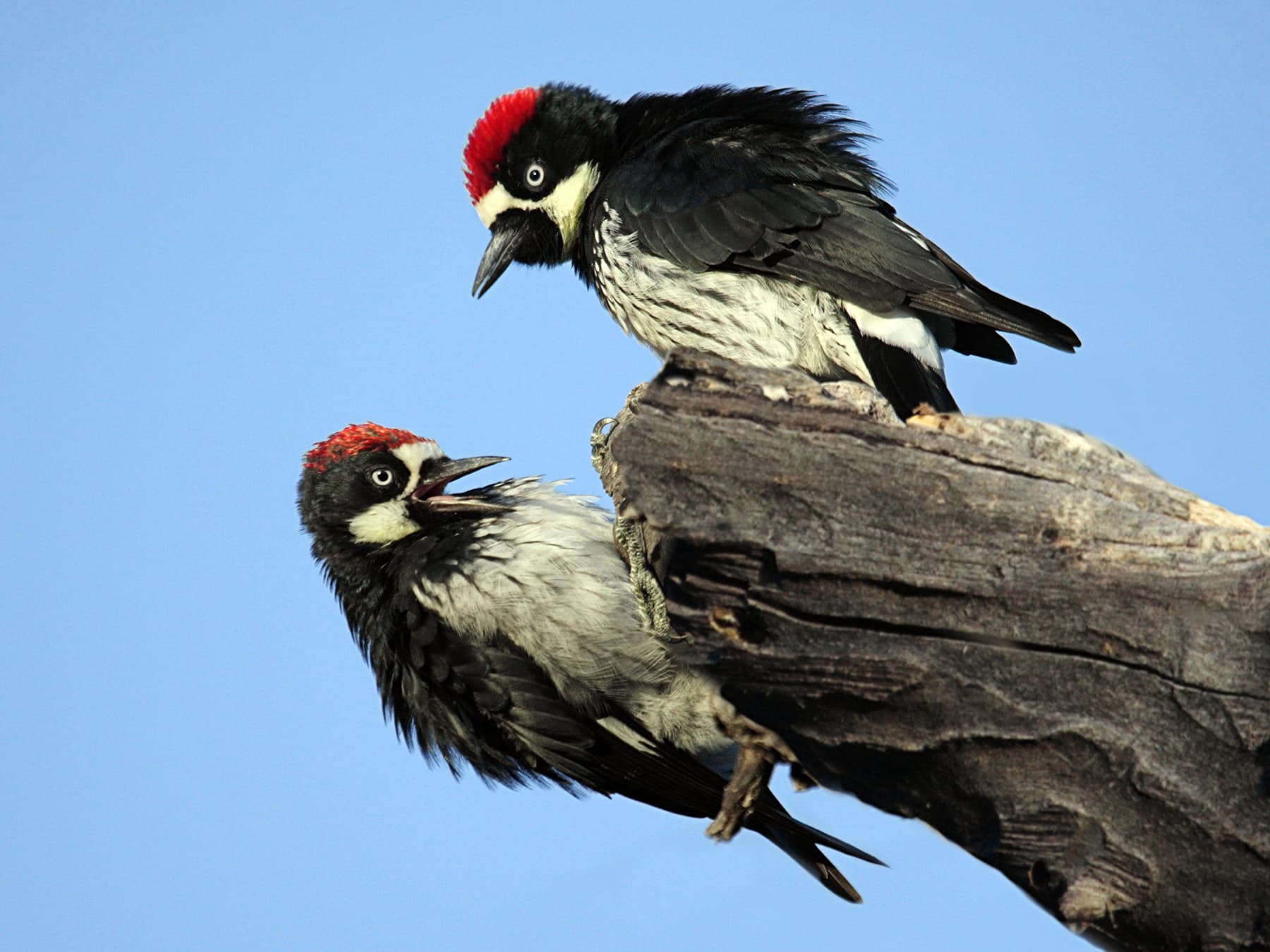
Female acorn woodpeckers are similar to males, although usually slightly smaller. The key difference between the sexes is in females, a black band separates the white forehead from the bright red cap. In females, a smaller area of red is present, towards the rear of the crown.
Juvenile acorn woodpeckers are duller in color than adult males but have similar markings, with dull red coloring visible on the crown. Their eyes are initially dark but gradually lighten to white within the first three months.
How big are Acorn Woodpeckers?
A medium-sized member of the woodpecker family, acorn woodpeckers are larger than downy woodpeckers but slightly smaller than northern flickers and hairy woodpeckers. Females are usually marginally smaller than males.
- Length: 19 cm to 23 cm (7.5 in to 9.1 in)
- Wingspan: 35 cm to 43 cm (14 in to 17 in)
- Weight: 65 g to 90 g (2.3 oz to 3.2 oz)
Its size
Adults- Length
- 20–24 cm
- Wingspan
- 35–43 cm
- Weight
- 65–90 g
Its song and calls
What sound does an Acorn Woodpecker make?
As well as their “comical” appearance, acorn woodpeckers have a call that sounds a lot like cackling laughter. Other vocalizations include a loud ‘waka-waka-waka’ call, heard as a contact call or showing territorial boundaries. Noisy trilling and chattering notes from groups are also common.
- Call0:00 / 0:31
Recorded in California, United States · September 2012
When and where to see it
OctoberHere all year
Most recorded in October
- 1. California0.88%
- 2. Arizona0.64%
- 3. Oregon0.37%
- 4. New Mexico0.27%
- 5. Texasunder 0.1%
Each dot is a county, state or province: the bigger and darker, the larger the bird’s share of that place’s bird records that month. Grey dots: no regular records. The ringed point is the centre of the bird’s records this month; the arrow shows how it moved since last month, and the dashed loop its path through the year. “Arrivals” colours places where it becomes regular this month (orange) or is in its last regular month (grey). GBIF eBird Observation Dataset, 2019–2024. Map data: Natural Earth, US Census Bureau; place centres © OpenStreetMap contributors.
In your area
See when the Acorn Woodpecker is recorded in your county, state or province.
How often the Acorn Woodpecker turns up in the United States and Canada through the year, from birdwatchers' records.
United States
Resident · all year · most records in August
Canada
Scarce · most records in October
Show as a table
| Month | United States | Canada |
|---|---|---|
| January | 0.17% (regular) | – |
| February | 0.16% (regular) | – |
| March | 0.15% (regular) | – |
| April | 0.15% (regular) | – |
| May | 0.11% (regular) | – |
| June | 0.14% (regular) | <0.001% |
| July | 0.16% (regular) | <0.001% |
| August | 0.21% (regular) | – |
| September | 0.16% (regular) | – |
| October | 0.15% (regular) | 0.001% |
| November | 0.16% (regular) | – |
| December | 0.18% (regular) | – |
Worldwide: recorded regularly in 11 countries
Countries where it was recorded in at least 3 of the 6 years 2019–2024. Linked countries have their own bird list.
North America (10)
- Belize
- Canada
- Costa Rica
- El Salvador
- Guatemala
- Honduras
- Mexico
- Nicaragua
- Panama
- United States
South America (1)
Data: EOD – eBird Observation Dataset (Cornell Lab of Ornithology), accessed via GBIF.org, CC BY 4.0. Records from 2019–2024, aggregated and filtered by Birdfact. How these lists are made
What is the habitat of an Acorn Woodpecker?
Oak woodlands meet all the habitat requirements of acorn woodpeckers for both their foraging and nesting needs. Mixed woodlands, with oaks alongside pine trees, are also a popular choice. Urban and suburban parks with oak trees are also increasingly common environments for sightings.
Acorn woodpeckers are present from sea level up to elevations of around 4,000 m (13,000 ft) in the Andes. Sightings are more prevalent in hilly or semi-mountainous terrain.
What is the range of an Acorn Woodpecker?
Acorn woodpeckers are only found in a limited geographical area on the west coast of the US, stretching along the coast of Washington, Oregon, and California. To the south, they spread throughout the oak forests of Central America, reaching Colombia in the south.
Check out this in-depth guide for more information on the Acorn Woodpeckers range and habitats.
Where do Acorn Woodpeckers live?
The presence of oak trees is the key factor for acorn woodpeckers when establishing a territory, and because their yearly crops are subject to variation from year to year, populations are fairly fluid. California is said to be the heart of the range, where acorn woodpeckers are both a widespread and common resident species.
How rare are Acorn Woodpeckers?
Within their range, acorn woodpeckers are considered widespread and abundant, and in regions where they are present, they are often the most common woodpecker species, especially in regions dominated by oak woodlands. The overall population is estimated to be around 7.5 million individuals.
Where can you see Acorn Woodpeckers in the US?
The only acorn woodpeckers in the US are isolated populations found in Washington, Oregon and California. Occasional reports are recorded of individual vagrants and small populations further inland, across the southwestern states of Arizona, New Mexico, Colorado, Nevada, Oklahoma, Texas and Utah.
Where can you see Acorn Woodpeckers in Canada?
Occasionally, acorn woodpeckers cross the border from Washington into British Columbia, but no major populations have been established in Canada yet.
Migration
Do Acorn Woodpeckers migrate?
Acorn woodpeckers are non-migratory and remain in the same territories all year round. They may relocate short distances in search of a more plentiful supply of acorns if trees in the immediate locality have not had a fruitful year and they haven’t been able to build up a sufficient supply in their ‘granary’ stores.
Are Acorn Woodpeckers native to the US?
Native to the extreme western regions of the US, acorn woodpeckers are only found in the Americas, with their usual range extending from Washington in the north southwards through Oregon and California, into Central America, and reaching the coast of Colombia in South America. They are not found in the wild in other parts of the world.
Tips for seeing it
- Look for them in oak woodlands, especially near large, dead trees used as granaries
- Listen for their distinctive 'waka-waka' call
- Observe telephone poles and wooden structures in urban areas, which they sometimes use as substitute granaries
- Visit wildlife refuges or national parks in California or Arizona for prime viewing opportunities
What it eats
What do Acorn Woodpeckers eat?
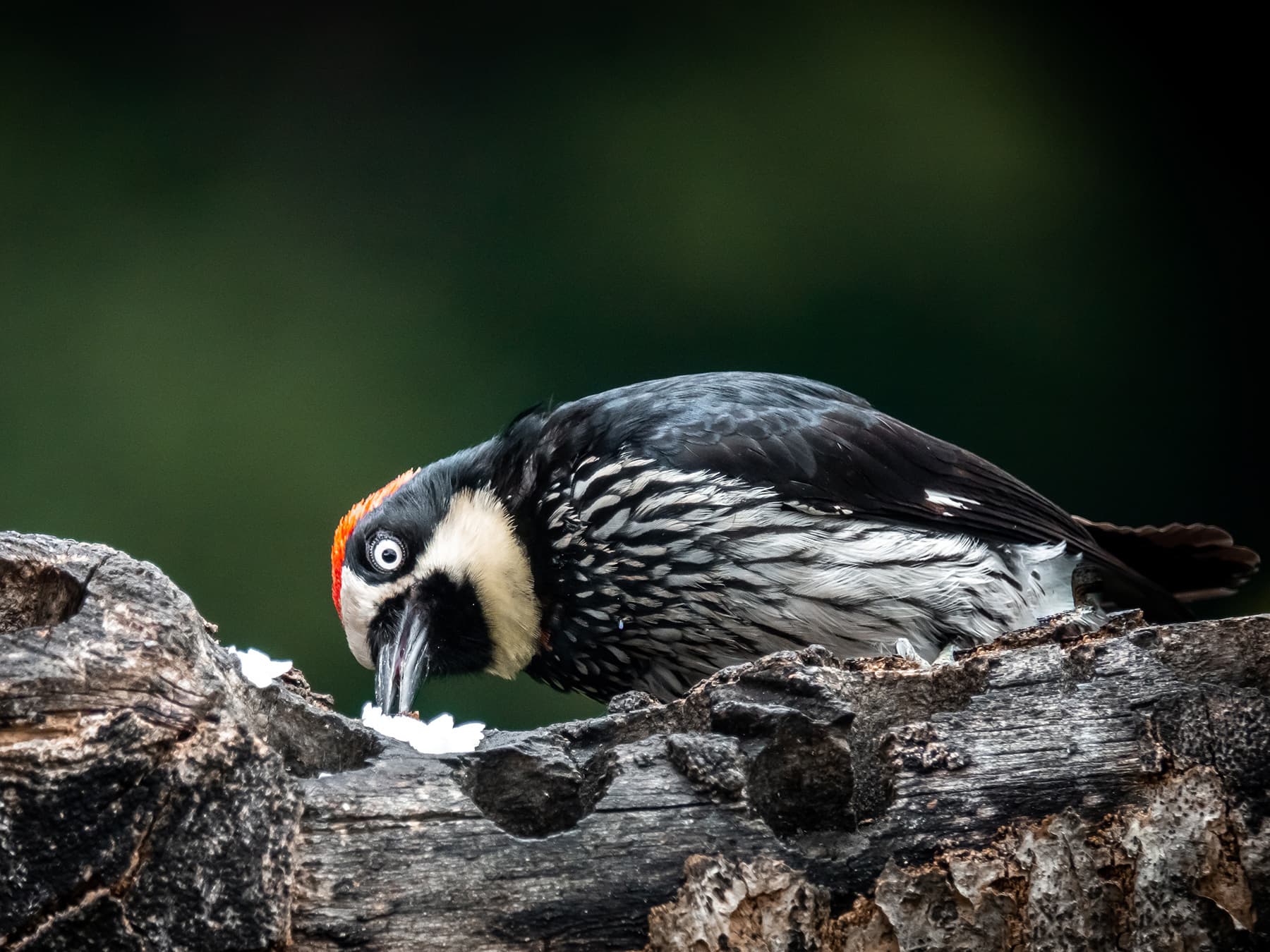
Despite its name, an acorn woodpecker’s chief food source is insects, particularly flying ants. A sallying technique to catch prey in mid-flight is used, with acorn woodpeckers watching for suitable flying insects from the upper branches of tall trees.
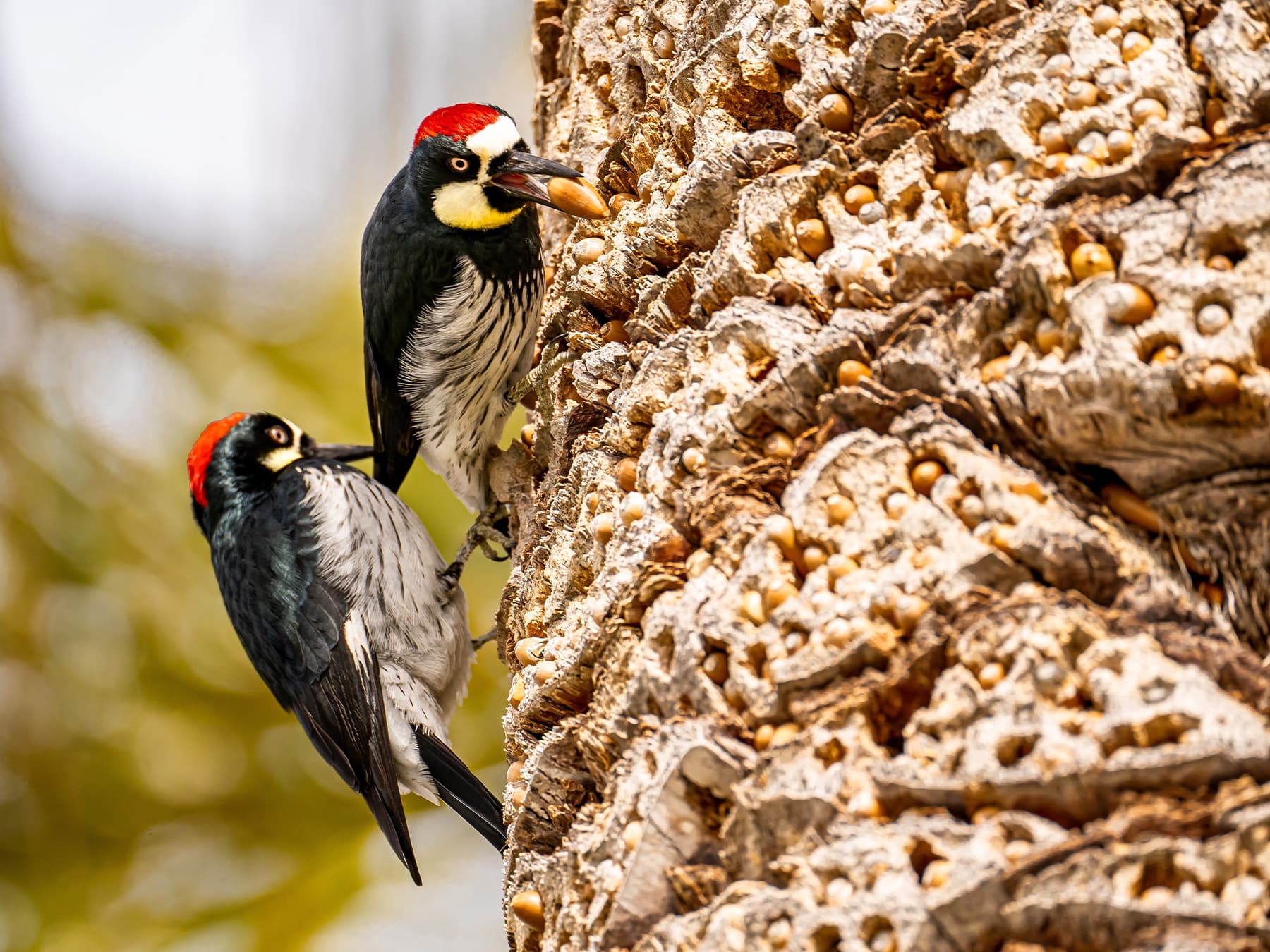
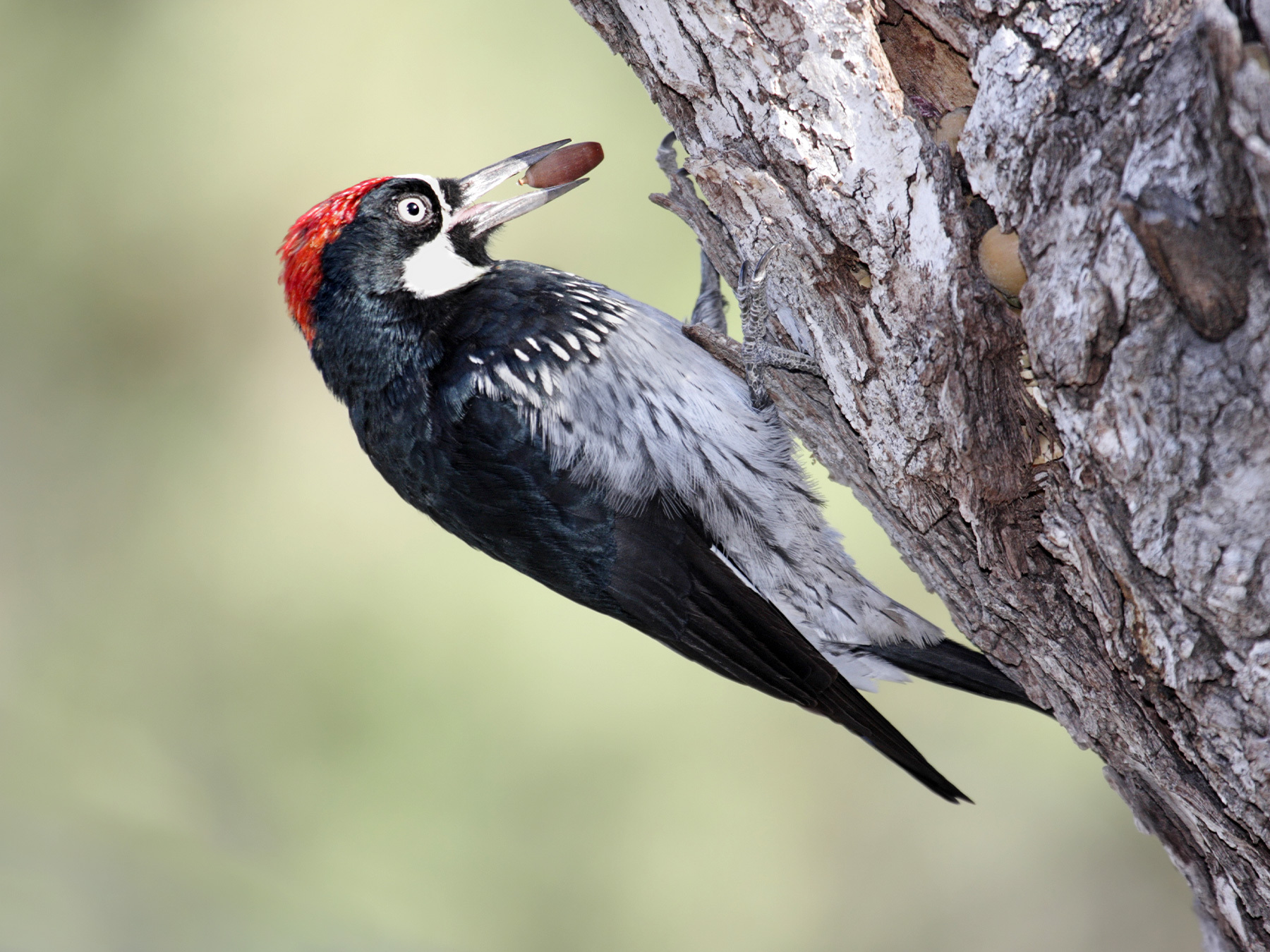
Acorns are eaten in large numbers, plucked directly from trees, and occasionally collected from the ground. These are stored in holes drilled in dead tree trunks and snags and used as a backup source of food throughout the year. Other foods include sap, catkins, sunflower seeds, mice, birds’ eggs and bats.
Do Acorn Woodpeckers eat acorns?
Acorn woodpeckers do depend on acorns as a source of food, although insects form a more important element of their diet. They drill acorn-sized holes in tree trunks, and post acorns into them, forming ‘granary’ stores. Once an acorn has dried out, it is then moved to a smaller hole, a considerably time-consuming process, but creates a valuable stash of food for times when insects and other foods are in shorter supply.
What do Acorn Woodpecker chicks eat?
Young acorn woodpeckers are fed with small acorn pieces and insects, such as beetles, flying ants and wasps. As nestlings grow, their dependence on acorns increases, with adults raiding their granary stores to keep up with the feeding demands.
Nesting and breeding
Where do Acorn Woodpeckers nest?
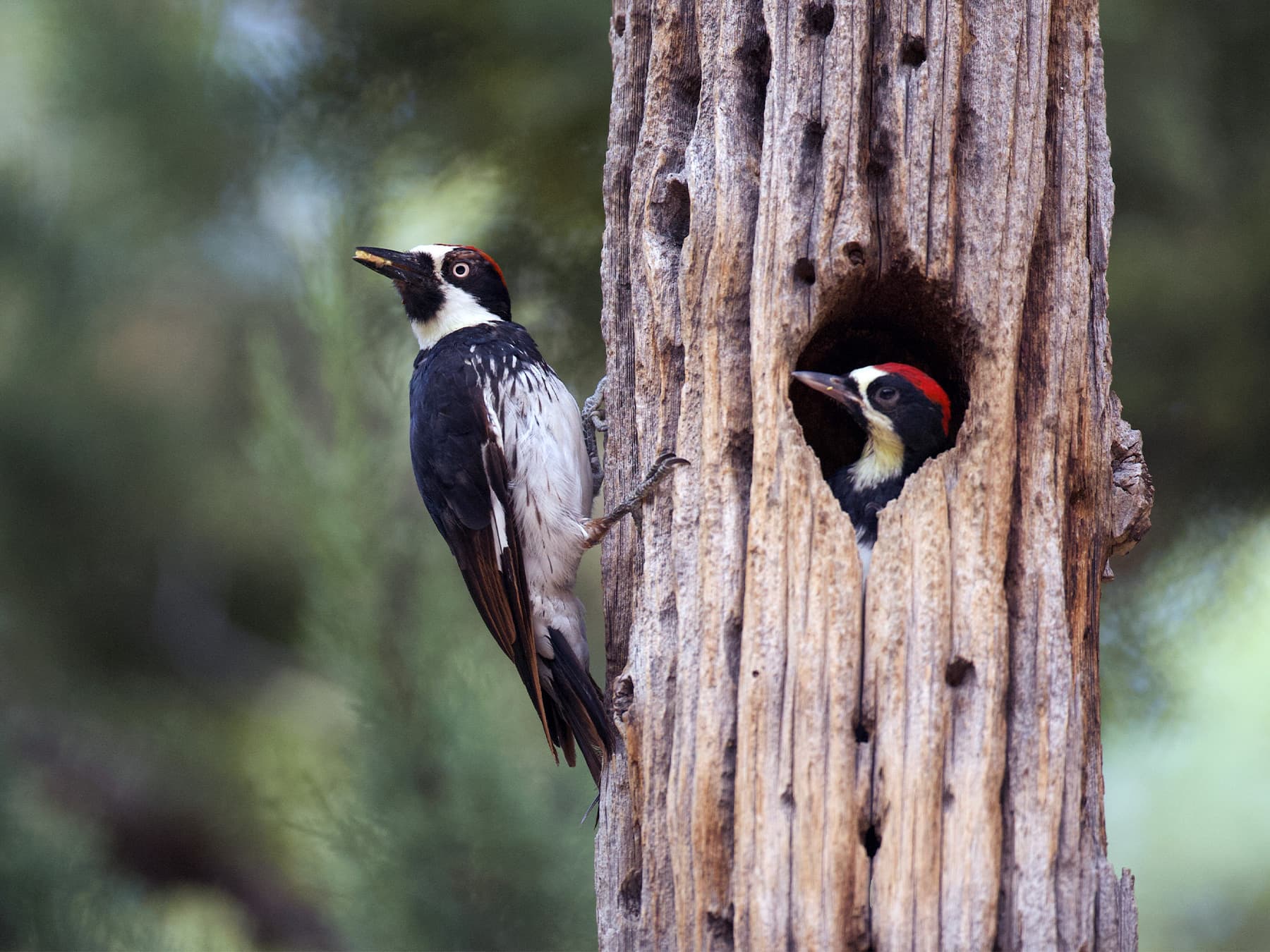
Nest cavities are excavated in large, mature trees which are either already dead or beginning to decay. Both male and female acorn woodpeckers are involved in chiseling out the chambers, and multiple cavities are constructed in the same territory, so those not used for nesting can be used for overnight roosting.
It’s common for previously used nests to be chosen again in future seasons, with up to 50 percent of nests reused each year. Wood chips line the base of the chamber, but no additional nesting material is added.
When do Acorn Woodpeckers nest?
Egg-laying for acorn woodpeckers begins in April (or on rare occasions, from as early as late March), and extends until June or July. May is the peak month for eggs to be laid. Occasionally, a second brood is laid later into the fall, in years where acorn crops are particularly abundant.
Incubation lasts for 11 days and is shared between the male and female.
What do Acorn Woodpecker eggs look like?
Between 3 and 7 eggs are laid, each measuring 2.5 cm (1 in) by 1.9 cm (0.8 in). Eggs are whitish in color and lack any markings.
Do Acorn Woodpeckers mate for life?
Mating and pairing habits of acorn woodpeckers are varied and complex, with some populations forming seasonally monogamous pairs, while in others, cooperative breeding is most common.
Acorn woodpeckers do not form lifelong pair bonds, but it is usual for them to remain in large social groups, with multiple individual birds involved in raising the young.
Typically, acorn Woodpecker communities contain between one and seven male breeders. These compete for matings with up to three different females, and several females may lay eggs in the same cavity. All non-breeding members of these social groups will take a role in incubating eggs and feeding and protecting the young.
Behaviour
Are Acorn Woodpeckers aggressive?
Acorn woodpeckers are cooperative breeders, living in close proximity to others of the same species, and working together to create vast caches of acorns in holes they drill in decaying tree trunks and branches.
Some competition may occur between breeding females, and the eggs of rivals may be destroyed before incubation starts.
Where do Acorn Woodpeckers sleep at night?
Overnight roosting spots used by acorn woodpeckers are typically disused holes in tree trunks, where they can rest without the threat of being disturbed by predators and are safe from any weather damage.
Why do Acorn Woodpeckers store acorns?
Acorn woodpeckers are famous for their habit of creating granaries in which they can store dozens of acorns which they then use as emergency food supplies when the availability of insects runs low. Caching acorns ensures there is a plentiful and immediate supply of food when hungry nestlings need to be fed.
Do Acorn Woodpeckers damage trees?
Acorn woodpeckers certainly make their mark when creating their granary holes in trees, drilling deep cavities in which to hide acorns. Up to 50,000 holes may be created in a single tree, and one report counted 700 lb of acorns that had been stashed in holes in the wall of a building.
As the trees used are most commonly already dead or dying, it might be argued that the granaries created by these hard-working woodpeckers shouldn’t really be classed as ‘damage’.
Lifespan and predators
How long do Acorn Woodpeckers live?
The average lifespan of an acorn woodpecker is estimated at around 9.5 years, with the oldest recorded individual reaching 17 years and 3 months.
Breeding is possible from one year of age, but due to the cooperative breeding seen in this species, it is not unusual for young birds not to breed until they reach 4 or 5 years of age, instead helping raise the young of other birds in their group.
What are the predators of Acorn Woodpeckers?
Cooper’s hawks are thought to be the largest natural threat to acorn woodpeckers in the United States, with adult birds targeted as well as nestlings and juveniles. Bull and gopher snakes raid nest cavities, taking eggs, young and brooding adults.
Are Acorn Woodpeckers protected?
Under the Migratory Bird Treaty Act of 1918, acorn woodpeckers are protected in the United States. It is a federal offense to deliberately kill, injure, trade, or trap an acorn woodpecker or to destroy, damage, or trade their eggs or young.
Are Acorn Woodpeckers endangered?
Globally, acorn woodpeckers are classed by the IUCN as a species of least concern. Loss of habitat and degradation of woodland landscapes is a concern for the future survival of the species.
Conservation
While currently listed as Least Concern, Acorn Woodpeckers face threats from habitat loss due to urban development and climate change.
Conservation efforts focus on preserving oak woodlands and maintaining suitable nesting sites. In some areas, artificial granary poles are being installed to support populations.
More photos
3 photos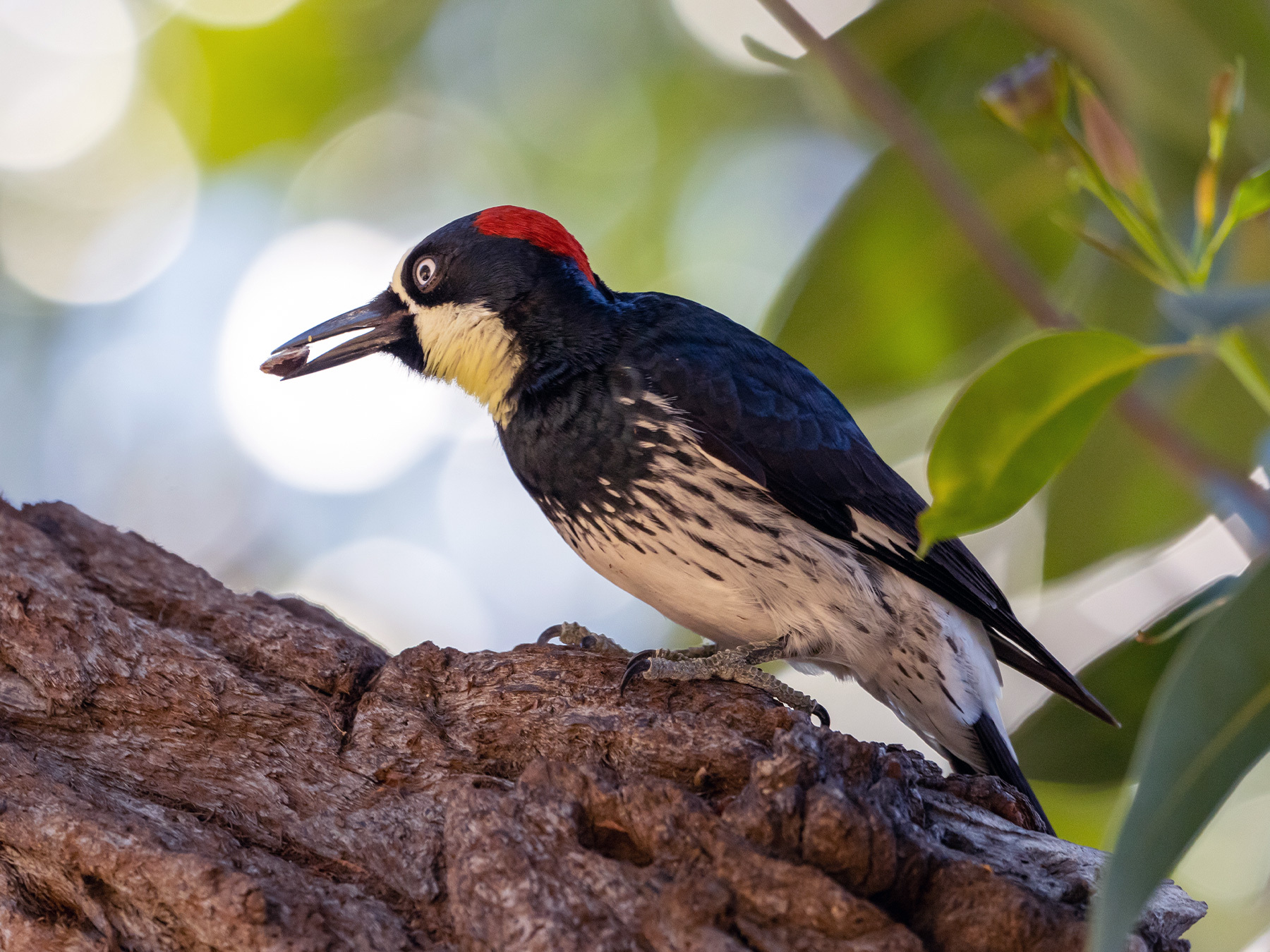
Quick facts
- Length
- 20–24 cm
- Wingspan
- 35–43 cm
- Weight
- 65–90 g
- Lifespan
- 10–15 years · oldest recorded 17 years
- Family
- Woodpeckers
- Migration
- Resident
- Global status (IUCN)
- Least Concern
- World population
- 7,500,000 mature individuals
- Population trend
- Increasing
- Also called
- California Woodpecker
- Scientific name
- Melanerpes formicivorus
Questions
3Are Acorn Woodpeckers protected in the US?
The Migratory Bird Treaty Act of 1918 offers protection to acorn woodpeckers, their nest sites, eggs, and young. This legislation safeguards the species against being killed, injured, taken into captivity, or sold to the pet trade.
What attracts Acorn Woodpeckers?
A rich supply of acorns and an availability of decaying or dead trees is the perfect combination for attracting acorn woodpeckers. Areas with oak trees alongside open land for foraging for insects are also important to allow acorn woodpeckers to catch prey in mid-air.
Why are they called Acorn Woodpeckers?
Acorn woodpeckers are so named for their unique behavior of storing acorns in tree trunks, by drilling a series of deep holes in rotten wood and creating caches as future food stores. Acorns are not their main food source, however: the second part of the species' Latin name “formicivorus” is possibly more accurate, as it means ‘ant-eating’.
Sources
5- 1IUCN. 2016. The IUCN Red List of Threatened Species. Version 2016-3 Source (opens in a new tab)
- 2IUCN. 2016. The IUCN Red List of Threatened Species. Version 2016-3 Source (opens in a new tab)
- 3Koenig, Walter, D. et., al. 1995. The Birds of North America, No. 194.
- 4Partners in Flight (2022) Source (opens in a new tab)
- 5Longevity Records Of North American Birds. Version 2023.1 Source (opens in a new tab)

Checked by
Nathan Cope, founder and editor
Nathan founded Birdfact and leads its writers and contributors in the UK, the US and Canada. He has watched and studied birds for more than ten years, and checks every article and species guide before it’s published.